

Three letters appear on almost every form you have ever filled out. They show up in hospitals, dating apps, government databases, and group chats. Most people type them without thinking — yet very few stop to consider just how much weight those three letters actually carry.
What DOB Full Form Actually Means
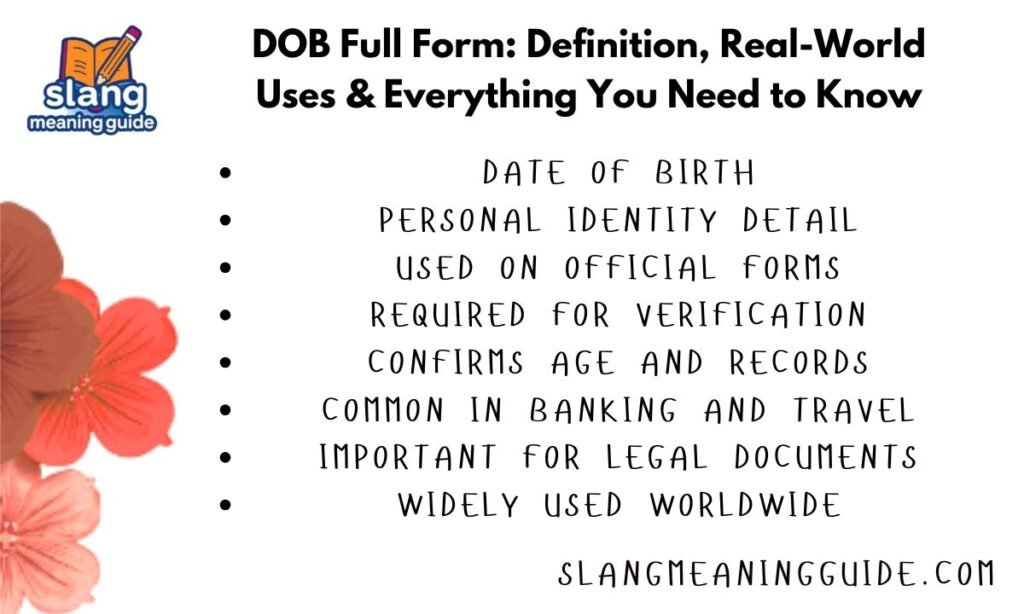
DOB stands for Date of Birth — the complete record of the day, month, and year a person was born.
- It is one of the oldest and most universally used personal identifiers in the world
- Appears across every context: medical, legal, digital, social, and governmental
- Written as an abbreviation to save space on forms, databases, and messages
- Recognized globally in both formal documentation and casual conversation
- In digital communication, it functions as shorthand in texts, DMs, and chat platforms
Secondary meanings of DOB (context-dependent):
- Date of Business — used in commercial and corporate registration contexts
- Department of Buildings — a government agency reference in some U.S. cities
- Dob (Australian slang) — to inform on someone, as in “dob someone in”
- DOB (chemistry) — 2,5-dimethoxy-4-bromoamphetamine, a chemical compound
- Deutsche Oper Berlin — the opera company in Berlin’s Charlottenburg district
In the vast majority of everyday use, DOB means Date of Birth — nothing else.
Core Meanings and Formats of DOB
DOB appears in multiple formats depending on the platform, country, or purpose:
Full DOB — complete day, month, and year (e.g., 15 March 1996)
Numeric DOB — numbers-only format (e.g., 03/15/1996 or 15/03/1996)
International DOB format — Year-Month-Day to eliminate regional confusion (e.g., 1996-03-15)
Partial DOB — month and day only, used publicly to protect privacy (e.g., April 12)
DOB verification — confirmation of birth date for identity checks in banking, travel, and security
DOB entry field — the form input box on registration and application pages
Correction DOB — formal process to fix incorrect birth date records in official systems
DOB disclosure — the act of sharing your birth date with an institution or individual
Each format exists for a specific reason — full DOB for identity, partial DOB for privacy, international format for cross-border clarity.
Historical Background of DOB as a Term
Birth dates have been recorded for thousands of years — the abbreviation is modern, but the concept is ancient:
Ancient Egypt and Rome tracked births for census, taxation, and military conscription
Medieval Europe recorded birth dates primarily in church baptismal registers
19th century — civil registration systems standardized birth recording in most Western nations
Early 20th century — government ID systems, passports, and social security programs made DOB a formal data field
1960s–1980s — computerized databases adopted DOB as a standard primary identifier
1990s–2000s — the internet and digital forms spread the abbreviation globally
2010s–present — mobile apps, social platforms, and messaging culture made DOB a casual shorthand in everyday digital communication
Why DOB Matters in Digital Communication
In texting, messaging apps, and online platforms, DOB functions differently than on a paper form:
- Casual friend texts → “Hey, what’s your DOB? Setting up the group surprise 🎂”
- Dating app profiles → Age displayed automatically based on DOB entered at sign-up
- Gaming communities → Age-gate verification uses DOB to restrict access
- Online forms → Every sign-up flow from Netflix to banking requires a DOB entry
- Group chats → “Drop your DOB so I can add everyone to the birthday calendar”
- Social media bios → Some users list partial DOB (month/day) publicly
Tone matters when asking for a DOB digitally:
- Adding a birthday emoji (🎂🎉) signals friendly intent
- A bare “DOB?” with no context can feel blunt or even suspicious
- In professional channels (Slack, Teams), spell it out as “date of birth” for clarity
- In casual chats, DOB is universally understood and completely acceptable shorthand
DOB in Professional and Official Contexts
In formal settings, DOB carries significant legal and administrative weight:
- Medical records — used to match patients to files and prevent mix-ups between people with similar names
- Government ID — passport, driving licence, and national ID card all require DOB
- Banking and finance — KYC (Know Your Customer) processes mandate DOB verification
- Legal documents — contracts, wills, and court filings require full DOB for identity confirmation
- Employment forms — HR onboarding documents collect DOB for tax records and benefits
- Travel — airline bookings and border control use DOB as a primary identity checkpoint
- Age verification — websites and platforms legally require DOB to restrict minors from adult content
Misreading or entering DOB incorrectly in any of these contexts can:
- Delay processing of applications
- Trigger identity mismatch errors
- Create legal complications in sensitive documents
- Cause issues with insurance, medical treatment, or travel clearance
DOB in Social Media and Personal Life
Outside official contexts, DOB takes on a warmer, more personal role:
- Birthday reminders — Facebook, Instagram, and Google Contacts use DOB to alert friends
- Astrology content — DOB feeds into birth chart generators, zodiac apps, and numerology tools
- Milestone posts — “Today my DOB marks 30 years” appears regularly on anniversary posts
- Privacy choices — many users share only month/day on public profiles, keeping the year private
- Verification prompts — platforms like TikTok and YouTube use DOB to enforce age restrictions
- Gift planning — friends exchange DOBs to coordinate surprise events and purchases
Common Misunderstandings About DOB
Several misconceptions circulate, especially among younger or non-native English speakers:
1: Thinking DOB is slang — it is a formal abbreviation, not internet slang like “lol” or “tbh”
2: Confusing it with “dob” (Australian slang) — “dob someone in” means to report them; completely unrelated to Date of Birth
3: Assuming the format is universal — MM/DD/YYYY (US) vs DD/MM/YYYY (UK/most of world) causes frequent errors on international forms
4: Treating partial DOB as sufficient for verification — institutions require full DOB; month and day alone do not confirm identity
5: Sharing DOB publicly without caution — full DOB is a key data point in identity theft and should be shared only with trusted parties or official institutions
Regional and Cultural Differences in DOB Usage
How DOB is recorded and interpreted varies by region:
United States — uses MM/DD/YYYY format; DOB is requested on virtually every official form
United Kingdom and Europe — uses DD/MM/YYYY; the term “date of birth” is slightly more common than the abbreviation in formal writing
East Asia (Japan, South Korea, China) — birth year carries cultural weight (zodiac, age hierarchy); YYYY/MM/DD format is standard
Middle Eastern countries — DOB appears on national IDs and official documents; some communities also track birth dates by Islamic (Hijri) calendar
Australia — uses DD/MM/YYYY; “dob” as slang (to inform on someone) is completely separate from the abbreviation
South Asia (India, Pakistan) — DOB is on every official document; the term is widely understood across English-speaking urban populations
How to Respond When Someone Asks for Your DOB
Context determines the right response:
Casual / friendly:
- “It’s April 12 — the best day of the year, just saying 😄”
- “March 3! Why, are you planning something?”
Professional / formal:
- “My date of birth is [Day Month Year] — happy to provide documentation if needed.”
Privacy-conscious:
- “I’d prefer not to share that digitally — can we handle this through official channels?”
- “I only share full DOB with verified institutions, but I can confirm the month and year.”
Playful / deflecting:
- “Old enough to know better, young enough to pretend I don’t.”
- “Why do you ask — is this a surprise party situation?”
DOB Compared With Similar Abbreviations
| Abbreviation | Full Form | Context |
| DOB | Date of Birth | Universal — personal identity |
| DOJ | Date of Joining | HR and employment records |
| DOI | Date of Issue | Documents and publications |
| DOD | Date of Death | Medical records and obituaries |
| DOM | Date of Manufacture | Product labeling and warranties |
| ETA | Estimated Time of Arrival | Logistics and travel |
| POB | Place of Birth | Passports and legal documents |
DOB and POB often appear together on identity documents — birth date plus birthplace forms a stronger identity verification pair than either alone.
Frequently Asked Questions
What does DOB stand for in full?
DOB stands for Date of Birth — the day, month, and year a person was born, used as a primary identity field on official documents and digital platforms.
Is DOB formal, casual, or both?
DOB works in both registers — it appears on passports and legal forms just as naturally as it shows up in a friend’s birthday planning text.
Why does DOB format differ between countries?
The US uses MM/DD/YYYY while most of the world uses DD/MM/YYYY — a long-standing regional convention that causes errors when forms don’t specify the expected format.
Is it safe to share your full DOB online?
No — full DOB is a core data point in identity theft; share it only with verified institutions and keep the year private on public social media profiles.
Does DOB have any meaning outside of Date of Birth?
Yes — in Australian slang “dob” means to inform on someone, and DOB also appears as an abbreviation for Department of Buildings and Deutsche Oper Berlin, but Date of Birth is the dominant meaning in all major global contexts.
Conclusion
DOB is three letters that follow a person from the moment they are registered into any system — medical, legal, governmental, or digital. It is simultaneously the most routine abbreviation on any form and one of the most personally significant data points a person carries.
Understanding its formats, contexts, privacy implications, and regional differences makes you a sharper communicator in a world where three letters can open a door, verify an identity, or accidentally reveal more than you intended.