
Someone called you “jo” and it stopped you cold. It sounds simple — maybe even like a name — but the emotion packed into that two-letter word runs surprisingly deep. Before you brush it off or overthink it, here is everything you need to know.
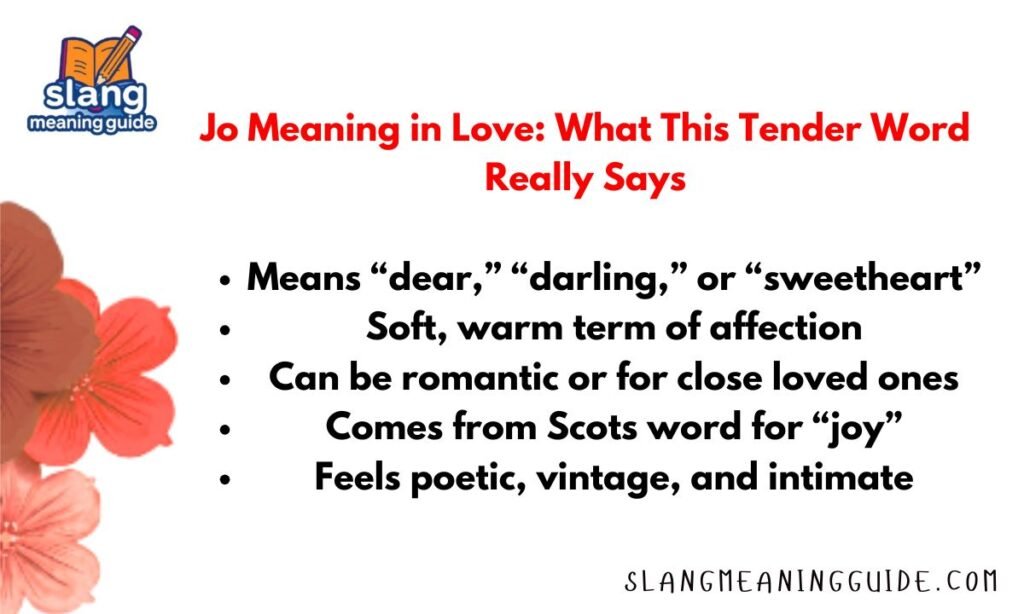
The word “jo” in the context of love means sweetheart, dear, or darling. It originates from Scottish and Scots dialect, where it has been used as a tender term of endearment since at least the 1520s. It does not exclusively mean romantic partner — it can refer to anyone held dear. But when used in a love context, it carries warmth, closeness, and genuine affection.
What “Jo” Means
“Jo” is a Scots word derived from an older form of “joy.” It functions like “dear” or “darling” — a soft, intimate address that signals emotional closeness without being overly formal or dramatic.
It is gender-neutral. You can use it for a partner, a close friend, or even a beloved family member. The meaning shifts slightly based on tone and context, but the emotional core stays the same: this person matters to you.
Core Meanings Explained
Jo as a Romantic Term of Endearment
Definition: A direct address to a romantic partner, equivalent to “darling” or “sweetheart.”
Usage: Used in place of a name when speaking directly to someone you love. It adds warmth and intimacy without being dramatic or over the top.
Examples:
- “Come here, my jo.”
- “Good night, jo. Sleep well.”
- “You’re my jo — always have been.”
Jo as an Expression of General Affection
Definition: A broader term of fondness that applies to close friends, family, or anyone deeply valued.
Usage: Not every use of “jo” is romantic. A parent might call a child “my jo.” A close friend might use it in warm, affectionate conversation. It indicates deep personal care, not just romantic love.
Examples:
- “How are ye, jo?”
- “You’ve been my jo since we were kids.”
- “My jo, I’m so proud of you.”
Jo in Poetic and Literary Use
Definition: A stylistic word choice used in poetry, song, and creative writing to evoke Scottish heritage, romantic nostalgia, or historical intimacy.
Usage: Robert Burns made this word famous in his 1789 poem “John Anderson My Jo.” Since then, writers and poets have used it to add emotional texture and cultural authenticity to romantic language.
Examples:
- “John Anderson, my jo, John, we clamb the hill together.” — Robert Burns
- “She called him her jo in every letter she ever sent.”
- “The ballad spoke of a jo long gone but never forgotten.”
Origin and Evolution
“Jo” comes from the Scots language, where it developed as a variant of the word “joy.” The emotional logic is clear — a jo is someone who brings you joy.
| Term | Estimated Origin | Platform Where It Became Popular | Current Status |
| Jo (Scots endearment) | circa 1520s | Scottish oral tradition and literature | Active in Scotland; poetic elsewhere |
| Jo (Burns popularization) | 1789 | Scottish poetry and song | Widely recognized in literary circles |
| Jo (modern romantic use) | 2010s onward | Social media captions, romantic texts | Niche but growing in aesthetic circles |
| Jo (name abbreviation) | Medieval | General English usage globally | Common as a shortened name worldwide |
The word has lived quietly for five centuries. It never went fully mainstream, but it never disappeared either. In 2026, it shows up in romantic social media content, heritage language campaigns like #LoveYerLeid in Scotland, and aesthetic captions that reach for something more poetic than “babe” or “boo.”
How People Use Jo in Conversations
In modern messaging, “jo” tends to appear when someone wants to express warmth without using an overworked word like “babe” or “love.” It feels specific, slightly vintage, and genuinely tender — which is exactly why people reach for it.
On social media, it appears most in romantic captions, poetry posts, and heritage content from Scottish users. Non-Scots sometimes adopt it for its aesthetic quality — the word looks and sounds soft, which matches the emotional tone people want to set.
Text and social media examples:
- “Thinking of you, my jo 🌹”
- “Night, jo. You mean everything 💕”
- “Love ye, jo — always and always.”
- “My jo came through for me again 🤎”
- “Bonnie jo, you made my whole day ❤️”
Common Misunderstandings
Many people encounter “jo” for the first time and assume it is just a shortened name or a typo. That misread causes them to miss the emotional weight the speaker intended.
Incorrect interpretations:
- Thinking “jo” always refers to someone named Jo or Joanna
- Assuming it only applies to a romantic partner and not to close friends or family
- Treating it as universal modern slang — it is still more cultural and regional than mainstream
- Mispronouncing it as “joe” (like the name) — in Scots it rhymes with “glow”
- Using it in formal writing without understanding how old-fashioned it reads outside Scottish contexts
Formal vs Informal Use
“Jo” is almost entirely an informal word. It belongs in personal messages, romantic conversations, poetry, and casual affectionate speech.
Informal use (where it fits):
- Late-night texts: “Miss you, jo.”
- Romantic captions: “My jo 🌹”
- Spoken endearment: “Come here, my jo.”
- Family warmth: “How’s my wee jo today?”
Formal use (where it does not fit):
- Business emails — it reads as strange and out of place
- Academic writing — unless you are specifically analyzing Scots language
- Professional social media — unless the brand has a clearly personal, poetic voice
- Introductions to people you do not know well
The word carries intimacy by design. Outside that intimate space, it either confuses people or sounds forced.
Comparison With Similar Words
| Word | Meaning | Where It’s Used | Difference From Jo |
| Darling | Beloved, dear | Global English | More polished and formal; less culturally specific |
| Babe | Romantic partner | Modern casual English | More casual and contemporary; lacks poetic roots |
| Love | General affectionate address | British English | Broader and more common; less intimate by frequency |
| Dear | Valued person | Formal and informal English | More neutral and less romantic in tone |
| Hen | Friendly address (female) | Scottish English | Friendly but not romantic; gendered |
| Pet | Affectionate address | Northern British English | Warmer than “dear” but lacks the romantic depth of “jo” |
“Jo” stands apart because it carries both romantic history and cultural identity. The others are warmer or cooler versions of the same idea, but none carry five centuries of poetic use behind them.
Examples in Social Media and Text Messages
Real-world usage keeps it short and emotionally direct. Here is how it actually appears:
“Good morning, jo ☀️ Hope today treats you well.”
“My jo, I’d walk a thousand miles 💌”
“Night jo 💕 You’re the best part of my day.”
“Proud of you, my jo. Always.”
“This one’s for my jo — you know who you are 🌹”
The pattern is consistent: short sentence, the word “jo” placed like a name at the end or middle, and often paired with a soft emoji. It never overwhelms the message — it simply makes it warmer.
Frequently Asked Questions
What does “jo” mean in love?
It means sweetheart or darling — a tender Scots word for someone you hold dear.
Is “jo” only used in Scotland?
It originated in Scotland but appears in romantic and poetic content worldwide, especially in aesthetic social media posts.
Can “jo” be used for friends, not just partners?
Yes — “jo” can refer to anyone deeply valued, including close friends and family members.
Is “jo” a modern slang word?
No — it dates to the 1520s, though it is seeing a small revival in digital romantic content.
How do you pronounce “jo”?
It rhymes with “glow” — a soft, single syllable, not pronounced like the name “Joe.”
Conclusion
“Jo” is a small word with a long history and a genuine emotional charge. It crossed five centuries from Scottish poetry to modern text messages without losing its core meaning: this person brings me joy, and they deserve to know it. Use it where it fits — quietly, warmly, and with intention.