
Ever seen “OMS” in a message and paused for a second? It looks simple, but the meaning can shift fast. One chat feels playful, another sounds serious. Understanding it changes how you read the whole conversation.
Core Meanings Explained
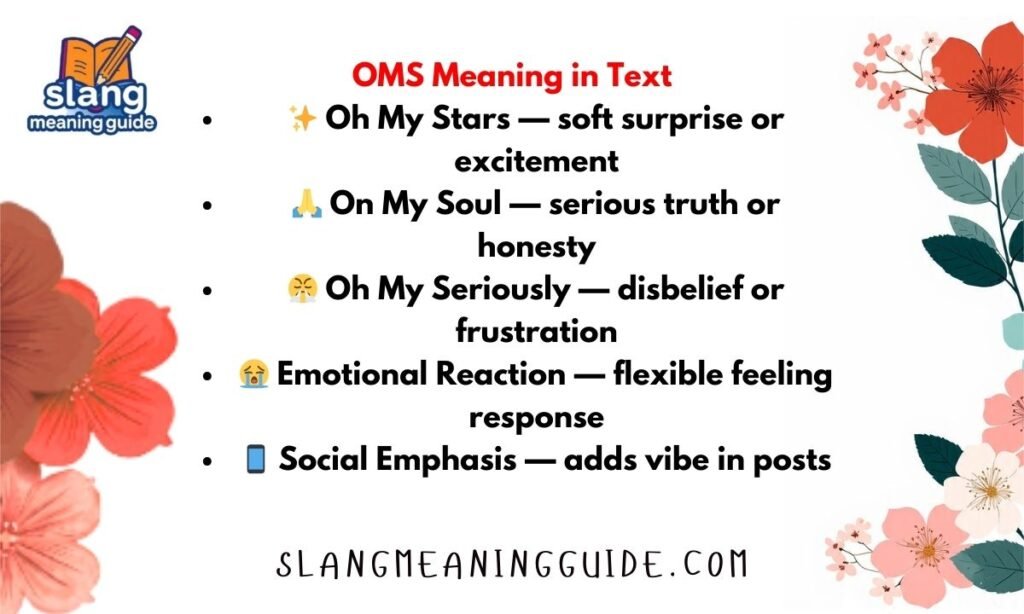
OMS = Oh My Stars
Oh My Stars is a soft, polite reaction to surprise or excitement. It feels lighter than OMG and often sounds playful.
- “OMS, that sunset looks unreal!”
- “OMS you actually won?!”
- “OMS this is so cute 😍”
- “OMS I didn’t expect that at all.”
- “OMS that twist shocked me.”
OMS = On My Soul
On My Soul expresses strong honesty or emotional emphasis. It signals that someone is serious or telling the truth.
- “OMS I didn’t do it.”
- “OMS I was there yesterday.”
- “OMS I’ll send it tonight.”
- “OMS that story is true.”
- “OMS I’m not joking.”
OMS = Oh My Seriously
Oh My Seriously shows disbelief, frustration, or sarcasm. It often appears when something feels ridiculous.
- “OMS, why would you do that?”
- “OMS this again?”
- “OMS that makes no sense.”
- “OMS I can’t deal with this.”
- “OMS you forgot again?”
OMS = Emotional Reaction (General Use)
Sometimes OMS works as a flexible reaction without strict meaning. Tone and emojis define it.
- “OMS 😭 that’s too funny.”
- “OMS this hurts.”
- “OMS I love this song.”
- “OMS I’m tired of this.”
- “OMS what just happened?”
OMS = Casual Emphasis in Social Media
On platforms like TikTok and Snapchat, OMS boosts expression. It adds personality to short comments.
- “OMS this video 😂”
- “OMS trending again!”
- “OMS this vibe is perfect.”
- “OMS I relate to this.”
- “OMS best post today.”
Origin + Evolution Timeline
| Term | Estimated Origin | Platform Where It Blew Up | Current Status |
| Oh My Stars | Early 1900s (spoken English) | Forums, early social media | Still used, softer than OMG |
| On My Soul | 2000s (AAVE, hip-hop) | Twitter/X, TikTok | Strong Gen Z usage |
| Oh My Seriously | 2010s | Messaging apps | Moderate usage |
| General OMS slang | 2015–2020 | Snapchat, Instagram | Widely flexible |
| Social reaction OMS | 2020s | TikTok, Reels | Growing trend |
OMS began as a spoken phrase like “Oh My Stars.” Digital culture shortened it for speed. Social media later expanded its meanings. Now OMS adapts based on tone, platform, and audience.
Usage in Text Messages
OMS appears mostly in casual conversations. It reacts quickly to events, jokes, or emotions. Tone depends on context and emojis.
- Surprise: “OMS that’s amazing!”
- Shock: “OMS I didn’t see that coming.”
- Humor: “OMS this meme 😂”
- Honesty: “OMS I’m serious.”
- Frustration: “OMS not again.”
It fits fast chats where typing speed matters. People use it to keep conversations expressive but short.
OMS also helps soften reactions. Compared to stronger slang, it feels friendlier. That makes it popular in daily messaging.
Usage Across Platforms
OMS changes slightly depending on where it appears. Platform culture shapes tone and meaning.
- WhatsApp: Personal and emotional
- Snapchat: Fast, casual reactions
- Instagram: Comments and captions
- TikTok: Expressive and trend-driven
- Discord: Informal and playful
For example:
- “OMS this filter 🔥” (Instagram)
- “OMS that clip 😭” (TikTok)
- “OMS reply fast” (Snapchat)
Each platform adds its own style. Still, the core idea remains emotional expression.
Common Misunderstandings
Many people misread OMS because it has multiple meanings. Context matters more than the letters themselves.
- Assuming OMS always means OMG
- Confusing it with technical terms
- Missing sarcasm without emojis
- Using it in formal writing
- Misreading emotional tone
Always read the full message before reacting. Small clues like emojis or punctuation help clarify meaning.
Formal vs. Informal Uses
| Term | Informal Use | Formal/Professional Equivalent |
| OMS (Oh My Stars) | OMS that’s amazing | That is impressive |
| OMS (On My Soul) | OMS I’m serious | I assure you |
| OMS (Reaction) | OMS this is funny | That is amusing |
| OMS (Frustration) | OMS not again | This is frustrating |
| OMS (General) | OMS wow | That is surprising |
OMS belongs in casual communication. It feels natural among friends and social media users.
In professional settings, avoid OMS. Use clear and formal language instead. This prevents confusion and keeps tone appropriate.
Comparisons With Similar Abbreviations
- OMG — Stronger and more dramatic than OMS
- ISTG — Similar to “On My Soul” but more direct
- ONG — Very close to OMS in sincerity
- WOW — Neutral reaction, less expressive
- SMH — Shows disappointment, not surprise
- TBH — Focuses on honesty, not emotion
- NGL — Casual honesty marker
- OOPS — Light reaction to mistakes
OMS stands out because it balances emotion and softness. It works in more situations without sounding extreme.
When to Use OMS
Use OMS when the tone is casual and expressive. It fits friendly conversations and online reactions.
- Chatting with friends
- Reacting to posts
- Sharing emotions quickly
- Light arguments or jokes
- Social media comments
Avoid OMS when clarity and professionalism matter. Context always comes first.
How to Respond to OMS
Responding depends on tone. Match the emotion in the message.
- Excitement: “Right? It’s amazing!”
- Curiosity: “What happened?”
- Agreement: “Same here OMS!”
- Humor: “Haha I know 😂”
- Serious tone: “I understand.”
Simple replies keep conversations flowing. Overthinking is not necessary.
Popularity and Trends
OMS continues to grow because it feels fresh. People want alternatives to overused slang like OMG.
- Short and easy to type
- Sounds softer and friendly
- Works across platforms
- Adapts to multiple meanings
- Fits Gen Z communication style
Social media drives its popularity. Trends change quickly, but flexible slang like OMS lasts longer.
Frequently Asked Questions
What does OMS mean in texting?
It usually means Oh My Stars or On My Soul.
Is OMS the same as OMG?
No, OMS is softer and less intense.
Can OMS be serious?
Yes, when it means On My Soul.
Is OMS used professionally?
No, it is informal slang.
Why is OMS popular?
Because it feels expressive, short, and flexible.
Conclusion
OMS is a flexible slang term with multiple meanings. Context decides whether it shows surprise, honesty, or emotion. Understanding OMS helps you read messages accurately and respond naturally.