
Ever read a text and had no idea what it meant? You’re not alone. British slang moves fast. One day it’s street corners. The next, it’s everywhere. This guide breaks down famalam and the slang terms surrounding it — clearly, quickly, and honestly.
What Does Famalam Mean?
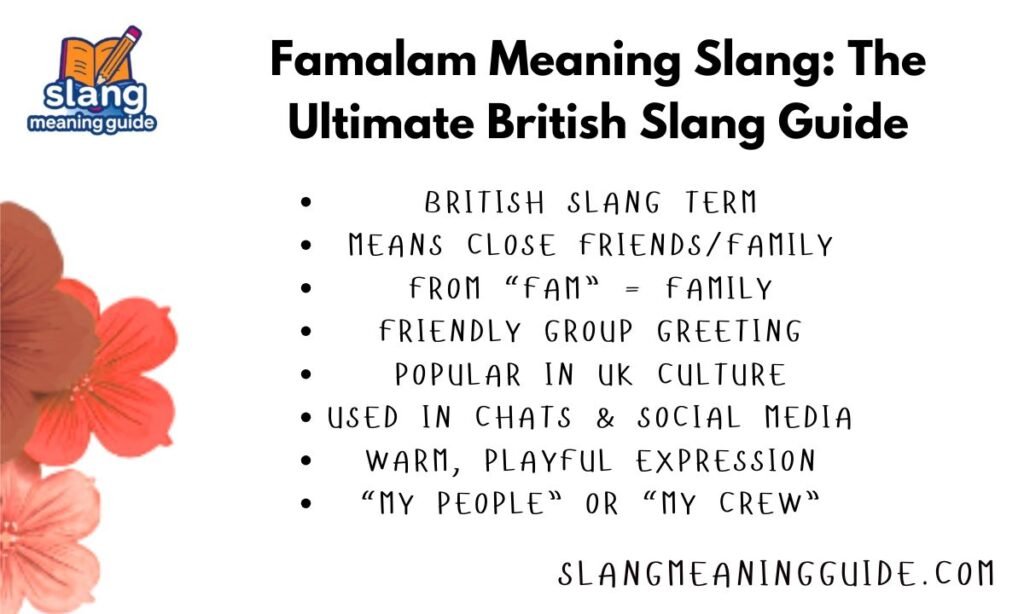
Famalam is British slang for family or a close group of friends.
It’s an extended, playful version of fam — itself short for “family.” The word uses a rhyming, reduplicative structure: fam-a-lam. It adds warmth and humor. It turns a simple greeting into something more affectionate and distinctly British.
Think of it as the UK street equivalent of saying “my people” or “my crew.”
Core Definition
Famalam (noun/address): A term of endearment used to refer to close friends or family. Rooted in UK Black British youth culture. Popularized in the 2010s.
It is used as:
- A greeting: “Yes famalam!”
- A reference to a group: “The whole famalam’s coming tonight.”
- A term of affection: “Love you, famalam.”
- A casual shoutout: “Big up the famalam.”
Famalam Meaning: UK Slang in Depth
In the UK, especially in cities like London, Manchester, and Birmingham, famalam carries real cultural weight. It is not just a word. It signals belonging.
The term blew up through UK grime culture, road slang, and social media. YouTube personalities and content creators like KSI used it openly. The BBC sketch show Famalam — a Black British comedy series that aired from 2017 to 2020 — brought the word into mainstream British television.
Famalam British Slang: Formal vs. Informal Uses
| Context | Example Sentence | Tone |
| Casual greeting | “Yes famalam, long time!” | Friendly / Warm |
| Group reference | “Gathering the whole famalam.” | Inclusive |
| Social media caption | “Out here with the famalam 🖤” | Affectionate |
| Formal writing | ❌ Not used | N/A |
| Professional email | ❌ Not appropriate | N/A |
Famalam is strictly informal. You would never see it in a CV, an essay, or a work email. It lives in text messages, social posts, voice notes, and real-life conversation.
Origin and Evolution of Famalam
Where Did It Come From?
Famalam evolved from fam, which itself came from family. The playful suffix -alam was added through a technique common in British street slang — taking a word and extending it with rhythm.
This mirrors older British slang patterns like Cockney rhyming slang, where creativity and wordplay were built into everyday speech.
Timeline: Famalam From Street to Screen
| Period | What Happened |
| Early 2000s | “Fam” enters UK urban slang via grime and road culture |
| 2008 | “Famalam” first documented on Urban Dictionary |
| 2010s | Spreads across London youth, social media, and YouTube |
| 2017–2020 | BBC series Famalam cements the word in British pop culture |
| 2020–present | Still used but seen as slightly nostalgic or retro by Gen Z |
Key milestones:
- Urban Dictionary first listed famalam in 2008
- Wiktionary classifies it as a slang alternative form of “fam”
- BBC comedy Famalam aired for three series (2017–2020)
- KSI and the Sidemen helped spread the term via YouTube
Common Misunderstandings About Famalam
People unfamiliar with UK slang often get this wrong.
Myth 1: It only means literal family. Wrong. It mostly means close friends — people you treat like family.
Myth 2: It’s American slang. It’s not. Famalam is distinctly British, rooted in UK Black culture.
Myth 3: It means “familiar.” Some people guess this. It doesn’t. It comes from fam (family), not familiar.
Myth 4: It’s still peak-trending. Famalam had its biggest moment in the mid-2010s. Today, younger Gen Z users may call it dated — but it’s still understood and used with affection.
Related Slang Terms Explained
What Does “Based” Mean in Slang?
Based means someone is confident, authentic, and unapologetically themselves.
Originally from rapper Lil B, it started as a term meaning someone who didn’t care what others thought. Today it’s widely used on TikTok, Reddit, and Twitter as a compliment.
Examples:
- “He wore that fit with zero hesitation. Based.”
- “Taking a break from social media? Based.”
- “She told her boss exactly what she thought. Based.”
- “That take was controversial but honestly based.”
It’s often used as a one-word reaction. Someone shares a bold opinion. You reply: “Based.”
What Does “Dee” Mean in Slang?
Dee is used in Australian and New Zealand slang as a shorthand for detective. In casual UK or US usage, it can simply refer to someone using the letter D as a nickname or initial.
Examples:
- “Dee’s been undercover for months.” (detective context)
- “Everyone just calls him Dee.” (nickname)
- “Dee’s the one to talk to.” (informal reference)
- “The Dees are on his trail.” (police, Aus slang)
What Does FYD Mean in Slang?
FYD has two common meanings depending on the platform:
- Follow Your Dreams — used motivationally on Instagram and TikTok
- F* Your Dreams** — used sarcastically or humorously between close friends
Examples:
- “Keep pushing, FYD always.” (motivational)
- “You wanna be famous overnight? FYD bro.” (sarcastic)
- “Caption it FYD — that energy is real.” (inspirational post)
- “He hit me with a FYD when I told him my business idea.” (playful jab)
Context matters everything here. Know your audience before you type it.
What Does IFO Mean in Slang?
IFO stands for In Front Of. It’s used in texting and online chats when describing location or positioning.
Examples:
- “I’m IFO the restaurant, where are you?”
- “Don’t say that IFO her mum.”
- “He did that IFO everyone.”
- “Meet me IFO the station.”
It’s a simple logistical abbreviation. Not edgy. Just convenient.
What Does “Boh” Mean in Slang?
Boh is an Italian slang term meaning “I don’t know” or “who knows.” It’s a shoulder-shrug in word form. In English-speaking online communities, it’s picked up as a casual expression of uncertainty.
Examples:
- “What time does it start?” “Boh.”
- “Is she coming?” “Boh, she hasn’t replied.”
- “Boh, I’ll figure it out later.”
- “No idea, boh.”
What Does “BOC” Mean in Texting?
BOC stands for Big Old Crush. It can also mean Board Of Control in some contexts, but in casual texting it usually signals a strong romantic interest.
Examples:
- “I have a total BOC on him.”
- “She’s been my BOC since secondary school.”
- “Admit it, that’s your BOC.”
- “Don’t tell anyone but I’ve got a BOC on my coworker.”
What Does “OF” Mean in Slang?
In modern slang, OF almost always refers to OnlyFans — the subscription-based content platform.
Examples:
- “She said she’s starting an OF.”
- “Did he really sub to her OF?”
- “OF money is real money these days.”
- “They keep mentioning OF in every comment.”
It’s become so embedded in internet culture that the acronym alone carries the full meaning.
What Does “Falma” or “Famalam” Mean in English Slang?
Falma is a less common variation sometimes seen in text. It traces back to the same root as famalam — a playful extension of fam. Some use it as a shorter, quicker version.
Examples:
- “What’s good falma?”
- “Miss the whole falma rn.”
- “Real ones only, famalam.”
- “Big up the famalam for always showing up.”
Both forms carry the same meaning: your people, your tribe, your chosen family.
Famalam and the BBC Show: Pop Culture Connection
The BBC sketch comedy Famalam gave the word serious mainstream exposure.
The show starred primarily Black British comedians, including Samson Kayo and Gbemisola Ikumelo. It ran from 2017 to 2020 across three series. Critics called it a sharp, culturally specific achievement. Samson Kayo was nominated for a BAFTA for his performance.
The show used the word as its title deliberately — it signaled community, humor, and cultural identity in one single term.
Why British Slang Spreads So Fast
Several reasons explain how words like famalam travel from streets to screens:
- Social media: TikTok, Twitter, and YouTube amplify slang instantly
- Grime and UK rap: Artists carry slang into mainstream culture
- Comedy and TV: Shows like Famalam normalize street language
- Gen Z communication style: Short, expressive, and community-coded
- Cross-cultural sharing: UK slang reaches global audiences through content creators
Once a word hits YouTube or TikTok with millions of views, it spreads in hours.
Frequently Asked Questions
What does famalam mean in British slang?
It means close friends or family — people you’re deeply connected to, used as an affectionate greeting or reference.
Is famalam still used in 2026?
Yes, but mostly by older millennials or in nostalgic contexts. Gen Z may find it slightly dated.
Where did the word famalam originate?
It evolved from “fam” (family) in UK Black British youth culture, first documented online around 2008.
What is the difference between fam and famalam?
Both mean the same thing. Famalam is simply a more playful, extended, and rhythmic version of fam.
Is famalam used in American English?
Rarely. It is almost exclusively a British slang term, though American audiences may recognize it through UK content.
Conclusion
Famalam is more than just a word. It captures warmth, community, and a distinctly British way of expressing closeness.
From grime culture to BBC television, it traveled a long road. Along the way, it picked up cultural meaning that goes beyond its dictionary definition.
Whether you’re decoding a text, exploring UK slang, or just trying to understand what KSI is saying — now you know. Famalam means your people. Your crew. Your tribe.