

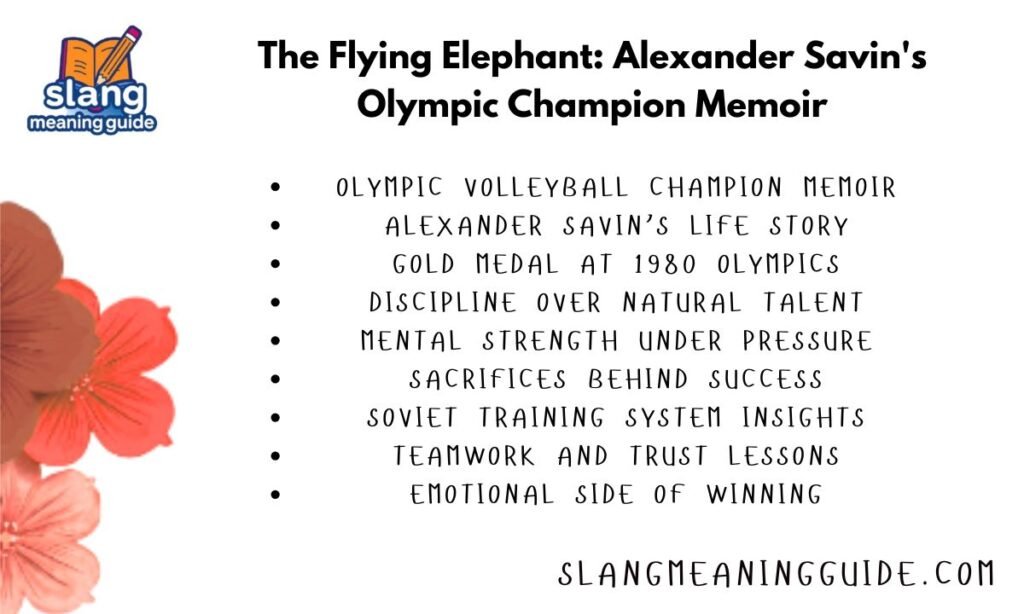
Most sports memoirs celebrate the trophy. This one studies the cost. Alexander Savin earned a gold medal at the 1980 Moscow Olympics — but his memoir goes far deeper than that moment.
It reveals exactly what Olympic-level discipline looks like from the inside, and why the man nicknamed “The Flying Elephant” became one of the most respected figures in volleyball history.
Who Is Alexander Savin?
Alexander Savin is a Soviet-era volleyball legend born in 1957. He played middle blocker for the USSR national team and is recognized as one of the greatest players in the history of the sport.
His career produced remarkable results — a silver medal at the 1976 Olympics, a gold medal at the 1980 Moscow Games, and over a decade of dominance on the international stage. He is now an inductee of the International Volleyball Hall of Fame.
From Small-Town Athlete to Olympic Gold Medalist
Savin’s journey began far from the spotlight. He came up through the rigorous Soviet sports training system, which prioritized consistency, discipline, and structured repetition over raw talent.
His development followed a path familiar to elite Soviet athletes: long training camps, limited contact with family, and a deeply team-oriented culture that left little room for individualism. That environment shaped not just his game, but his character.
Why He Was Called the Flying Elephant
The nickname sounds contradictory — and that tension is exactly the point. Savin stood tall and powerful at the net, built like a blocker should be. But his leaping ability was extraordinary.
He achieved a peak jump reach of 392 centimeters, combined with the physical mass of a true middle blocker. The nickname captured something real: a man who defied what his body was supposed to be capable of. That paradox became the memoir’s title and its central metaphor.
What Is the Flying Elephant Memoir About?
The Flying Elephant: Memoirs of an Olympic Champion is a 514-page account of Savin’s complete athletic journey. It moves from early training through Olympic competition, into coaching and mentorship.
This is not a victory lap. It is a detailed, honest look at the cost of sustained excellence at the highest level of sport.
The Core Themes of the Book
The memoir does not follow the predictable arc of most athlete biographies. It avoids the usual formula of struggle, breakthrough, and triumph. Instead it examines the interior experience of elite competition.
The recurring themes throughout the book include:
- Discipline over talent — how structured systems, not raw ability, produced results
- Mental resilience under pressure — managing fear, expectation, and the weight of representing a nation
- Team dynamics — trust, communication, and the invisible coordination required in volleyball
- Identity after achievement — what happens to an athlete’s sense of self once the medals are won
- Sacrifice and isolation — the personal cost of months spent in training camps away from family
These themes carry the book. They are honest about what elite performance actually demands — not romanticized, not softened.
What Sets It Apart from Generic Sports Biographies
Most sports autobiographies peak during the victory chapter. This one is strongest in its quieter, more reflective sections. Savin spends significant time on uncertainty — the fear before competition, the emotional exhaustion after success, the strangeness of public admiration.
That honesty gives the memoir credibility. It does not ask the reader to admire him. It simply shows what the experience was actually like.
The Soviet Sports System Through Savin’s Eyes
One of the most valuable aspects of this memoir is its firsthand account of Soviet sports culture. That training system is often referenced in discussions of athletic excellence, but rarely described from the inside.
Savin details what a typical training day looked like during major competition preparation. Early starts, blocking drills, film study, scrimmages, and team meetings stretched across a day running from 6 a.m. to 10 p.m., six days a week for months at a time.
What the Training Camp Reality Looked Like
Athletes lived and trained in isolation. Contact with the outside world was limited. The environment was designed to remove distractions and build focus, but it also created its own pressures — loneliness, dependency on teammates, and a life defined almost entirely by performance.
Savin does not present this system as purely admirable or purely brutal. He shows it as a complex environment that produced extraordinary athletes while extracting significant personal costs. That balance is what makes the historical sections feel real rather than nostalgic.
The Relationship With Setter Vyacheslav Zaitsev
One of the most compelling professional relationships described in the memoir is between Savin and setter Vyacheslav Zaitsev. Their partnership was built on years of repetition and mutual trust.
Zaitsev understood precisely where to put the ball for Savin’s approach. That synchronization did not happen by accident — it was the product of thousands of training hours building unconscious coordination. The memoir explains how this kind of partnership develops and why it is so difficult to replicate.
Kindle Edition: Features and Reading Experience
The Kindle edition of The Flying Elephant was published in October 2025. It runs 514 pages and includes over 240 rare photographs sourced from family collections and historical archives.
This visual documentation is one of the standout features of the digital edition. The photographs include training camp images, competition moments, and personal portraits that bring the written narrative into sharper focus.
Why the Kindle Format Works Well for This Memoir
Sports memoirs read well in digital format. Readers often engage with them in short sessions — during travel, between workouts, or in the evening. The Kindle edition supports this pattern with adjustable font sizes, word-wise features, and the ability to highlight passages for later reference.
The philosophical and reflective sections of this book are exactly the kind of writing readers want to be able to mark and revisit. The Kindle format makes that easy. Enhanced typesetting also ensures the reading experience holds up across devices.
Key Kindle Edition Specifications
| Feature | Details |
| Author | Alexander Savin |
| Editor & Translator | Andrei Savine |
| Language | English |
| Publication Date | October 26, 2025 |
| Print Length | 514 pages |
| File Size | 68.8 MB |
| Photographs | 240+ rare images |
| Features | Word Wise, Page Flip, Enhanced Typesetting |
The Emotional Core of the Memoir
The strongest memoirs earn their emotional impact through restraint. They do not tell readers what to feel — they describe the experience and allow the feeling to arrive naturally.
That is the approach Savin takes throughout the book. He describes pressure without dramatizing it. He discusses failure without self-pity. While He reflects on success without demanding admiration.
What Champions Feel That the Public Never Sees
The memoir is frank about the emotional reality of winning at the Olympic level. Success brings its own complications. The identity of an athlete becomes so tied to competition that the period after retirement can feel disorienting.
Savin explores how public recognition can coexist with private loneliness. He discusses the strangeness of being celebrated for something that required years of personal sacrifice most people never witnessed. That section alone sets this book apart from standard athletic biography.
Lessons Beyond the Volleyball Court
The themes in this memoir extend well beyond sports. Readers working in competitive business environments, education, coaching, and creative fields will recognize the dynamics Savin describes.
Discipline without flexibility creates rigidity. Success without reflection creates emptiness. Team performance requires trust that has to be earned slowly and can collapse quickly. These are not volleyball lessons — they are human ones.
Who Should Read This Book
This memoir works for a wide range of readers, not just volleyball fans.
Volleyball players and coaches will find direct insight into training philosophy, game psychology, and the technical development of elite players. The sections on blocking technique and setter-blocker coordination have practical value.
Sports psychology enthusiasts will appreciate the honest account of how elite athletes manage fear, expectation, and emotional burnout. Savin does not gloss over the mental difficulty of sustained performance.
General memoir readers who enjoy reflective nonfiction will find the writing accessible and the emotional territory recognizable. You do not need sports knowledge to connect with a story about ambition, sacrifice, and identity.
Leadership and performance professionals will find the sections on team dynamics, training systems, and long-term excellence directly applicable outside of athletics.
Frequently Asked Questions
What is The Flying Elephant memoir about?
It is a 514-page sports memoir by Soviet Olympic volleyball champion Alexander Savin, covering his career, training, and life behind elite competition.
Why is Alexander Savin called “The Flying Elephant”?
He earned the nickname for combining extraordinary leaping ability with the powerful physical build of a middle blocker — a rare and unlikely combination.
Does the Kindle edition include photographs?
Yes, the Kindle edition includes over 240 rare photographs from family collections and historical archives, covering training, competition, and personal moments.
Is this book only for volleyball fans?
No. Its themes of discipline, identity, pressure, and achievement make it relevant to athletes in any sport, coaches, professionals, and general memoir readers.
Where can I buy the Kindle edition?
It is available on Amazon and major Kindle platforms worldwide, published in October 2025 under Alexander Savine as editor and translator.
Conclusion
The Flying Elephant Memoirs of an Olympic Champion Kindle Edition Alexander Savin is one of the most honest accounts of elite athletic life published in recent years.
It earns its place in sports literature not by celebrating medals but by examining what those medals actually cost — in time, sacrifice, identity, and emotional endurance. Pick it up for the volleyball history. Stay for the human truth behind it.