
Three letters. Zero explanation. That’s how IGH shows up in most messages. You read it, pause, and suddenly you’re not sure if your friend is agreeing, frustrated, or done with the conversation. This guide breaks down exactly what IGH means — and how to read it every single time.
What Does IGH Mean?
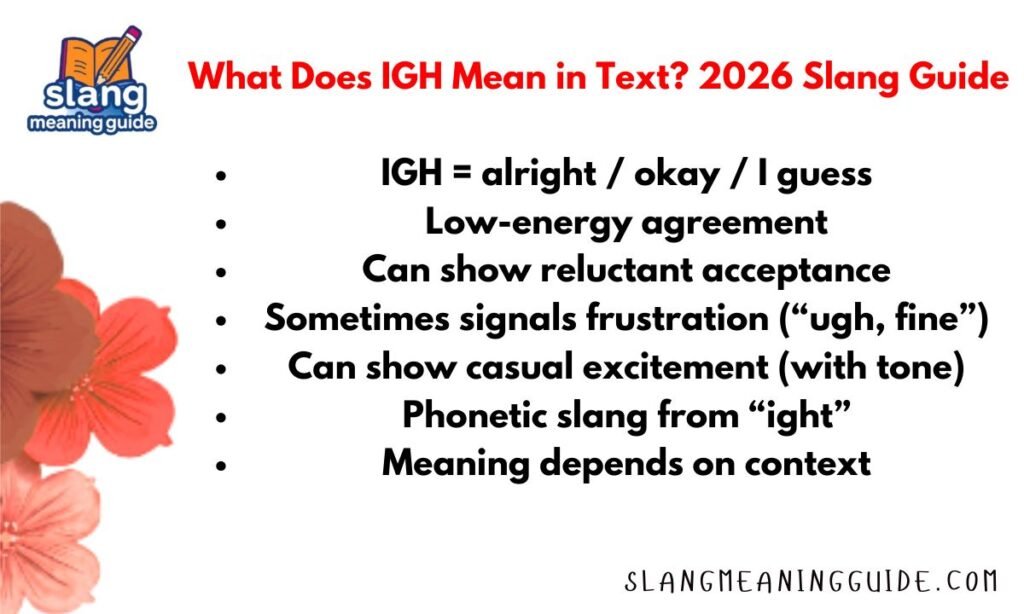
IGH is a casual slang abbreviation used in texting and online chats. It most commonly means “alright,” “okay,” or “I guess” — depending entirely on tone and context. Think of it as a verbal shrug typed out in three letters.
It is not a firm yes. It is not a no. It sits right in the neutral middle, somewhere between reluctant agreement and quiet acceptance. That emotional ambiguity is what makes IGH so widely used — and occasionally so confusing.
Primary Definition
IGH functions as a low-energy acknowledgment in casual conversation. When someone replies with IGH, they are signaling that they heard you, they are okay with the situation, and they are not particularly excited about it either way.
The closest spoken equivalent is a soft, drawn-out “alright” — the kind someone says when they go along with a plan they didn’t choose. It is not rude and dismissive. It just communicates a quiet, casual acceptance without any extra energy behind it.
Phonetic Origin
IGH is not a traditional acronym. It does not stand for a fixed phrase the way LOL or BRB does. Instead, IGH is a phonetic shorthand — it mimics the sound of “ight,” which itself is how “alright” sounds when spoken quickly in casual conversation.
This sound-based origin is what separates IGH from most texting abbreviations. People are not decoding letters — they are writing how the word actually sounds in their head. That makes IGH feel more natural and spontaneous than most slang terms.
Origin in Slang
IGH emerged from spoken African American Vernacular English (AAVE), where “ight” has long been a casual way to say “alright.” As texting culture grew and Gen Z moved conversations to platforms like Snapchat and TikTok, spoken speech patterns started appearing in written form.
The word made the jump from voice to text as messaging became faster and more informal. By the early 2020s, IGH was appearing regularly in group chats, comment sections, and DMs. By 2026, it is firmly established across all major social platforms.
Common Uses of IGH in Text
IGH is flexible — and that flexibility is the whole point. It works in different emotional contexts without changing its form. The letters stay the same; the feeling behind them shifts based on the conversation. Reading that shift correctly is the key to understanding what someone actually means when they send it.
The three most common uses of IGH each carry a distinct emotional tone. Learn to spot which one is at play and you will never misread an IGH again.
Agreement or Confirmation
The most common use of IGH is simple agreement. When someone says IGH in response to a plan, suggestion, or statement, they are saying: “okay, I’m with it.” It confirms without enthusiasm — like nodding along rather than saying “yes, absolutely.”
This version shows up constantly in group chats and DM conversations. Someone proposes a time to meet, a place to go, or a decision to make — and IGH is the reply that moves things forward without adding fanfare. It is casual confirmation. Nothing more.
Showing Frustration
IGH can also carry a frustrated or exhausted tone. In this context it sounds less like “alright, sure” and more like “ugh, fine.” The letters are the same but the vibe shifts completely based on what came before in the conversation.
Look for this use after complaints, bad news, or unwanted updates. If someone just told their friend their weekend plans fell through and gets back an “igh,” that IGH is closer to a tired sigh than an agreement. Context — not the word itself — does all the work here.
Expressing Excitement
A third, less obvious use of IGH leans toward positive energy. In this case it functions almost like “alright, let’s go!” — a casual signal of enthusiasm before something good happens. The tone is lighter and the context is usually something the sender is looking forward to.
This version tends to appear before events, outings, or good news. It reads less like resignation and more like a relaxed version of “yes, finally.” Spotting this use requires reading the surrounding messages carefully, but once you see it, the positive energy behind the IGH is clear.
IGH Examples in Conversations
Seeing IGH in real exchanges makes the meaning land immediately. The examples below cover texts, social media, and group chats — showing how the same three letters shift in tone across different situations.
Text Message Samples
Here are realistic text exchanges that show IGH in action across different emotional contexts:
Neutral agreement:
“We’re meeting at 7, yeah?” “Igh, see you then.”
Frustrated acceptance:
“The event got moved to Sunday.” “Igh… seriously? Fine.”
Casual excitement:
“Pizza night is back on.” “Igh!! Let’s go.”
First example, IGH is a simple confirmation. In the second, it reads as mild frustration before reluctant acceptance. In the third, the double exclamation point shifts the whole tone toward enthusiasm. Same word — three completely different feelings.
Social Media Comments
On TikTok and Instagram, IGH appears in comment sections as a quick reaction to relatable content. It signals “same,” “I get it,” or “honestly, fair” without requiring a full sentence. The brevity fits perfectly into the fast-scroll comment culture of both platforms.
A creator posts about being tired after a long week. The top comment: “Igh, me every Thursday.” That IGH carries shared exhaustion. Another creator shares unexpected good news. A comment reads: “Igh okay, we love that.” That IGH leans toward surprised approval. Context from the video content shapes the meaning entirely.
Group Chat Replies
Group chats are where IGH thrives most. In a busy group thread, long replies get ignored. Short, tone-accurate responses get read. IGH fills that role perfectly — it acknowledges without derailing, agrees without demanding attention.
Someone drops plans in a group chat. Three people respond with “igh.” That is not disinterest — that is everyone confirming in the most efficient way possible. In group chat language, three IGHs mean the plan is locked in without anyone making a production of it.
Variations and Similar Slang
IGH does not exist in isolation. It sits inside a wider ecosystem of similar slang terms, each carrying slightly different energy and usage patterns. Knowing the differences helps you choose the right one and read incoming messages more accurately.
The most important comparison is between IGH and its closest relative: Ight.
Ight as the Extended Form
IGH and Ight are closely related — nearly interchangeable for most people. Ight is the slightly more complete version, still informal, still casual, but feels a tiny bit more committed than a bare IGH. Ight reads as “alright, I’m in.” IGH reads as “alright, sure, whatever.”
Both come from the same phonetic root. The difference is subtle — more vibe than definition. Ight tends to appear when someone is slightly more on board. IGH tends to appear when someone is going along rather than actively choosing.
Other Okay Abbreviations
IGH compares interestingly with similar slang terms across the agreement spectrum:
| Term | Meaning | Energy Level |
|---|---|---|
| IGH | Alright / I guess | Low — neutral to reluctant |
| Ight | Alright | Slightly higher — casual agreement |
| IK | I know | Neutral — acknowledgment only |
| FR | For real | Medium — genuine confirmation |
| NGL | Not gonna lie | Medium — honest admission |
IGH sits at the low-energy end of that table. It is softer and more non-committal than all of them.
Platform Differences
IGH behaves slightly differently depending on the platform. On Snapchat, it appears most often in quick one-on-one DM exchanges — fast, personal, emotionally readable because the chat history provides context. And On TikTok, it shows up in comments where the video content does the emotional heavy lifting.
On Instagram, IGH splits between DMs and comment sections, functioning similarly to both Snapchat and TikTok depending on where it lands. In WhatsApp group chats, it serves primarily as efficient agreement — a way to confirm without starting a thread.
When to Use or Avoid IGH
IGH is a tool. Like any tool, it works perfectly in the right setting and completely wrong in the wrong one. Knowing when to reach for it — and when to put it away — is what separates natural usage from awkward miscommunication.
The core rule is simple: IGH belongs in casual, informal digital spaces. Anywhere that requires clarity, professionalism, or emotional precision, it does not belong.
Best Platforms
IGH works best in:
- One-on-one text conversations with friends
- Group chats where everyone shares the same informal communication style
- TikTok and Instagram comment sections
- Snapchat DMs where fast replies are expected
- Discord servers with casual communities
In these spaces, IGH lands exactly as intended. The audience understands the tone and the format rewards brevity.
Professional Alternatives
In professional settings, replace IGH with clear, full language. Instead of IGH in an email, write “Understood” or “Sounds good.” Instead of IGH in a work message, write “That works for me” or “Confirmed.”
The reason is simple: IGH depends on shared informal context to make sense. Most professional communication strips that context away. Without it, IGH reads as lazy, unclear, or indifferent — none of which serve you in a work environment.
Misunderstanding Risk
The biggest risk with IGH is that someone outside the informal digital communication world reads it as dismissive or cold. A parent, a teacher, or a colleague who does not regularly use texting slang may interpret IGH as indifference or even mild disrespect.
This is not what IGH means in casual usage — but meaning matters less than perception if the recipient reads it wrong. In any conversation where tone ambiguity could cause a problem, skip IGH and use full words instead.
Frequently Asked Questions
What does IGH stand for in text?
IGH stands for “alright” or “I guess” — it is a phonetic shorthand, not a strict acronym.
Is IGH the same as Ight?
They are very similar — Ight carries slightly more energy, while IGH leans more toward reluctant or neutral acceptance.
How do you pronounce IGH?
IGH sounds like “ight” — a shortened, casual version of the word “alright.”
Can IGH show frustration?
Yes — depending on context and tone, IGH can express mild frustration or tired acceptance rather than simple agreement.
Where is IGH used most?
IGH is most common on Snapchat, TikTok, Instagram, and in casual text message conversations, especially among Gen Z.
Conclusion
IGH is one of the smallest words in modern texting slang — and one of the most emotionally layered. It can mean agreement, frustration, excitement, or quiet acceptance depending entirely on the context surrounding it. Understanding what IGH means in text is less about memorizing a definition and more about reading the room — because in 2026 digital communication, tone always speaks louder than letters.