
Your friend sends you a single letter, “W,” and nothing else. No context, no explanation. You stare at it for a second before it clicks.
The Simple Answer: “W” Means Win
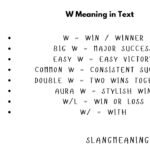
“W” stands for “win.” In this context, it’s used to signify a positive outcome or event or to express approval of it. Think of it as an Internet-age equivalent to a thumbs-up but with more immediate impact and a touch more zest.
This abbreviation can appear anywhere from status updates to comments, serving as a cheerleader’s sign that someone did something truly worthwhile.
It’s a way to acknowledge and celebrate positive happenings in the online world. And that’s how you can spot it—as a reaction to somebody sharing great news with their followers.
- “I got the internship!” “W”
- “We won the game 3-1.” “Big W”
- “Found parking right in front.” “W for you today.”
That last example matters. “W” doesn’t require anything huge. A parking spot counts. A good sandwich counts. The bar is low, and that’s part of the fun.
Where “W” Actually Came From
This one didn’t start on TikTok. It started on scoreboards.
Sports and gaming have used W, L, and D (win, loss, draw) for record-keeping forever. A boxer’s record reads “12W-3L.” A fantasy football league tracks the same letters every week.
From Gaming Chats to Everyday Slang
Online gaming picked this up early. Players needed something faster to type than “we won” while the match was still moving. “W” did the job.
From there, it spread to Twitter during sports conversations, where fans used it to react to plays in real time. TikTok and Instagram picked it up next, and by the early 2020s, “W” had left gaming and sports behind almost completely. Now it just means “a good thing happened.”
How People Actually Use “W” Today
The core meaning hasn’t changed, but the ways people dress it up have multiplied.
Big W, Massive W, and Small W
Adding a size word in front changes the intensity, not the meaning.
| Phrase | What it signals |
| W | A solid win, no extra emphasis needed |
| Big W | A win that felt bigger, more satisfying, or unexpected |
| Massive W | A major win, often said with some exaggeration for fun |
| Small W | A minor win, something modest but still worth noting |
None of these are official rules. People mix and match based on how excited they feel in the moment.
“Ws” as the Plural
Sometimes people track wins over time instead of celebrating just one.
- “Taking Ws this week.”
- “Nothing but Ws lately.”
- “That’s another W for the team.”
This version treats winning as an ongoing streak rather than a single event, which is common in fitness, career, and personal growth posts.
Replying to Someone Else’s Win
“W” isn’t only for your own achievements. It works just as well as a supportive reply.
- Friend posts a new job announcement. You comment “W.”
- Someone finishes a marathon. You reply, “MASSIVE W.”
- A coworker closes a big deal. You sent “W energy” today.
It’s short, but it reads as genuine encouragement rather than a generic “nice.”
“W” on Different Platforms
The meaning stays the same everywhere, but the tone shifts slightly depending on where you see it.
TikTok
TikTok comment sections lean on “W” constantly, often paired with other slang like “W rizz” (impressive charm or confidence) or “W content” (a video worth watching). It’s casual, quick, and usually stacked with emojis.
On Instagram, “W” tends to show up in captions and story replies more than comments. Someone posts a milestone, a workout result, or a life update, and “W” gets dropped in the replies as quiet support.
X (formerly Twitter)
On X, “W” often attaches to opinions and takes, not just personal wins. A “W tweet” means a post people agreed with or found sharp. It’s less about literal victory and more about a post landing well with the crowd.
“W” vs. “L”: The Two Sides of the Coin
You can’t really talk about “W” without mentioning its opposite.
- W means win, success, or something good.
- L means loss, failure, or something disappointing.
People use both together to frame everyday events like a scoreboard. Missed the bus? That’s an L. Got the last seat anyway? That’s a W. It turns small daily moments into a running tally, which is part of why the slang caught on so widely. It makes ordinary life feel a little more like a game.
“W” and Similar Slang Terms
A few related words often show up alongside “W,” and it helps to know how they’re different.
- Dub: Just another way to say “W.” Comes from spelling out the letter (“double-u”). Same meaning, slightly more casual.
- GG: Short for “good game.” Used to close out a match respectfully, win or lose. It’s not automatically positive the way “W” is.
- Props: A short way of giving someone credit or respect for something they did.
“W” is still the simplest and most common of the group, which is probably why it’s stuck around longer than most slang trends.
When “W” Doesn’t Fit
“W” works great in texts, comments, and casual chats. It doesn’t belong everywhere, though.
- Skip it in professional emails. “That’s a W for the team” reads fine in a Slack message, but it looks out of place in a client email or a formal report.
- Skip it when the context is serious. Slang tends to undercut sincerity in emotional or sensitive conversations.
- Watch your audience. Younger audiences recognize “W” instantly. Older or more formal audiences might just be confused by it.
A good rule of thumb: if you’d use an exclamation point and a casual tone anyway, “W” probably fits.
A Quick Note on Other Meanings of “W”
Context always matters with a single letter like this. “W” isn’t exclusive to slang.
- In physics, “W” stands for watt, a unit of power.
- On maps and compasses, “W” stands for west.
- In some medical notes, “W” can refer to weight or white blood cells.
- In casual writing, “w/” is shorthand for “with.”
None of these overlap with the slang meaning in normal conversation, but it’s worth knowing why a stray “W” in a different context might mean something else entirely.
Frequently Asked Questions
What does “W” mean in a text message?
It means “win,” used to celebrate good news or a positive outcome.
What does “Big W” mean in comments?
It means an especially satisfying or notable win, bigger than an everyday “W.”
Is “W” appropriate in professional messages?
Not usually. It fits casual chats and social media better than formal emails or reports.
What’s the opposite of “W” in slang?
“L,” which stands for loss and marks a failure or disappointing outcome.
Does “W” always mean something huge happened?
No. People use it for small wins too, like good weather or finding a parking spot.
Final Thoughts
“W” is a minor character that carries a massive meaning behind it—something great has happened. This particular keyboard key was first used in sports and gaming communities to signify a score on a scoreboard.
It then made its way to chatrooms and Twitter as an expression of excitement and has since evolved into a popular social media staple. It’s used to congratulate or hype up friends, and it saves more eloquent phrases for more formal situations.