
It is one of the most recognizable names in music history — but where did it actually come from? The phrase “Wu-Tang” carries layers of meaning that most people have never fully explored. It reaches back centuries before hip-hop even existed. If you think it is just a group name, you are only seeing the surface.
Wu-Tang refers primarily to the iconic hip-hop collective Wu-Tang Clan, formed in Staten Island, New York in 1992. However, the name itself draws from Chinese martial arts culture, specifically the sacred Wudang mountain in China and a classic kung fu film called Shaolin and Wu Tang.
Over decades, it evolved into a layered cultural symbol representing brotherhood, street wisdom, lyrical skill, and Eastern philosophy. In modern usage, “Wu-Tang” appears in conversations, memes, and social media as both a direct reference and a broader compliment.
What Wu-Tang Means
At its most literal, Wu-Tang is a martial-arts-inspired name rooted in Chinese culture. The Wudang mountain in Hubei Province, China, is a sacred Taoist site linked to legendary martial arts traditions.
The 1983 kung fu film Shaolin and Wu Tang brought that name into Western popular consciousness. When RZA and the founding members of the Wu-Tang Clan chose the name, they were intentionally connecting their music to that warrior tradition — discipline, mastery, and power through craft.
Beyond the literal origin, the name grew into a mythology. The group and their fans created backronyms like“Witty Unpredictable Talent And Natural Game” to give the name additional meaning. Five-Percent Nation teachings also informed how members understood the name spiritually.
Today, Wu-Tang functions as both a proper noun and a cultural shorthand — something you invoke when you want to signal that something is sharp, legendary, or authentically street-smart.
Core Meanings Explained
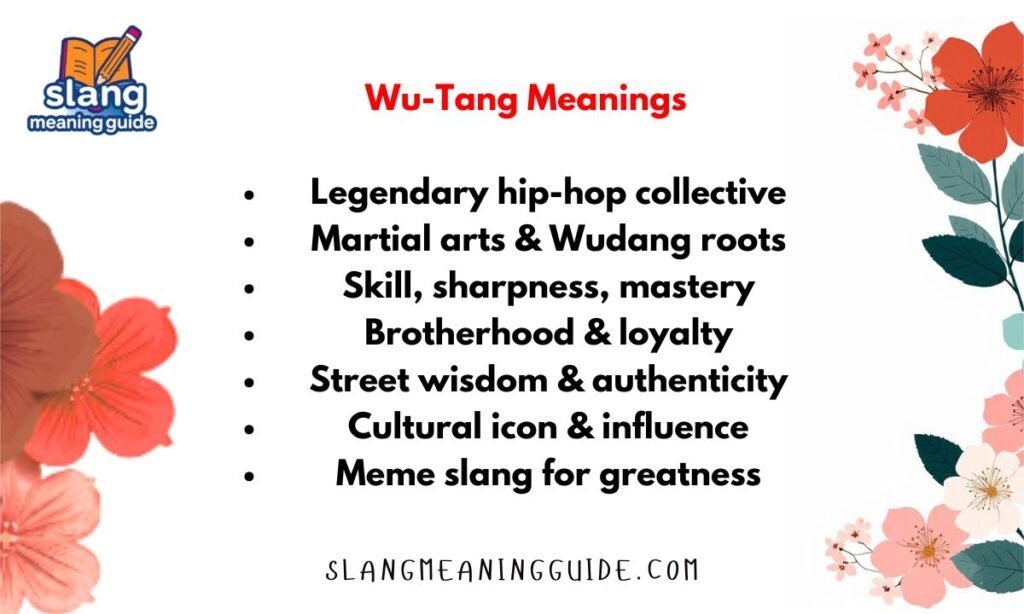
The Hip-Hop Group
The most direct meaning. Wu-Tang refers to the Wu-Tang Clan, one of the most influential rap collectives ever formed.
- Used when discussing music, albums, or rap history.
- “I’ve been listening to Wu-Tang since Enter the Wu-Tang dropped in 1993.”
- “Wu-Tang Clan is easily the greatest rap collective of all time.”
A Martial Arts and Cultural Reference
Wu-Tang traces to Wudang, a real Chinese mountain tied to Taoist martial arts and spiritual discipline.
- Used when discussing the group’s Eastern philosophy influences or kung fu films.
- “The whole Wu-Tang aesthetic was inspired by old-school kung fu movies.”
- “Wudang martial arts shaped how RZA built the group’s identity.”
Slang for Skill and Sharpness
In casual modern usage, calling something or someone “Wu-Tang” implies that it is impressive, sharp, or masterfully executed.
- Used as a compliment in informal conversation or social media.
- “That presentation was straight Wu-Tang — nobody came close.”
- “Your comeback in that debate was Wu-Tang level, honestly.”
A Symbol of Brotherhood and Loyalty
Culturally, Wu-Tang represents tight group loyalty — a crew that operates as one unified force.
- Used when talking about tight-knit friend groups or team dynamics.
- “Our squad is built different. We move like Wu-Tang.”
- “Real friendships have Wu-Tang energy — loyal and unbreakable.”
Meme and Internet Culture Reference
Wu-Tang frequently appears in memes, jokes, and internet humor as a marker of legendary or unexpected quality.
- Used in meme captions, Twitter jokes, or TikTok commentary.
- “This budget pizza somehow tasted Wu-Tang. I have no explanation.”
- “That plot twist was absolutely Wu-Tang — nobody saw it coming.”
Origin and Evolution
The journey from a Chinese mountain to a global cultural shorthand is a long one. Here is how Wu-Tang’s meaning evolved over time:
| Term / Phase | Estimated Origin | Platform Where It Became Popular | Current Status |
| Wudang Mountain (武当) | Ancient China (Taoist tradition) | Martial arts culture and film | Active as a historical and spiritual site |
| Shaolin and Wu Tang (film) | 1983 | Kung fu cinema, VHS culture | Classic film, widely referenced |
| Wu-Tang Clan (music group) | 1992 – Staten Island, NY | Radio, MTV, hip-hop community | Active and globally legendary |
| Backronym: “Witty Unpredictable…” | Mid-1990s | Hip-hop culture, fan communities | Widely known, part of the brand |
| Internet slang and memes | 2010s onward | Twitter, Reddit, TikTok, Instagram | Active and growing in casual use |
How People Use Wu-Tang in Conversations
In everyday texting, Wu-Tang shows up as a quick cultural reference or a playful compliment. People drop it when they want to say something is legendary without overexplaining. It works best among people who share an appreciation for hip-hop, street culture, or internet humor. The word carries weight without needing a full sentence to explain it.
On social media, Wu-Tang references spike around music anniversaries, viral moments, or whenever a creator wants to invoke authenticity and craft. Brands, comedians, and athletes use it to connect with audiences who value street-smart credibility. It is shorthand for excellence rooted in hustle and culture.
- “Just put together a Wu-Tang playlist for the drive. Ready.”
- “Bro came in with Wu-Tang energy and owned the whole room.”
- “This album dropped like a Wu-Tang record — no warning, just heat.”
- “Our team executed that plan like Wu-Tang — coordinated and sharp.”
- “Why does this street food taste Wu-Tang good? Unexplainable.”
Common Misunderstandings
Because Wu-Tang has so many layers, people often misread it. Some assume it is purely a music reference. Others think it is offensive slang or a random internet joke with no real roots. The truth is that every layer of the word — from the Taoist mountain to the meme format — is connected by a consistent thread of power, mastery, and cultural identity.
- Wrong: Wu-Tang only refers to martial arts and has nothing to do with music.
- Wrong: The name is just something RZA made up with no real meaning.
- Wrong: Wu-Tang is offensive or aggressive slang.
- Wrong: Using it as a compliment sounds strange or forced.
- Right: Wu-Tang is a layered cultural term that works across music talk, casual compliments, and internet humor depending on context.
Formal vs Informal Use
Wu-Tang is almost entirely an informal term. In academic or journalistic writing, you would spell out “Wu-Tang Clan” as a proper noun when discussing the group’s music or cultural impact. In any other context — texts, social media, casual conversation — the word operates as expressive slang. Using it in a formal professional email or a business report would feel out of place.
Informal examples:
- “That comeback was Wu-Tang, no notes.”
- “We need to move like Wu-Tang on this project — tight and coordinated.”
- “This beat is giving full Wu-Tang vibes.”
Formal / journalistic examples:
- “The Wu-Tang Clan’s 1993 debut album redefined the sound of East Coast hip-hop.”
- “Wu-Tang Clan remains one of the most studied collectives in the history of popular music.”
- “The group’s name derives from the Wudang martial arts tradition in Chinese culture.”
Comparison With Similar Words or Slang
| Word | Meaning | Where It’s Used | Difference From Wu-Tang |
| GOAT | Greatest of all time | Sports, music, social media | More universal; Wu-Tang carries specific cultural depth |
| Legendary | Exceptionally famous or impressive | Formal and informal contexts | Wu-Tang is more niche and culturally specific |
| Cold | Impressively skilled or unfazed | Hip-hop and street slang | Cold describes a person; Wu-Tang describes a level or style |
| Fire | Excellent, high quality | Social media, texting, music | Fire is broad; Wu-Tang implies strategic excellence |
| Drip | Stylish appearance or energy | Fashion, social media | Drip is about aesthetics; Wu-Tang is about skill and identity |
Examples in Social Media and Text Messages
Text message:
A: “How did your interview go?”
B: “Wu-Tang. I walked in, said what I had to say, and walked out confident.”
Twitter/X post:
“This new producer came out of nowhere and dropped an album that sounds like Wu-Tang produced it. Underground of the year.”
Instagram caption:
“Five years of this crew. Still moving like Wu-Tang. 🐝”
TikTok comment:
“The way he handled that heckler was completely Wu-Tang. Calm, sharp, and done in two sentences.”
Group chat:
“We need to pull up to this event Wu-Tang style — everyone ready, no chaos, just execution.”
Frequently Asked Questions
What does Wu-Tang mean in everyday conversation?
It signals that something or someone is exceptionally sharp, skilled, or operating at a legendary level — drawn from the Wu-Tang Clan’s iconic reputation.
Where did the name Wu-Tang originally come from?
It traces to the Wudang mountain in China, Taoist martial arts tradition, and the 1983 kung fu film Shaolin and Wu Tang, which inspired the hip-hop group’s name.
Is Wu-Tang slang or a proper name?
It is both — a proper name for the rap group and an informal slang term used to describe excellence, loyalty, or sharp execution in casual contexts.
Can you use Wu-Tang as a compliment?
Yes, calling someone or something Wu-Tang in an informal setting is a strong cultural compliment, implying mastery and authenticity.
Is Wu-Tang still relevant in internet culture today?
Absolutely — the term continues to circulate on TikTok, Twitter, and Instagram both as a music reference and as a flexible cultural shorthand for anything impressively executed.