
You just got a message that says “location TBD” and now you’re wondering if the plan is still happening. Three letters, but they carry a lot of weight depending on where you see them. Whether it shows up in a work email, a group chat, or a social media post, TBD means something slightly different each time.
Core Meanings Explained
TBD is not a one-trick abbreviation. It stretches across five distinct uses, and knowing each one saves you from misreading a message or using it the wrong way yourself.
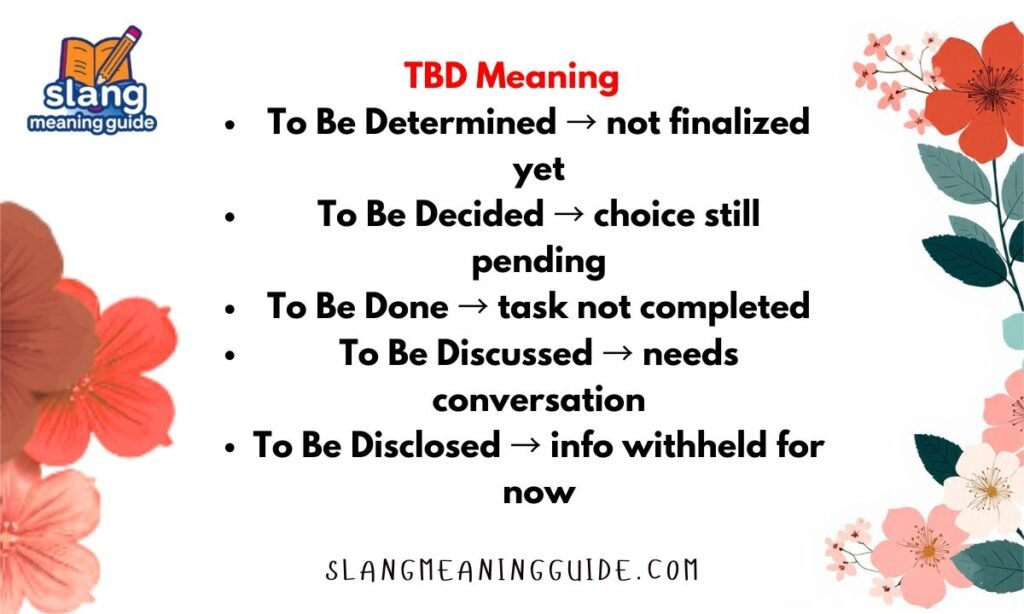
1. To Be Determined
This is the primary and most widely recognized meaning of TBD. It signals that a specific detail, like a date, venue, or outcome, has not yet been settled but will be confirmed later.
It acts as a placeholder, not a cancellation. The sender is telling you that the information exists in some form, just not in a final form yet.
- “The annual company retreat is confirmed for Q3, venue TBD.”
- “She told me she’s moving next month, exact date TBD.”
- “The match is scheduled for Saturday, kickoff time TBD.”
- “Job offer accepted, start date TBD pending HR confirmation.”
2. To Be Decided
This version is slightly more casual and implies that a choice still needs to be made by one or more people. It often points to a decision that is actively being discussed.
You see this more in personal conversations than in professional documents. It suggests that input or agreement is still being gathered before a final call is made.
- “Are you coming to the reunion? Still TBD, waiting on my brother.”
- “Menu for the party is TBD, we’re taking suggestions.”
- “Budget for the project is TBD until the client confirms scope.”
- “Whether we fly or drive is TBD, depends on ticket prices.”
3. To Be Done
Less common but still in active use, this version refers to a task or action that is pending. It shows up frequently in project management tools, task lists, and developer notes.
Think of it as a to-do item that has been acknowledged but not yet started or completed. It marks work that is on the radar but not in motion yet.
- “Campaign copy: TBD” on a shared content calendar.
- “Testing phase TBD after dev team completes core features.”
- “Speaker bio for the conference website is TBD.”
- “Terms and conditions page: TBD before launch.”
4. To Be Discussed
This interpretation comes up in meeting contexts, shared agendas, and collaborative planning. It signals that a topic has been flagged but needs a proper conversation before any decision is made.
While not the standard definition, it is used frequently enough in workplace settings that it is worth knowing. Context matters heavily here.
- “Q4 strategy: TBD at Thursday’s leadership sync.”
- “Pricing adjustment: TBD with the finance team next week.”
- “Partnership terms: TBD once legal reviews the draft.”
- “Team restructuring: TBD after performance reviews are done.”
5. To Be Disclosed
This version appears in formal and legal contexts, particularly when information exists but cannot be shared publicly or internally yet. It suggests that something is being withheld temporarily, not that it is unknown.
You might see this in contracts, press releases, or confidential documents where specific figures or names have not been cleared for sharing.
- “Acquisition price: TBD pending regulatory approval.”
- “Guest speaker for the summit: TBD due to contractual restrictions.”
- “Partner organization: TBD until the announcement is made official.”
- “Salary band for the role: TBD, subject to final board sign-off.”
Origin and Evolution Timeline
TBD did not start on social media. It has a much longer paper trail than most people realize, and its journey from formal documentation to everyday texting is a good example of how professional language bleeds into casual communication over time.
| Term | Estimated Origin | Platform Where It Blew Up | Current Status |
| To Be Determined | Early 1900s (academic/legal writing) | Corporate memos and printed schedules | Standard in professional and casual use |
| To Be Decided | Mid-20th century (planning docs) | Group chats and event planning apps | Common in informal and semi-formal use |
| To Be Done | 1980s–1990s (project management) | Tools like Asana, Trello, Jira | Widely used in tech and product teams |
| To Be Discussed | 2000s (digital meeting agendas) | Slack, Teams, email threads | Frequently used in workplace communication |
| To Be Disclosed | Corporate/legal (ongoing) | Contracts and press communications | Niche but active in formal writing |
Quick timeline breakdown:
- Early 1900s: “To be determined” appears in academic papers and legal documents to flag pending outcomes.
- 1970s–1980s: TBD enters sports schedules and TV listings when opponents or airings are not yet confirmed.
- 1990s: Project management software brings TBD into digital planning tools and corporate workflows.
- 2000s: SMS and email normalize TBD in everyday casual and semi-professional communication.
- 2010s–present: Social media, Slack, Discord, and TikTok push TBD into mainstream usage across all age groups and industries.
Common Misunderstandings
A lot of the confusion around TBD comes from people assuming it has one fixed meaning when it actually shifts based on context. The most widespread mistake is thinking TBD always means “To Be Discussed,” which is not its standard definition.
That interpretation makes logical sense in a meeting setting, but using it that way in a formal document or public announcement can create real confusion.
- TBD does not mean canceled. Plans labeled TBD are still happening; only a detail is missing.
- TBD is not the same as TBA. TBD means something is undecided, while TBA means it is decided but not yet publicly shared.
- TBD does not mean ignored. It signals that a follow-up is expected, not that the item has been dropped.
- TBD is not exclusively formal. It works in casual texting just as well as in a corporate calendar.
- TBD is not always about time. It can refer to locations, prices, people, decisions, or outcomes.
Formal vs. Informal Uses
TBD is one of the rare abbreviations that moves comfortably between professional documents and casual texting. The word itself does not change, but how you frame it around other text shifts the tone significantly.
Informal usage examples:
- “Weekend plans are TBD, let’s see how the weather looks.”
- “Which restaurant? Honestly TBD lol, open to suggestions.”
- “My schedule this week is TBD but I’ll hit you up.”
- “Costume for Halloween: TBD but definitely not basic.”
Formal usage examples:
- “The venue for the Q1 all-hands meeting is TBD pending facilities confirmation.”
- “Project kickoff date is TBD, subject to client approval of the proposal.”
- “Speaker lineup: TBD. Announcements will follow by end of month.”
- “Budget allocation for Phase 2 remains TBD at this stage.”
The core rule is simple. Use TBD freely in texts, DMs, and internal messages. In client-facing documents or public-facing content, spell it out as “to be determined” for clarity and professionalism.
Comparisons With Similar Abbreviations
TBD gets mixed up with several close relatives. Understanding the difference makes your communication more precise.
| Abbreviation | Full Form | Key Difference |
| TBD | To Be Determined | Something is undecided and still being worked out |
| TBA | To Be Announced | Something is decided but not yet publicly revealed |
| TBC | To Be Confirmed | Something is likely decided, awaiting final verification |
| WIP | Work In Progress | A task is actively being worked on, not pending |
| Pending | Pending | Formal word for awaiting action; no time frame implied |
| ASAP | As Soon As Possible | Signals urgency; opposite energy to TBD |
The simplest way to remember the difference: TBD means no decision yet, TBA means a decision exists but is being held back, and TBC means a decision is close to final but needs one more confirmation.
Frequently Asked Questions
1. What does TBD mean in a text message?
It means “To Be Determined” and signals that a detail has not been decided yet.
2. Is TBD appropriate to use in a professional email?
Yes, especially in internal communication, but spell it out in formal or client-facing documents.
3. What is the difference between TBD and TBA?
TBD means undecided; TBA means decided but not yet publicly announced.
4. Can TBD mean “To Be Discussed”?
Informally yes, but the standard meaning remains “To Be Determined” or “To Be Decided.”
5. How should I respond when someone sends TBD?
Acknowledge it and ask for a timeline if the detail affects your plans.
Conclusion
TBD is three letters doing a lot of heavy lifting across texts, emails, calendars, and social media every single day. Once you understand its core meanings, the subtle differences between its variations, and when to use each one, you will read and write it with far more confidence. It is not just an abbreviation, it is a communication tool that tells people you are aware, accountable, and planning to follow through.