
Shakira blamed monotony for the end of her relationship — and millions instantly understood. The word “monotonía” went viral overnight because it named something everyone has felt but rarely said out loud. This guide breaks down the full monotonia meaning — in English, Spanish, music, psychology, and real life.
What Is the Meaning of Monotonia?
Monotonía (also spelled monotonia) is a Spanish word with a direct English translation: monotony. It refers to a state of dullness, sameness, or lack of variety in experiences, routines, or environments.
The word comes from two ancient Greek roots:
- “monos” — meaning single or alone
- “tonos” — meaning tone or sound
Originally it described a single musical note held without variation. Over centuries, the meaning expanded to cover emotional, psychological, and social repetition in everyday life.
Monotonia Meaning in English: Core Definition
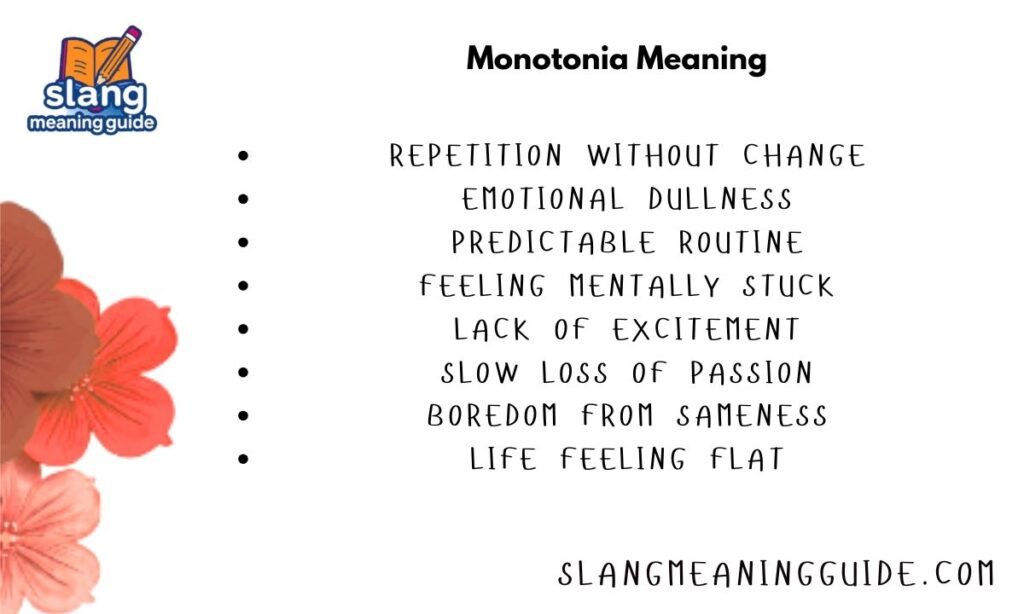
The monotonia meaning in English centers on one core idea — repetition without meaningful change. It describes the feeling when life becomes predictable, flat, and emotionally uninspiring.
Simple ways to understand monotonía in English:
- Repetition — the same experiences cycling over and over
- Lack of variety — little change in routine, environment, or emotion
- Emotional flatness — feeling bored, disengaged, or mentally numb
- Predictable patterns — knowing exactly what comes next, every single day
- Tedium — a dragging sense that time is not moving or changing
In short: monotonia meaning in English = monotony, tedium, sameness, or dullness.
Monotonia Meaning in Spanish: La Monotonía Explained
In Spanish, la monotonía is defined by the Diccionario de la Real Academia Española as: “lack of variety in anything.” It is a feminine noun used widely in everyday speech across Latin America and Spain.
How La Monotonía Is Used in Spanish
In spoken Spanish, la monotonía appears in personal conversation, literature, and music. It captures feelings that are difficult to express with simpler words.
Common Spanish uses of la monotonía:
- “La monotonía del trabajo” — the monotony of work
- “Romper la monotonía” — to break the monotony
- “La monotonía apaga la vida” — monotony extinguishes life
- “Vivir en la monotonía” — to live in monotony
- “Salir de la monotonía” — to escape the monotony
Meaning of Monotonia in Spanish vs English
| Spanish Term | English Equivalent | Nuance |
| La monotonía | Monotony | Exact translation — feeling of sameness |
| El aburrimiento | Boredom | Emotional reaction to monotonía |
| La rutina | Routine | Daily pattern — can be positive or negative |
| La repetición | Repetition | The act of repeating — neutral term |
| El tedio | Tedium | A deeper, heavier form of monotonía |
Monotonia Meaning in English Synonyms
Several English words carry similar meanings to monotonía. Knowing the synonyms helps you understand the word’s full emotional range.
Best English synonyms for monotonía:
- Monotony — the direct translation and closest match
- Tedium — heavier, more draining feeling of sameness
- Dullness — lack of excitement or stimulation
- Sameness — continuous repetition without variety
- Uniformity — everything appearing identical
- Repetitiveness — the quality of repeating endlessly
- Humdrum — informal term for a dull, uneventful routine
- Dreariness — a gloomy, grey feeling of unchanging routine
- Flatness — emotional lack of highs or lows
Key insight: Monotony describes the situation. Boredom describes the emotional response to that situation. They are related but distinct.
Monotony Meaning in Hindi: एकरसता
For Hindi speakers, monotony translates to एकरसता (ekarasata) — literally meaning “the state of one flavor” or “same-tasting experience.”
Related Hindi concepts:
- एकरसता (ekarasata) — monotony, sameness
- नीरसता (neerasata) — dullness, lack of interest
- ऊब (oob) — boredom, the feeling caused by monotony
- दिनचर्या (dinicharya) — daily routine (neutral or positive)
- थकान (thakan) — fatigue, sometimes caused by prolonged monotony
In Hindi-speaking cultures, monotony is often framed as something to overcome through devotion, creativity, or community rather than something to simply escape.
Monotonia Meaning: Shakira Song Explained
The word “monotonía” became globally searched after Shakira used it as a song title in October 2022. The release instantly sparked millions of searches worldwide.
Shakira Monotonia Song: Background and Release
Shakira released “Monotonía” on October 19, 2022, featuring Puerto Rican singer Ozuna. The song was her second single following her split with footballer Gerard Piqué, released after “Te Felicito.”
Key facts about the Shakira Monotonía song:
- Genre: Bachata
- Album: Las Mujeres Ya No Lloran (released March 2024)
- Label: Sony Music Latin
- Music video views: Over 14 million in the first 10 hours on YouTube
- Chart performance: Reached #3 on Billboard’s Hot Latin Songs; #18 on the Billboard Global 200
- Recorded at: A2F Studios, Miami
Shakira Monotonia Lyrics Meaning
Shakira’s lyrics tell the story of a love that did not end through betrayal or anger — it ended through slow, quiet sameness. The phrase “Fue culpa de la monotonía” (It was monotony’s fault) was teased across social media before the release as a multi-part cryptic message.
The Shakira monotonia lyrics meaning, line by line in concept:
- “No fue culpa tuya, ni tampoco mía” — It wasn’t your fault, nor mine
- “Fue culpa de la monotonía” — It was monotony’s fault
- “Nunca dije nada, pero me dolía” — I never said anything, but it hurt
- “Yo sabía que esto pasaría” — I knew this would happen
The song captures a deeply relatable emotional truth: relationships sometimes end not because of a dramatic event, but because nothing happened at all. The monotonía — the sameness — slowly killed the love.
Ozuna Monotonia Meaning: A Different Perspective
Ozuna’s version of “Monotonia” is a separate song by the Puerto Rican singer and carries a different emotional story. In his song, Ozuna reflects on grief after losing a loved one.
The Ozuna monotonia meaning centers on:
- “Mi vida ahora se basa en la monotonía” — My life is now based on monotony
- His mind replays memories of someone who is gone
- He cannot move forward despite time passing
- He imagines a place where they can be reunited — free from pain
The Ozuna monotonía meaning is therefore about grief-driven monotony — when life feels grey and purposeless after loss. It is a more melancholic reading of the same word.
Monotonia Meaning Song: Key Differences Between the Two Songs
Both songs use the same word but express completely different emotional experiences. Understanding both deepens your understanding of what monotonía can mean.
- Shakira’s Monotonía — about a romantic relationship dying through slow emotional stagnation; acceptance and moving on
- Ozuna’s Monotonía — about grief and loss; life becoming grey and repetitive after losing someone beloved
- Shared theme: Both artists express that monotony is not passive — it actively destroys something precious
Monotonia Meaning Slang: Modern Usage
In modern slang, especially across Spanish-speaking social media platforms, “monotonía” has taken on everyday casual uses far beyond its formal definition.
Common slang uses of monotonía in 2026:
- “Estoy en modo monotonía” — I’m in monotony mode (feeling stuck and bored)
- “Esta semana fue pura monotonía” — This week was pure monotony
- “Rompamos la monotonía” — Let’s break the monotony (call to do something spontaneous)
- “La monotonía me está matando” — The monotony is killing me (dramatic expression of boredom)
On TikTok and Instagram, the hashtag #monotonia and #lamonotonia frequently appear in content about burnout, repetitive routines, and calls for lifestyle change. The Shakira song turbo-charged this usage in 2022 and it has remained part of everyday digital vocabulary.
Monotonia Es Un Asesino Lento: What This Phrase Means
“La monotonía es un asesino lento” translates to “Monotony is a slow killer.” This phrase appears frequently in Spanish-language literature, motivational content, and social media.
It carries a powerful meaning:
- Monotony does not destroy instantly
- It erodes motivation, passion, creativity, and joy gradually
- People often do not notice until significant damage is done
- It applies to relationships, careers, creative work, and mental health
This phrase aligns with psychological research showing that prolonged monotony reduces dopamine activity in the brain’s reward system — gradually draining motivation and engagement.
Rompiendo la Monotonia del Tiempo: Breaking Time’s Monotony
“Rompiendo la monotonía del tiempo” means “breaking the monotony of time.” This poetic Spanish phrase appears in literature and music to describe moments that make time feel alive again.
It captures the idea that time without variety feels slow, grey, and heavy. When something new or meaningful happens, it “breaks” the flat passage of time and makes life feel real again.
Ways people break the monotonía del tiempo:
- Travel — new environments reset the brain’s sense of time
- Creative projects — art, writing, or music create new neural pathways
- New relationships — fresh human connection revives emotional engagement
- Learning — new skills and knowledge challenge the mind productively
- Spontaneous decisions — unplanned actions introduce genuine novelty
Monotonia Meaning and Examples: Real-Life Contexts
The monotonia meaning shifts slightly depending on where it appears. Recognizing these contexts helps you understand the word’s full range.
Monotonia in Personal Life
Monotony in personal life appears when daily routines follow an identical pattern for long periods. It is not laziness — it is the absence of meaningful variety.
Personal monotonia examples:
- Waking, commuting, working, eating, sleeping — same cycle every day
- Living in the same physical environment for years without change
- Socializing with the same small group in the same settings
- Consuming the same type of content, food, or entertainment daily
Monotonia in Relationships
Relationship monotonia is one of the most emotionally costly forms. It does not announce itself loudly — it sneaks in quietly and erodes connection over time.
Signs of monotonia in a relationship:
- Conversations becoming predictable and surface-level
- Shared experiences disappearing from the routine
- Physical and emotional affection becoming mechanical
- Excitement or curiosity about the other person fading quietly
- Feeling more like roommates than romantic partners
This is precisely what Shakira describes in her song — not cheating, not fighting — just the slow death of feeling anything new together.
Monotonia in the Workplace
Work-related monotonia is among the most common complaints across industries. Repetitive tasks, fixed environments, and limited growth opportunities all contribute.
Workplace monotonia signs:
- Doing identical tasks with no creative input
- No skill development or new challenges offered
- Knowing exactly how every workday will unfold
- Reduced motivation despite adequate pay
- Clock-watching becoming the dominant workday activity
Companies that address workplace monotonia through:
- Task rotation and cross-training
- Creative collaboration opportunities
- Clear career progression pathways
- Flexible environments and autonomy
see measurable improvements in both productivity and employee retention.
Monotonia in Digital Life
Digital monotonia is a modern, fast-growing phenomenon. Scrolling through repetitive social media content, watching the same content formats, and consuming identical trending material all create a digital version of monotonía.
Signs of digital monotonia:
- Opening apps without intention and feeling no satisfaction
- Content feeling repetitive despite thousands of options
- Scrolling for long periods without stopping at anything meaningful
- Creators posting identical formats to chase algorithms
La Monotonia Meaning in Different Cultural Perspectives
How people experience and interpret la monotonía varies significantly across cultures — just as the provided reference notes.
Western cultures — tend to view monotonía as something to actively overcome; productivity and personal growth culture push against routine
Eastern traditions — embrace certain forms of repetition as a path to mastery; martial arts, meditation, and spiritual practice use structured repetition intentionally
Latin cultures — music, community, festivals, and social connection are the primary tools for breaking monotonía, as reflected in Shakira’s bachata treatment of the theme
Middle Eastern traditions — daily routine is often respected as stability and dedication; monotonía is not always seen as negative
South Asian perspectives — the concept of एकरसता in Hindi suggests that monotony can be addressed through devotion, ritual, and community rather than escapism
Frequently Asked Questions
What does monotonia mean in simple words?
Monotonia means a state where life feels repetitive, dull, and lacking variety — whether in relationships, work, or daily routine.
What is the Shakira monotonia meaning in the song?
Shakira uses monotonía to describe how her relationship with Gerard Piqué died through slow emotional sameness rather than a dramatic event.
What is monotonia meaning in English synonyms?
The best English synonyms for monotonía are monotony, tedium, dullness, sameness, dreariness, and humdrum.
What does “la monotonía es un asesino lento” mean?
It means “monotony is a slow killer” — expressing how repetitive patterns gradually destroy motivation, passion, and joy over time.
What is the Ozuna monotonia meaning compared to Shakira’s?
Ozuna’s monotonía is about grief and loss — life becoming grey and purposeless after losing someone — while Shakira’s is about a relationship dying through emotional stagnation.
Conclusion
The monotonia meaning carries far more emotional weight than a simple dictionary entry suggests — it captures the slow erosion of love, motivation, creativity, and aliveness that happens when life stops changing.
Whether you encountered the word through Shakira’s viral bachata, through Spanish class, or through your own quiet feeling of sameness, the concept speaks to a universal human experience. Understanding la monotonía is the first step toward breaking it — intentionally, creatively, and before it does its slow damage.