
It sounds like a made-up word. It sounds like a scientific field. And thanks to one 2023 pop song, it suddenly sounds like a cultural battle cry. Before you look it up anywhere else, here’s what you actually need to know.
What Does Nymphology Mean?
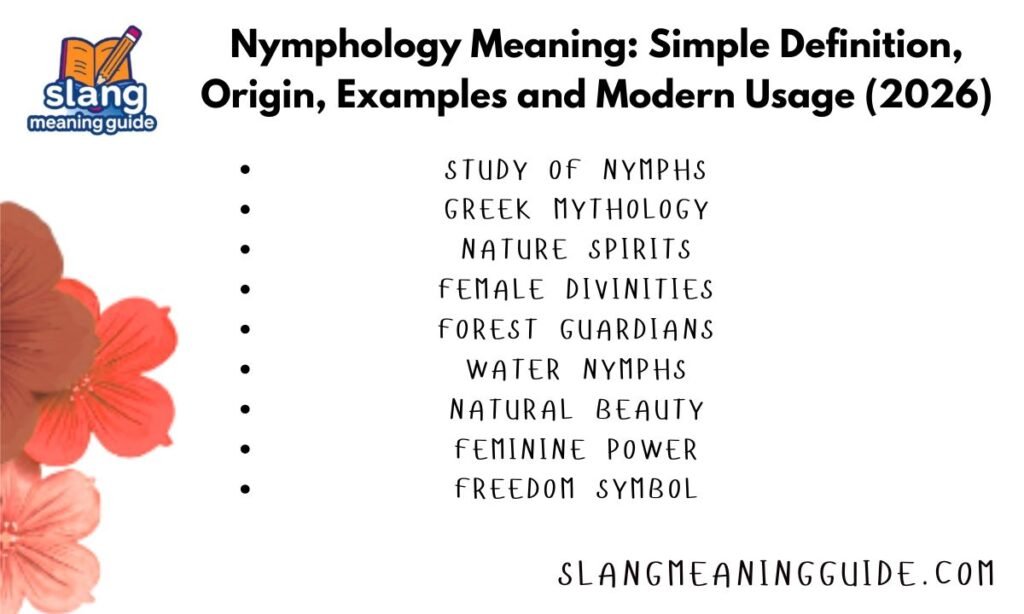
Nymphology has two lives — one ancient, one modern. In its classical sense, it refers to the academic study of nymphs in Greek and Roman mythology. In its modern pop-culture sense, it’s a term reclaimed and weaponized by Melanie Martinez in her 2023 track to push back against how society boxes in femme-presenting people.
- Classical meaning: The study of nymphs — mythological female nature spirits in ancient Greek and Roman traditions
- Academic use: Appears in mythology studies, classical literature, and cultural history
- Modern use: Popularized as a commentary on femininity, identity, and objectification
- Key distinction: It is not the same as nymphomania — a completely different and outdated clinical term
Simple Definition
Break the word down and it becomes obvious:
- Nymph = a mythological female spirit from Greek tradition
- -ology = the study of something (from Greek logia)
- Nymphology = the study of nymphs
That’s the dictionary-level answer. In practice, the word carries more weight depending on who’s using it and why.
What Is a Nymph?
In ancient mythology, a nymph is a minor female divinity — not a goddess, but a spiritual being tied to specific places in the natural world.
- Dryads — spirits of trees and forests
- Naiads — spirits of rivers, lakes, and springs
- Oreads — spirits of mountains and caves
- Nereids — sea maidens, daughters of the sea god Nereus
- Limnades — spirits of freshwater lakes
Nymphs were:
- Beautiful, young, and graceful in all ancient descriptions
- Tied to a specific location — they were essentially the life-force of that place
- Mortal in some myths, immortal in others
- Sometimes entangled in stories with gods, heroes, and mortals
- Symbols of nature’s beauty, fertility, and wildness
Origin and History of Nymphology
Word Origin
The word pulls directly from ancient Greek:
- “nymphē” — meaning “bride,” “young woman,” or a nature spirit
- “-logia” — meaning “the study of”
- The compound entered formal English through classical and Latin scholarship
- It appeared in early academic writing about Greek religion and mythology
- Rare in everyday language — it belongs mostly to literary and scholarly circles
Historical Background
How the word evolved through time:
Ancient Greece: Nymphs were taken seriously as minor deities — farmers left offerings at springs and rivers to honor them
Roman period: The tradition carried forward, with Latin scholars cataloguing different nymph types in their writings
Medieval Europe: Nymph mythology survived through poetry, art, and classical education
Renaissance: Artists and poets revived nymph imagery heavily — think paintings of nymphs in forest streams
19th century: Classical mythology scholarship gave nymphology more formal academic footing
2023: Melanie Martinez dropped the track NYMPHOLOGY on her album PORTALS, and the word entered mainstream conversation overnight
Understanding Nymphs in Mythology
Nymph mythology is richer and more layered than most people realize.
Key things scholars study in nymphology:
- The origin stories of different nymph classes
- How nymphs interact with major Olympian gods (Apollo, Artemis, Dionysus)
- The role of nymphs as symbols of natural forces and seasonal cycles
- How nymph worship connected ancient people to the land
- The transition of nymph figures from religion into literature and art
- Gender politics embedded in how ancient cultures portrayed nymphs
- How nymph mythology was recycled into Renaissance painting and Romantic poetry
Real-Life Examples of Nymphology
Even a rare word shows up in real sentences when the context is right.
Example 1: “Her academic paper examined nymphology through a feminist lens, arguing that nymph figures in ancient texts often served male narrative purposes.”
Explanation: A scholarly use — studying how nymph mythology reflects gender power dynamics.
Example 2: “The fantasy novel drew heavily from nymphology, populating its forest with distinct nymph types each tied to a different natural element.”
Explanation: A creative writing use — using mythology as world-building material.
Example 3: “After hearing the song, she went down a rabbit hole of nymphology and ended up reading about Dryads for two hours.”
Explanation: The most common modern use — pop culture sparking genuine curiosity about the word’s roots.
Short Dialogues Using Nymphology
Dialogue 1: In a Classroom
Student: “Professor, is nymphology an actual field of study?” Professor: “It’s a niche area within classical mythology and folklore studies — not its own department, but a recognized area of research.” Student: “So it’s basically the mythology of nature spirits?” Professor: “Exactly. Greek and Roman nature spirits, their classifications, and their roles in ancient culture.”
Dialogue 2: In a Book Club
Maya: “This book keeps referencing nymphology. What does that actually mean?” Jordan: “It’s the study of nymphs — those nature spirit figures from ancient Greece.” Maya: “Oh, so not a modern thing at all?” Jordan: “Ancient concept, but the Melanie Martinez song made people look it up again.”
Dialogue 3: Online Discussion
User1: “Is nymphology even a real word or did Melanie make it up?” User2: “It’s real. The study of mythological nymphs. She used it as commentary on how society treats women.” User1: “Honestly that makes the lyrics hit differently now.”
Personality Traits Linked to Nymphology Interest
People drawn to nymphology — whether academically or culturally — tend to share a few common traits:
- Love for classical mythology — Greek and Roman stories feel alive to them, not just old
- Interest in gender studies or feminist theory — especially in the context of the Martinez song
- Creative and artistic orientation — nymph imagery shows up heavily in visual art, poetry, and fashion
- Connection to nature — nymph lore is fundamentally about the natural world as a living, spiritual place
- Curiosity about language — they’re the type to look up where a word comes from
- Appreciation for symbolism — comfortable holding multiple meanings of the same word at once
Modern Usage of Nymphology (Updated for 2026)
1. Academic Writing
Nymphology appears in:
- Classical studies journals analyzing Greek and Roman religion
- Feminist literary criticism examining how female nature spirits are portrayed
- Art history papers on Renaissance paintings featuring nymph subjects
- Mythology textbooks covering minor divinities
2. Fantasy Literature
Writers use nymphology as:
- A worldbuilding framework for elemental spirits
- A source for character archetypes in high fantasy
- A way to give depth to female supernatural characters beyond “just magic”
3. Social Media (Rare but Creative)
How it shows up online in 2026:
- Aesthetic accounts using “nymph-coded” imagery reference the concept
- Mythology TikTok creators explaining the word after it trended post-Martinez
- Book reviewers tagging mythology-heavy fiction with nymphology themes
- Art accounts using nymph mythology as visual storytelling
4. Artistic Branding
Artists and creators use nymphology themes in:
- Jewelry design inspired by Naiad and Dryad imagery
- Eco-fashion collections referencing natural spirits
- Album aesthetics and visual art tied to feminine nature symbolism
- Poetry collections exploring identity through mythological figures
Common Mistakes and Misconceptions
Mistake 1: Confusing It with “Nymphomania”
This is the most common error — and the most important to correct.
- Nymphology = the study of mythological nymphs (classical, academic, literary)
- Nymphomania = an outdated and now-rejected clinical term from the 19th century
- They share the root “nymph” but mean completely different things
- Using them interchangeably shows a misunderstanding of both terms
Mistake 2: Thinking It Is a Science
Nymphology is not a natural science:
- It does not study real living organisms
- It belongs to the humanities — mythology, literary studies, classical history
- You won’t find a nymphology lab or a biology department using the term
- It’s interpretive and cultural, not empirical
Mistake 3: Believing Nymphs Are Fairies
Nymphs and fairies are distinct:
- Nymphs come from ancient Greek and Roman mythology — they are place-bound nature spirits
- Fairies come primarily from Celtic and European folklore — a different tradition entirely
- They share some surface characteristics (small, female, magical) but have different origins and roles
- Mixing them up flattens the specific cultural history of both traditions
When Should You Use the Word Nymphology?
Good contexts:
- Academic essays on Greek mythology
- Fantasy fiction involving nature spirits
- Literary analysis of Romantic-era art or poetry
- Music criticism or cultural commentary on the Martinez song
- Conversations about classical studies or feminist mythology scholarship
Contexts to avoid:
- Casual texting — too rare and formal
- Professional emails — will confuse most readers
- General conversation — requires a lot of context to land correctly
Comparison: Nymphology vs Mythology
| Term | Meaning | Scope | Common Use |
| Mythology | The study of myths broadly | Wide — all cultures, all myth types | Very common |
| Nymphology | The study of nymphs specifically | Narrow — Greek/Roman nature spirits | Rare, academic |
Nymphology is a small, specific branch inside the larger field of mythology — like how ornithology sits inside biology.
Symbolic Meaning in Literature
When modern writers invoke nymphology themes, they’re usually reaching for specific symbolic ideas:
- Freedom — nymphs live outside human society, answerable to no one
- Wildness — they represent nature before it was tamed or named
- Feminine power — they hold authority over specific natural domains
- Transformation — many nymph myths involve shapeshifting or metamorphosis
- Forgotten knowledge — nature has wisdom human civilization has abandoned
Writers use nymph figures to say things about the natural world, femininity, and freedom that straightforward language can’t quite reach.
Cultural Importance of Nymphs
Why ancient people took nymphs seriously:
- Nymphs were considered the living essence of rivers, springs, and forests — not metaphors, but actual presences
- Farmers left offerings at water sources to honor Naiads, hoping for fertile land and safe passage
- Travelers respected mountain Oreads on long journeys
- Nymph worship was practical — it built a relationship between human communities and the natural world
- When ancient societies documented and studied nymph lore, they were preserving a system of ecological and spiritual knowledge
Nymphology Meaning in Melanie Martinez’s Song
Martinez didn’t just use the word — she redefined it for a generation.
Her stated intent for the track:
- She wanted to critique the “manic pixie dream girl” trope — the idea that quirky, femme-presenting people exist to serve and uplift men
- The chorus — “It’s nymphology, not psychology” — draws a hard line between being treated as a mythological fantasy and being respected as a real, psychologically complex person
- She pushes back against being forced into roles of “mom, healer, muse” while being dismissed as “crazy” for having needs
- The line “you can’t even spell but you’re an expert in nymphology” mocks people who claim to understand and define women while actually knowing nothing about their inner experience
- She references Sotheby’s — the fine art auction house — to critique how women’s identities get commodified
Key themes in the song:
- Rejection of objectification and reductive labels
- Pushback against emotional labor being extracted from women
- Reclaiming nymph imagery as an identity of power, not servitude
- The distinction between a fantasy projection and a real human being
How Nymphology Connects to Modern Environmental Ideas
An underexplored angle: nymph mythology actually anticipates modern environmental thinking.
- Ancient nymph worship built respect for specific natural places — rivers, forests, springs
- That place-based reverence mirrors modern conservation ethics
- Eco-feminism — the connection between the oppression of women and the exploitation of nature — maps closely onto how nymph figures were both revered and used in ancient stories
- Writers like Ursula K. Le Guin and contemporary eco-poets have drawn on nymph mythology to explore humanity’s fractured relationship with the natural world
- The Martinez song, read carefully, touches this too — the nymph figure as something wild and powerful that society tries to contain and define
How to Remember the Meaning Easily
Simple memory trick:
- Nymph = mythological nature spirit
- -ology = study of
- Nymphology = the study of mythological nature spirits
You already know the -ology pattern from biology, psychology, and sociology. Apply the same logic and the word sticks immediately.
Frequently Asked Questions
Is nymphology a real word?
Yes — it refers to the academic study of nymphs in classical mythology, though it rarely appears outside scholarly or literary contexts.
Did Melanie Martinez invent the word nymphology?
No — the word predates her, but she popularized it and gave it a new feminist meaning through her 2023 song on the PORTALS album.
What is the difference between nymphology and nymphomania?
Nymphology studies mythological nature spirits; nymphomania was an outdated and now-rejected 19th-century medical label — they are completely unrelated.
Are nymphs the same as fairies?
No — nymphs come from Greek and Roman mythology while fairies originate in Celtic and Northern European folklore, making them distinct cultural traditions.
Why did people suddenly search for nymphology in 2023?
Melanie Martinez released the track NYMPHOLOGY as part of her album PORTALS in March 2023, driving a massive surge in searches for the word’s definition and history.
Key Takeaways
- Nymphology = the study of nymphs in Greek and Roman mythology
- It is a rare, mostly academic word outside of modern pop culture
- Melanie Martinez used it as feminist commentary in her 2023 song
- It is not related to nymphomania — that is a separate and outdated term
- Nymphs were place-bound nature spirits tied to forests, rivers, mountains, and seas
- The word carries both classical scholarly meaning and modern cultural weight
Conclusion
Nymphology is one of those words that quietly existed for centuries before a single song sent millions of people searching for it. At its core, it’s about studying the female nature spirits that ancient Greek and Roman culture used to explain the living world around them — and about what those figures symbolize when artists pick them back up today.
Whether you encounter it in an academic paper, a fantasy novel, or a Melanie Martinez lyric, understanding the word’s full history makes it a lot more interesting than a dictionary definition ever could.