
You typed it fast. Spell-check flagged it. Now you’re second-guessing yourself. This happens to native speakers, ESL learners, and even professional writers. The answer is simple — but the reason why is worth knowing so you never get it wrong again.
What Does “Absence” Mean?
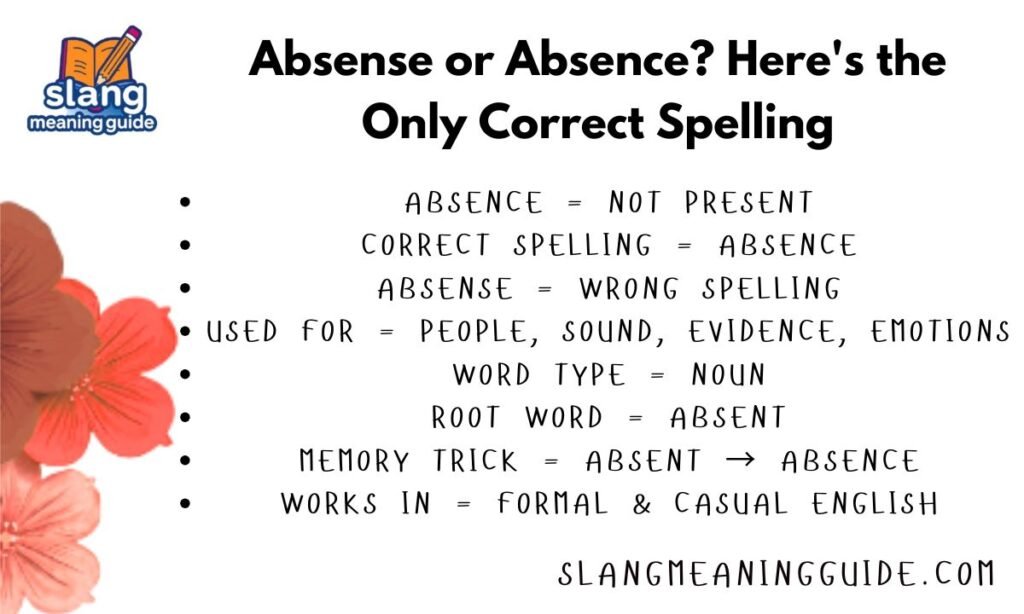
Absence is a noun. It means the state of not being present — whether that’s a person, a thing, or even a quality like sound or evidence.
The word covers three broad ideas:
- Physical absence — someone not showing up
- Absence of a thing — something expected that isn’t there
- A period of being away — a span of time someone was gone
Real-World Examples
- His absence from the meeting was noticed immediately.
- She sent an email to explain her absence from class.
- There was a complete absence of noise in the building.
- He returned to work after a three-week absence.
Each sentence uses absence the same way: to describe something or someone that should be there but isn’t.
Is “Absense” a Word?
No. Absense is not a real English word.
It has no definition, no dictionary entry, and no historical root. It is a spelling error — nothing more.
People write it because the word sounds like it ends in “-sense.” Say it out loud: AB-sens. That final sound tricks the brain into writing an “s” where a “c” belongs.
But the correct ending is -ence, not -ense.
Quick Answer: Absence vs Absense
| Absence | Absense | |
| Correct? | ✅ Yes | ❌ No |
| Real word? | Yes | No |
| Meaning | Not being present | None |
| Part of speech | Noun | Not valid |
| Ending | -ence | Incorrect |
| Use in writing | Always | Never |
Rule to remember: Absent → Absence. The root never changes, and neither does the ending.
Read Must: Yoloswag Meaning Slang: The Internet Era’s Boldest Battle Cry
Origin and Evolution of “Absence”
Understanding where a word comes from makes it easier to remember how to spell it.
Origin + Evolution Timeline
| Period | What Happened |
| Classical Latin | Word existed as absentia — meaning “being away” |
| Old French (13th century) | Became absence in written French |
| Middle English (14th century) | Entered English writing with the same spelling |
| Modern English | Standardized as absence, used in formal and informal contexts |
| Digital Age | “Absense” emerged as a common typo in search engines and social media |
Key milestones:
- Latin absentia gave English both “absent” and “absence”
- The “-ence” suffix was already established in English from similar Latin-origin words
- Absense never appeared in any recognized dictionary at any point in history
- Today it shows up in Google searches because people type it wrong and want to know the correct spelling
“Yoloswag” and Living Without Fear — When Absence Becomes a Mindset
Here’s where it gets interesting.
In internet culture, slang like yoloswag — the mashup of “YOLO” (you only live once) and “swag” — captures a carefree attitude. Living without worry. Not overthinking. Moving through life unbothered.
In that spirit, there’s something almost poetic about the word absence.
To live without fear is to embrace the absence of anxiety. To love without condition is to accept the absence of control. And To enjoy the moment is to sit in the absence of regret.
The word isn’t just about someone not showing up to a meeting. It carries weight. Writers use it to describe emotional voids, missing people, lost time.
That’s why getting it right matters. When you use absence correctly, your writing carries the full force of the word.
Common Misunderstandings About “Absence”
People get confused about more than just the spelling.
Misunderstanding 1: “Absense” is an alternate spelling It is not. There is no regional variant, no British vs. American difference. Absence is spelled the same in every form of English.
Misunderstanding 2: It only refers to people Wrong. You can have an absence of sound, an absence of evidence, an absence of leadership. It applies to anything missing.
Misunderstanding 3: “Absent” and “absence” work the same way grammatically They don’t. Absent is an adjective or verb. Absence is a noun.
- He is absent today. (adjective)
- His absence was noted. (noun)
Misunderstanding 4: “Abscence” is another valid spelling No. Abscence is also wrong. The only correct form is absence.
Formal vs. Informal Uses of “Absence”
The word works across every context — from text messages to legal documents.
Formal Uses
In professional and academic writing, absence shows up constantly:
- Workplace: “Please submit a reason for your absence before Friday.”
- Legal: “The absence of a signed contract voids the agreement.”
- Medical: “The patient showed an absence of reflexes in the left knee.”
- Academic: “Three unexcused absences will affect your final grade.”
Informal Uses
In casual conversation, the word is just as natural:
- “I noticed your absence at the party last night.”
- “There was a total absence of chill in that argument.”
- “His absence really changed the vibe of the group.”
- “She’s been thriving in his absence, honestly.”
The word never feels out of place — formal or casual, it carries well.
How to Never Misspell “Absence” Again
Three memory tricks that actually work:
Trick 1: Root word method Absent → Absence. The word “absent” is your anchor. You’d never spell it “absEnt,” so don’t add an extra “s” when you turn it into a noun.
Trick 2: Pattern matching Think of similar words: presence, silence, evidence. They all end in -ence. Absence fits the same pattern.
Trick 3: The “c” reminder “Even though it doesn’t make much sense, absence has a c in it.” That small joke encodes the rule into memory surprisingly well.
Frequently Asked Questions
Is “absense” ever correct?
No — absense is always a spelling mistake. The only correct form is absence.
What does absence mean in simple terms?
It means someone or something is not present where they should be.
How do you pronounce “absence”?
It’s pronounced AB-sens — three syllables, with stress on the first.
Can absence describe a thing, not just a person?
Yes. You can have an absence of evidence, sound, leadership, or emotion.
What is a “leave of absence”?
It’s formal permission to be away from work or school for a set period of time.
Conclusion
The difference between absence and absense is simple: one is a real word, one is a typo.
Absence — always, in every context, in every form of English.
The easiest way to lock it in: remember that absent is the root. Just add “-ce” and you’re done. No guessing, no second-checking, no getting flagged by spell-check again.
Get this one right and your writing gets a little sharper — whether you’re drafting a professional email, submitting an essay, or just texting someone about why you didn’t show up last night.