
You have typed this word thousands of times, but are you sure you are spelling it right? One version appears in every dictionary on earth. The other simply does not exist. The answer is clearer than you think, and it matters more than you realize.
The Short Answer: Is It Messege or Message?
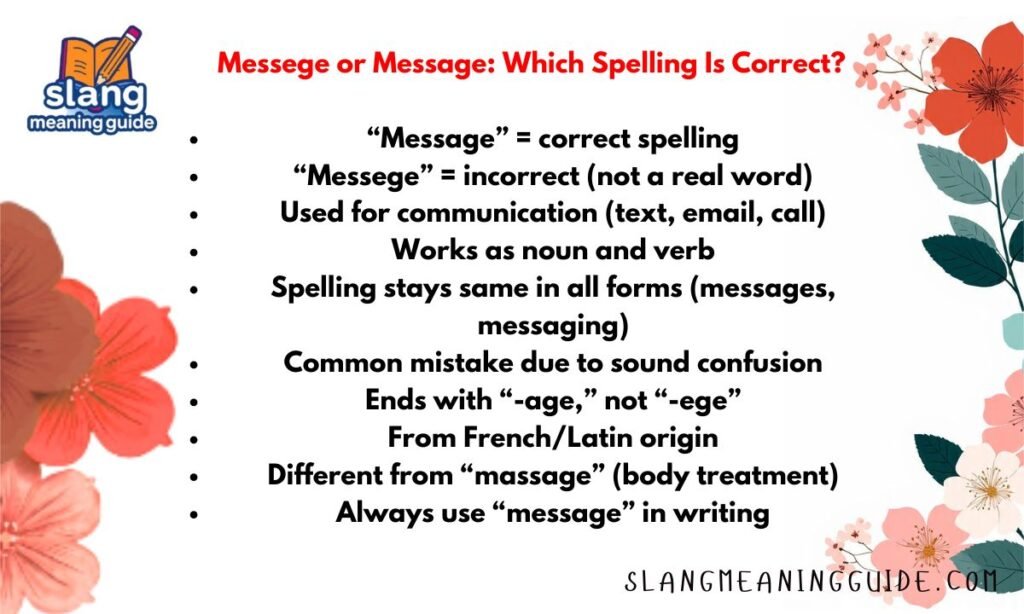
“Message” is the only correct spelling. “Messege” is not a real word. It has no dictionary entry, no accepted usage, and no standard place in written English.
This is not a matter of British versus American spelling, formal versus informal style, or old versus modern usage. It is simply a misspelling.
Why “Messege” Is Not a Word
“Messege” fails every test of standard English. No major dictionary lists it. No grammar guide accepts it. And No style manual acknowledges it as a valid variant. It does not appear in historical texts, academic writing, legal documents, or any published source as an intentional form.
Writers who use “messege” are making a spelling error, not a stylistic choice. The error is understandable because of how the word sounds when spoken aloud.
But understanding why it happens is different from accepting it as correct. It is always wrong, in every context, without exception.
Where the Confusion Comes From
The “a” in “message” does not sound like a typical short “a.” It sounds closer to an “i” or a soft “e.” Think of how you pronounce “luggage,” “postage,” and “baggage.” All of them end in “-age,” yet none sound like the letter “a” in “cat.”
That mismatch between sound and spelling is what drives the mistake. People hear “mess-ij” and assume the vowel in the middle must be an “e.”
English spelling is not purely phonetic, and “message” is a perfect example of that. The origin is Old French and Latin, which is why the spelling follows older conventions rather than modern sound rules.
What “Message” Actually Means
“Message” is a noun and a verb. It has three clear uses in modern English. Each one is common, well-established, and widely understood across every English-speaking country.
The word covers communication in all its forms — written, spoken, digital, and everything in between.
Message as a Noun
As a noun, “message” refers to a piece of information sent from one person to another. That could be a text, an email, a voicemail, a handwritten note, or a social media post. The word covers every channel of communication in one simple, clean term.
It also carries a broader meaning in media and literature. A film or book can have “a message” — a central idea or theme the creator wants the audience to understand.
In this sense, the word goes beyond communication and touches on meaning, intent, and purpose.
Message as a Verb
“Message” works as a verb too. You can message someone, meaning you send them a communication directly. This usage has grown dramatically with the rise of digital platforms.
“I messaged her yesterday” or “Message me when you land” are both completely standard in modern English. The verb form follows the same conjugation rules as any regular English verb. “Messages” is the third-person singular.
“Messaged” is the past tense. “Messaging” is the present participle. All of these forms use the same correct base spelling: message, never messege.
Message vs. Messege: A Direct Comparison
| Feature | Message | Messege |
| Dictionary listing | Yes | No |
| Correct spelling | Yes | No |
| Works as noun | Yes | No |
| Works as verb | Yes | No |
| Accepted professionally | Yes | No |
| Accepted academically | Yes | No |
| Etymology | Old French / Latin | None |
Message vs. Massage: A Separate Confusion
Some people confuse “message” with “massage.” These are two completely different words with completely different meanings. Mixing them up causes a very different kind of error.
One word describes communication. The other describes a physical treatment. Using the wrong one can create genuine misunderstanding.
What “Massage” Means
A massage is the act of applying pressure to muscles and soft tissue, typically to relieve tension or pain. A person who performs this professionally is a masseuse (female) or masseur (male).
The word comes directly from French and entered English as a loan word. “Massage” is never a substitute for “message” and vice versa. Sending someone a “massage” when you mean “message” is a meaning error, not just a spelling error.
It changes what you are actually saying, which is a much more serious communication breakdown than a simple typo.
How to Keep Them Straight
The simplest trick: if it involves your phone, email, or words, it is a “message.” If it involves your back, shoulders, or a spa table, it is a “massage.” The double “s” appears in both, but the vowel pattern is completely different once you focus on it.
“Message” has the pattern: m-e-s-s-a-g-e. “Massage” has the pattern: m-a-s-s-a-g-e. The first vowel is the key difference. “Message” starts with “me.” “Massage” starts with “ma.” Keep that distinction locked in and you will never mix them up again.
Why Getting This Right Actually Matters
Spelling errors look small. Their consequences are not. In professional and digital contexts, a misspelled common word signals something larger to the reader.
The word “message” appears in almost every type of document. Getting it wrong in the wrong place carries real costs.
In Professional Settings
Resumes, cover letters, client emails, and internal reports all carry your professional reputation. A misspelled common noun on a first impression document can be enough to raise doubts before the content is even evaluated.
In industries where written communication is a core job skill — marketing, PR, law, education, journalism — spelling accuracy is not optional.
A person who cannot spell “message” correctly in a job application signals to the hiring manager that attention to detail may be a weakness.
In Digital and SEO Contexts
Search engines treat “message” and “messege” as completely different strings of text. A website or article optimized for “messege” does not rank for “message” searches. The wrong spelling means missed traffic, lower authority scores, and weaker content performance.
Beyond SEO, readers notice. A page full of misspelled common words loses credibility quickly. Readers associate spelling accuracy with trustworthiness. Sites and authors that spell consistently and correctly hold reader attention longer.
Memory Tricks That Actually Work
Two practical tricks will lock in the correct spelling permanently and eliminate all future doubt.
Trick 1 — The “-age” family. Group “message” with words that share its pattern: postage, luggage, baggage, damage, passage. Every single one ends in “-age,” not “-ege.” Visualizing that family makes the correct ending automatic.
Trick 2 — Break it into parts. The word is built from “mess” + “age.” You already know both of those words. Put them together and you get the correct spelling instantly. There is no “-ege” in “mess” or “age,” so there is no “-ege” in “message.”
Frequently Asked Questions
Is “messege” ever correct in English?
No — it is always a misspelling with no dictionary entry in any English variety.
Why do people spell it “messege”?
Because the “a” in “message” sounds like “e” when spoken, causing phonetic guessing errors.
Is the spelling different in British and American English?
No — both spell it “message” with no variation across English-speaking countries.
Can “message” be used as a verb?
Yes — “I messaged you yesterday” and “message me later” are both standard and correct.
What is the difference between “message” and “massage”?
“Message” is communication; “massage” is a physical treatment applied to muscles and tissue.
Does autocorrect catch the “messege” error?
Most tools flag it, but autocorrect sometimes swaps it for “massage” rather than “message.”
What is the origin of the word “message”?
It comes from Old French “message” and Latin “missus,” meaning something sent.
Does the spelling change in plural or verb forms?
No — all forms (messages, messaged, messaging) use the same correct base spelling.
Conclusion
“Messege” is a misspelling that does not belong in any piece of writing, at any level of formality, in any English-speaking country. “Message” is the only correct form — as a noun, as a verb, and in every context from casual texts to formal documents. Fix the spelling once, commit the pattern to memory, and move forward with confidence.