
You have probably seen “ard” pop up in a conversation and wondered if you missed something. It looks like a typo, sounds like a sound effect, and carries more weight than its three letters suggest. Once you know what it means, you will start spotting it everywhere.
What Does ARD Mean in Text?
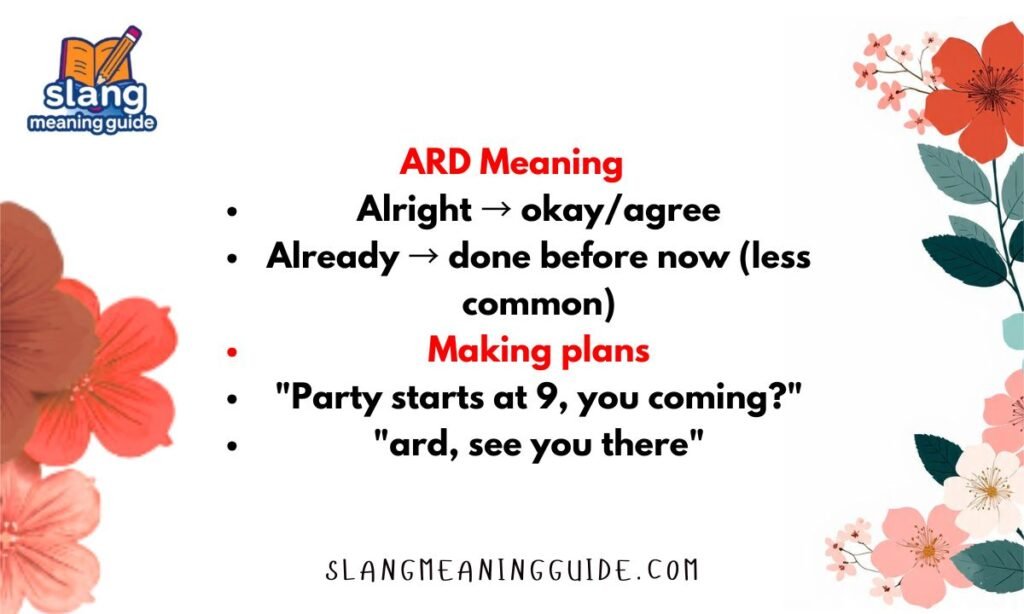
ARD is a slang abbreviation that stands for “alright.” It is one of those shorthand terms that packs a full word into a tiny package without losing any meaning.
In everyday texting, people use ARD to signal agreement, acknowledgment, or simple acceptance. It is the digital version of a casual nod.
ARD as “Alright”
This is the most common use by a wide margin. When someone texts you “ard,” they are saying they are fine with something, they agree, or they got the message.
Think of it like this: if a friend says “Meet me at 7,” and you reply “ard,” the whole exchange is settled. No extra words needed. It works as a standalone reply or inside a sentence, depending on how the conversation flows.
ARD as “Already”
Less common, but worth knowing. In fast typing, some people drop “ard” in place of “already” — especially in informal chats where speed matters more than spelling.
For example, “I ard told you” reads as “I already told you.” Context usually makes this meaning obvious. If the sentence structure points toward time or sequence, you are probably looking at this version.
Where Did ARD Come From?
The word did not come from a dictionary. It grew out of spoken dialect and found its way into written form through the rise of texting culture.
ARD has deep roots in African American Vernacular English (AAVE) and is especially associated with cities like Philadelphia and Baltimore. In those dialects, “alright” is often spoken quickly, with the first syllable softened. The result sounds closer to “ard” than the standard pronunciation.
From Street Slang to Social Media
Philadelphia speakers were using “ard” in everyday speech long before smartphones existed. When texting became mainstream in the 2000s, people started writing the way they talked. ARD made the transition naturally.
By the mid-2010s, it had gone national. Social media platforms like Twitter, Snapchat, and later TikTok gave the word a much larger audience. Once creators and influencers from Philly started using it on video content, viewers outside the region picked it up fast.
The Role of Phonetic Spelling
ARD is a textbook example of phonetic spelling in digital language. Rather than writing the “correct” form of a word, speakers write what they hear. This process has shaped dozens of modern slang terms.
Words like “aight,” “ight,” and “ard” all come from the same phonetic root. They reflect how “alright” sounds in different regional accents, each one capturing a slightly different pronunciation. ARD leans on the flat, compressed vowel sound common in Northeastern urban dialects.
How to Use ARD in a Conversation
Using ARD is straightforward. The key is knowing when it fits and when it does not.
It belongs in casual, informal spaces. Group chats, DMs, gaming lobbies, social media comments — these are its natural homes.
Everyday Usage Examples
Here are some realistic conversation examples showing how ARD actually shows up in texts:
| Context | Message | Reply with ARD |
| Making plans | “Party starts at 9, you coming?” | “ard, see you there” |
| Confirming info | “The meeting is pushed to Friday” | “ard, thanks for letting me know” |
| Agreeing to a request | “Can you pick up milk on the way?” | “ard” |
| Acknowledging news | “I got the job!” | “ard, that’s what’s up” |
When Not to Use ARD
ARD does not belong in professional communication. Emails, work messages, formal requests, or anything being sent to a manager or client should use “alright,” “understood,” or “noted” instead.
The same applies to written academic work, cover letters, and anything where tone and credibility matter. ARD signals familiarity and informality. In the wrong context, it can make you look careless rather than casual.
ARD vs. Similar Slang Terms
ARD is not the only shorthand for “alright” floating around in digital conversations. A few close relatives are worth knowing.
Each one carries a slightly different flavor, even if the core meaning is the same.
ARD vs. AIGHT vs. IGHT
These three are first cousins. AIGHT is probably the most widely recognized, having appeared in music and pop culture for decades. IGHT is a more stripped-down version that skips the “a” entirely. ARD is the most regionally specific of the three, though its reach has expanded significantly in recent years.
If you hear someone from Philadelphia use these terms in conversation, ARD is likely their default. Outside the Northeast, AIGHT and IGHT tend to appear more often. Online, all three coexist without much friction.
ARD vs. BET
BET and ARD are not the same thing, even though both get used as quick agreements. BET carries a stronger sense of enthusiasm. It signals that you are fully on board and excited about something.
ARD is more neutral and laid-back. It confirms without adding emotional weight. Use ARD when you want to say “okay, cool” — and save BET for when you actually want to convey energy or commitment.
Other Meanings of ARD
Outside of texting, ARD carries completely different meanings depending on the field. Knowing these helps avoid confusion in professional or academic contexts.
In medicine, ARD can stand for Acute Respiratory Disease. And In tech, Apple Remote Desktop uses the same acronym.
In statistics and public health, ARD means Absolute Risk Difference. None of these meanings apply in casual digital communication, but they are worth recognizing if you encounter ARD in a non-texting context.
Frequently Asked Questions
What does ARD mean in a text message?
It means “alright” — a casual way to agree, confirm, or acknowledge something.
Is ARD the same as saying “okay”?
Yes, it carries the same meaning in most contexts.
Where did ARD come from?
It originated in Philadelphia and Baltimore slang, rooted in AAVE and phonetic speech patterns.
Is ARD appropriate for professional messages?
No — keep it to casual, informal conversations only.
Can ARD mean “already”?
Sometimes yes, depending on sentence structure and context.
Is ARD used globally?
It started as regional U.S. slang but has spread globally through social media.
What is the difference between ARD and AIGHT?
Both mean alright, but AIGHT is more widely known and ARD is more tied to Philly/Baltimore origins.
Do older people use ARD?
It is most common among younger users and Gen Z, though it is spreading across age groups.
Conclusion
ARD is a compact, efficient piece of digital slang that means “alright” in nearly every texting context you will encounter. It grew from regional spoken dialect in cities like Philadelphia, traveled through text messaging culture, and landed firmly in the mainstream through social media. Knowing what it means and when to use it — and when not to — keeps your communication sharp and context-appropriate.