
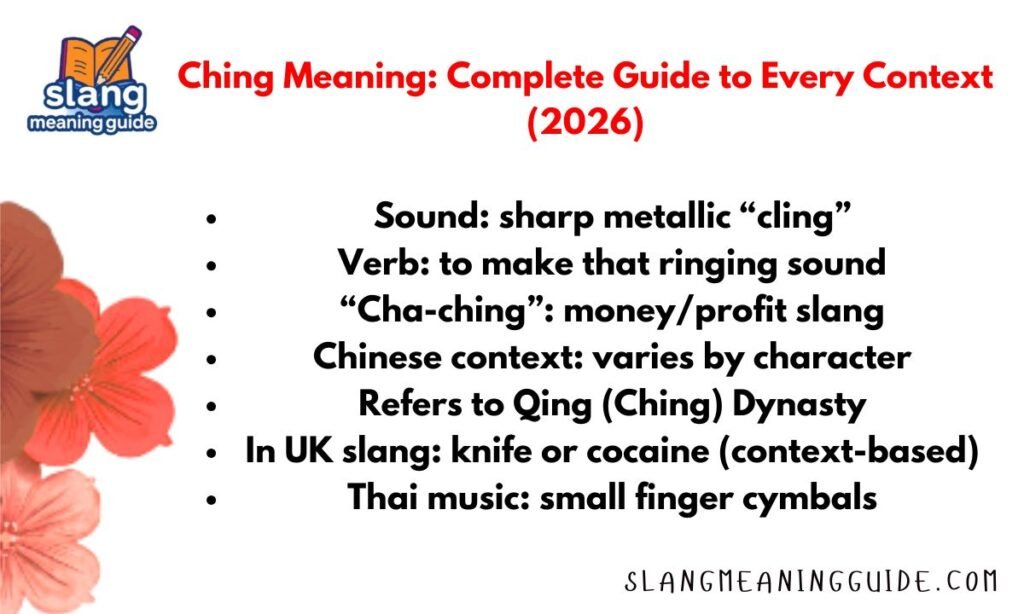
One small word. Dozens of meanings across languages, cultures, and slang. Most people only know “cha-ching” — but the word runs much deeper than that. Here is every meaning of ching you actually need to know.
What Does Ching Mean in English?
The most widely accepted English meaning of ching is a sharp, ringing sound — like metal or glass being struck. It functions as both a noun and a verb in everyday writing.
As a noun, it describes that high-pitched clinking noise. As a verb, it means to produce that sound. You will find it used most naturally in descriptive writing or sound effects.
Ching as a Sound Word
A ching is the quick, bright noise a coin makes when it hits a hard surface. It is also the sound of cutlery clinking, a glass being tapped, or a small bell being struck.
Writers use it when they want to capture a specific auditory moment. It is precise and punchy — two qualities that make it useful in fiction and casual writing.
Ching as a Verb
When used as a verb, ching describes the act of making that sharp metallic sound. A sentence like “the cutlery was chinging as the boat swayed” shows it in natural action.
The verb form is informal and more common in British English than American English. Most American readers will understand it from context even if they would not use it themselves.
Ching Meaning in Chinese Contexts
In Chinese-related usage, ching is an older romanization style for sounds now typically written in standard pinyin. It does not point to one single meaning.
The character behind the romanization determines everything. Multiple Chinese characters produce similar sounds, each carrying a completely different meaning — from “green” to “light” to “invite.”
The Ching Dynasty
The most historically significant use of Ching in English is as an alternate spelling of Qing — the last imperial dynasty of China. The Ching (or Qing) Dynasty ruled from 1644 to 1912 and was established by the Manchu people.
It was one of the longest-running and most geographically expansive dynasties in Chinese history. Today, historians and academic texts almost universally use the pinyin spelling “Qing,” but older books and Western records still use “Ching.”
I Ching: The Book of Changes
The I Ching is an ancient Chinese philosophical and divination text, often translated as “The Book of Changes.” It is one of the oldest books in the world and has influenced Chinese philosophy, literature, and thought for over three thousand years.
People use the I Ching by casting lots or coins to generate hexagrams — sixty-four symbols representing different life situations. Each hexagram comes with a text offering guidance or reflection. The I Ching is not related to the sound word or modern slang uses of ching.
Tao Te Ching
The Tao Te Ching is a separate classical Chinese text attributed to the philosopher Laozi. Its title translates roughly to “The Classic of the Way and Virtue” or “The Book of the Way and Its Power.”
It is the foundational text of Taoism and one of the most translated books in history. The word “Ching” here is an older romanization of the Chinese character for “classic” or “scripture.” Again, this is entirely unrelated to the English sound word.
Cha-Ching and Ka-Ching: The Money Meaning
These two expressions are the most widely recognized uses of ching-related words in everyday American English. Both are informal sound effects meant to imitate a cash register.
| Expression | Meaning | Tone |
| Cha-ching | Money incoming; a profitable moment | Playful, celebratory |
| Ka-ching | Same as cha-ching; alternate spelling | Identical tone and use |
| Ching (standalone) | Sharp ringing sound | Neutral, descriptive |
Cha-ching entered mainstream American speech as a way to celebrate a sale, a windfall, or any financially positive event. It is informal and light-hearted — never used in professional or formal writing.
Ching Meaning in UK Slang
In some parts of the UK, ching takes on meanings that are completely different from the sound word. Context matters enormously here.
In certain British street slang, ching can mean a knife. As a verb, it can mean to stab. These uses are associated with specific communities and urban environments and are not part of general British English vocabulary.
Ching as Drug Slang in the UK
In UK drug slang, ching is sometimes used as a word for cocaine. This usage is informal, street-level, and highly context-dependent.
It is not a term that appears in formal dictionaries. Anyone outside the specific social context where this slang circulates would be unlikely to recognize it. This meaning is unrelated to all other definitions of the word.
Ching in Music: Thai and Cambodian Finger Cymbals
In the context of Southeast Asian music, ching refers to a specific instrument. These are small, bowl-shaped finger cymbals made from thick bronze, used in the traditional music of Thailand and Cambodia.
A musician holds one cymbal in each hand and strikes them together to mark rhythm in classical and ceremonial performances. The sound they produce is exactly what the English word ching describes — a bright, ringing tone that cuts clearly through an ensemble.
This is one of the rare cases where the word, the sound it describes, and the object that makes that sound all align perfectly.
Words That Sound Like Ching: Common Confusions
Several words regularly get mixed up with ching in web searches. They look or sound similar but mean something completely different.
Chingu is a Korean word meaning “friend.” It has no connection to ching. Korean speakers use it as a common, everyday term for a peer or companion.
Chinglish is a blend of “Chinese” and “English.” It describes English that is heavily influenced by Chinese grammar or phrasing, typically produced by native Chinese speakers. The term can be neutral or dismissive depending on who uses it.
Chingasos is a Latin American Spanish slang term referring to punches or blows. It is regional and informal and carries no relation to the English word ching.
Chingy is most widely recognized as a stage name used by an American rapper. It is not a dictionary word and should not be confused with the general term.
How to Pronounce Ching
Ching is pronounced to rhyme with “ring” or “king.” The “ch” sound is the same as in “church” or “chair” — a soft, affricate consonant.
The vowel is a short “i” sound, not a long “ee.” The full pronunciation is a single syllable: /tʃɪŋ/. It is one of the easier English words to say correctly on the first attempt.
Ching Across Different Languages at a Glance
The word ching — or words that look and sound like it — shows up across multiple languages with wildly different meanings.
| Language / Region | Meaning of Ching |
| English | Ringing sound; clinking noise |
| UK slang | Knife; cocaine (context-specific) |
| Chinese (historical) | Older romanization; depends on character |
| Historical English | The Qing/Manchu Dynasty (1644–1912) |
| Thai/Cambodian music | Small bronze finger cymbals |
| American English | Part of “cha-ching” (money expression) |
Frequently Asked Questions
What is the most common meaning of ching in English?
The most common meaning is a sharp, ringing sound — like the clink of metal or glass being struck.
What does ching mean in Chinese history?
Ching refers to the Qing Dynasty, the last imperial dynasty of China, which ruled from 1644 to 1912.
What does cha-ching mean?
Cha-ching is an informal expression imitating a cash register sound, used to celebrate making money or a financial win.
What is the I Ching?
The I Ching is an ancient Chinese philosophical text known as “The Book of Changes,” used for reflection and divination.
What does ching mean in UK slang?
In some UK street slang contexts, ching can mean a knife or, separately, cocaine — though both uses are highly context-dependent.
Conclusion
Ching is one of those rare words that means something completely different depending on where you are and who you are talking to.
From ancient Chinese dynasties and classical philosophical texts to the bright clatter of finger cymbals and modern slang, this small word carries a surprising amount of weight.
Understanding which meaning applies is always a matter of context — and now you have all the context you need.