
You have seen it in forums, group chats, and Twitter threads a hundred times. Four letters. One opinion. But the moment you try to nail down exactly what IMHO means, things get surprisingly complicated.
The debate has made headlines, split offices, and sparked internet polls with tens of thousands of votes. So what does it actually mean — and does the answer even matter anymore?
What Does IMHO Mean?
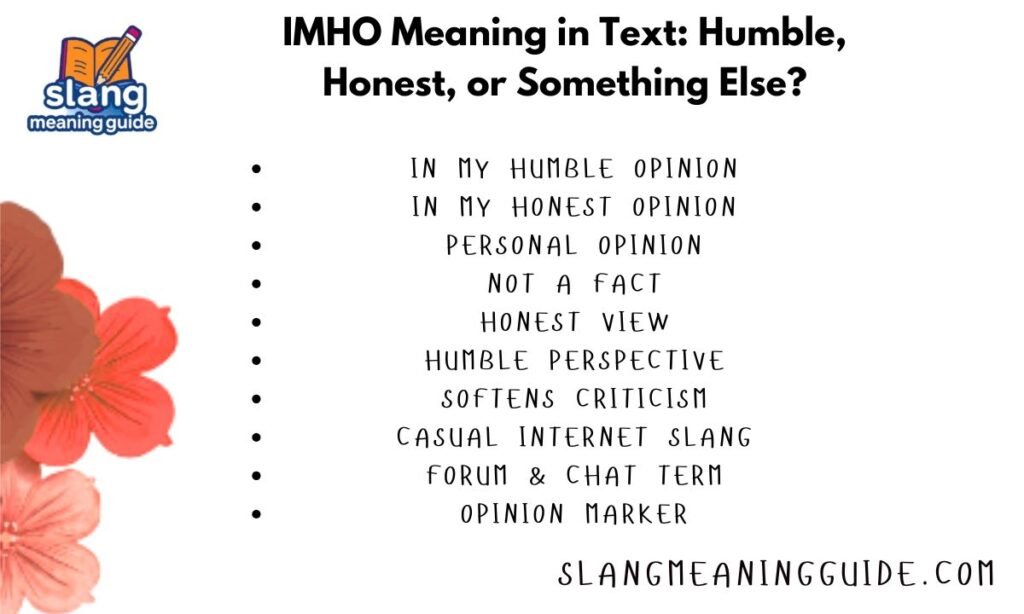
IMHO stands for “In My Humble Opinion” — at least, that is the original, documented definition. The initialism appeared in early internet forums and Usenet groups in the 1980s and 1990s, where users needed fast ways to signal that a statement was personal opinion, not fact.
- It is an internet slang initialism (each letter is spoken separately, unlike acronyms like NASA)
- The original full form: In My Humble Opinion
- The disputed alternative: In My Honest Opinion
- Both versions are used today — and both actually work in practice
Where Did IMHO Come From?
The word origin of IMHO traces back to the early days of networked computer communication.
- First documented use: Usenet discussion boards, early 1980s
- Purpose: to soften opinion-sharing in typed, asynchronous conversations
- It was part of a wave of text abbreviations like BTW (by the way), FYI (for your information), and IMO (in my opinion)
- The etymology of IMHO shows “humble” was always the intended H — dozens of early internet style guides and glossaries confirm this
- It spread from tech communities into mainstream internet culture through the 1990s and 2000s
- Today it lives in texts, social media posts, Reddit threads, Discord servers, and workplace Slack channels
The Big Debate: Humble or Honest?
This is the question that broke the internet — briefly.
- In 2018, employees at BuzzFeed openly disagreed about what the H stands for
- The story went viral; a public poll showed “honest” winning with around 59% of votes
- Merriam-Webster came down firmly on the side of “humble”
- The Atlantic published two competing pieces — one arguing for the original definition, one arguing it no longer matters
- NPR covered the IMHO acronym debate on air
Here is what the evidence actually shows:
- Many dictionary references list humble only
- Some list humble and honest
- None list honest only
- Etymologically, humble is the correct original meaning — there is no documented source for honest as the founding definition
Why “Honest” Feels Right to So Many People
Even though humble is the original meaning, honest has a strong intuitive logic behind it.
“Honest opinion”: communicates truthfulness — you are about to say what you actually think
“Humble opinion”: communicates tone — you are softening how you say it
- Many people use IMHO precisely because they are about to be blunt, not because they feel modest
- When someone writes “IMHO this plan is terrible” — they do not sound humble at all
- That ironic tension is actually part of what makes the phrase interesting
The honest vs humble split reflects a real semantic divide:
- Humble → modesty, openness, awareness that you could be wrong
- Honest → directness, sincerity, commitment to saying what you actually believe
IMHO as a Discourse Marker
Here is where it gets genuinely interesting from a language perspective.
- Linguists classify IMHO as a discourse marker — a word or phrase that signals how to interpret the statement that follows
- Other discourse markers: however, well, actually, you know, honestly
- A discourse marker does not change the meaning of the sentence — it shapes how the reader receives it
- IMHO tells the reader: this is a personal view, not a universal fact
This is why the humble vs honest debate may be a red herring:
- Like the words snafu, radar, and laser, IMHO has evolved beyond its letters
- Most people who use it have never thought about what H stands for
- They use it because it functions — it marks opinion, softens tone, and signals subjectivity
- The semantic meaning of IMHO today is the sum of how it is used, not what its letters technically say
How IMHO Works in a Sentence
Placement is flexible. IMHO can open a sentence, close it, or sit in the middle.
At the start:
- IMHO, the first season was way better.
- IMHO this needs more time before it launches.
At the end:
- That policy makes no sense, IMHO.
- She handled it well, IMHO.
In the middle:
- This is, IMHO, the most important issue on the table.
- The design is fine but, IMHO, it needs a stronger headline.
As a tone modifier:
- Nuclear war sounds pretty bad IMHO. (ironic use)
- IMHO this column is Absolutely Correct. (sarcastic use)
- I think IMHO you should talk to him first. (gentle nudge)
IMHO vs IMO: What Is the Difference?
These two are closely related but carry different social weights.
- IMO = In My Opinion — straightforward, neutral, no softening
- IMHO = In My Humble (or Honest) Opinion — adds a layer of tone, whether modest or ironic
- IMO is more direct; IMHO is more flexible
- In practice, IMHO often reads as slightly warmer or more self-aware
- Both are opinion markers used to separate personal view from established fact
Quick comparison:
- IMO this is wrong. — Direct and clean
- IMHO this is wrong. — Same point, slightly softer or more ironic depending on context
- IMNSHO (In My Not So Humble Opinion) — a self-aware variation where the speaker admits they are not being modest at all
IMHO in Different Online Contexts
The same four letters shift in tone depending on where you use them.
Reddit and forums:
- Used heavily to flag personal takes in debates
- Often signals: I know people disagree, but here is where I stand
Twitter / X:
- Used to add weight or irony to hot takes
- Sometimes used sarcastically to undermine the humility it claims to express
Work chat (Slack, Teams):
- Softens feedback or criticism between colleagues
- Signals: this is my view, not a directive
Group texts:
- Casual and quick; usually means “just my take”
- Almost never carries any real humility in a conversational sense
Is IMHO Formal or Casual?
Short answer: casual.
- It is internet language — not appropriate in formal reports, academic papers, or business emails to clients
- Fine in internal messages, social media, personal essays, online communities, and informal writing
- Its writing tone is friendly-to-neutral depending on context
- Using it in formal writing signals a lack of audience awareness
- In casual digital discourse, it fits naturally without explanation
IMHO and the Evolution of Internet English
IMHO is a case study in language evolution through digital communication.
- It started as a practical abbreviation in tech forums
- It spread into mainstream internet use as social media grew
- It evolved from a humble qualifier into something closer to a phatic expression — a conversational ritual more than a literal statement
- The debate over its meaning is itself evidence of how internet language works: words drift, shift, and outgrow their original letters
- This is normal — OK, bye, hello all have forgotten origins that most speakers never think about
- IMHO joined a long line of initialisms that became words in their own right
Common Variations of IMHO
The phrase has spawned several spin-offs worth knowing.
- IMO — In My Opinion (no H, more direct)
- IMNSHO — In My Not So Humble Opinion (self-aware and direct)
- IYHO — In Your Humble Opinion (turning the question back on someone)
- IHO — In His/Her Opinion (third-person variation, rare)
- All follow the same pattern: marking a statement as personal perspective rather than shared fact
Does the H Even Matter Anymore?
This is the most honest answer to the debate.
- If you use IMHO thinking it means humble — you are etymologically correct
- If you use it thinking it means honest — you are in good company with roughly half the internet
- If you use it and have never thought about it at all — you are using it correctly as a discourse marker in modern digital communication
- The function matters more than the letter
- IMHO works because everyone who reads it understands what it signals — opinion is being offered, not fact being stated
When to Use IMHO and When to Skip It
Use it when:
- Sharing a personal take in a discussion
- Softening feedback or criticism
- Adding irony or self-awareness to a strong statement
- Writing informally in chats, posts, or comments
Skip it when:
- Writing formal emails or professional documents
- Making factual claims that need to stand on their own
- Addressing an audience that may not recognize internet shorthand
- The tone is already clearly informal and the marker adds no value
IMHO in Modern Text and Social Media Language
IMHO remains one of the most durable text abbreviations from the early internet era.
- It has survived multiple waves of new slang
- It appears across generations — Gen X users who were on Usenet, Millennials who grew up on forums, and Gen Z users in Discord servers
- It is recognized across English-speaking digital communities globally
- Its staying power comes from its contextual usage — it is flexible enough to work across dozens of social situations
- As social media language keeps evolving, IMHO keeps finding new contexts to live in
Frequently Asked Questions
What does IMHO mean in a text message?
IMHO means “In My Humble Opinion” and signals that what follows is a personal view, not a fact.
Does IMHO mean humble or honest opinion?
Humble is the original and documented meaning, but honest is widely used today and broadly accepted in informal communication.
Is IMHO an acronym or an initialism?
IMHO is an initialism — each letter is read separately — not an acronym spoken as one word.
When did people start using IMHO?
IMHO originated on Usenet and early internet forums in the 1980s as a shorthand for softening personal opinions in online text discussions.
Is IMHO appropriate in professional emails?
No — IMHO is casual internet slang best suited for texts, social media, and informal digital communication, not formal or professional writing.
Final Thoughts
IMHO is four letters carrying more meaning than its founders probably intended. It started as a polite hedge on tech forums, became a global shorthand for opinion-sharing, and sparked a genuine linguistic debate about what words mean when their users disagree.
Whether your H is humble, honest, or simply habit — the word works. That is really the point. Language evolves through use, and IMHO has earned its place in the internet English vocabulary by being genuinely useful for over forty years.