
Someone just told you to kick rocks, and you’re not sure if it’s funny or rude. That split-second confusion is exactly what makes this phrase so interesting. Let’s break down what it means, where it came from, and how to use it right.
What “Kick Rocks” Actually Means
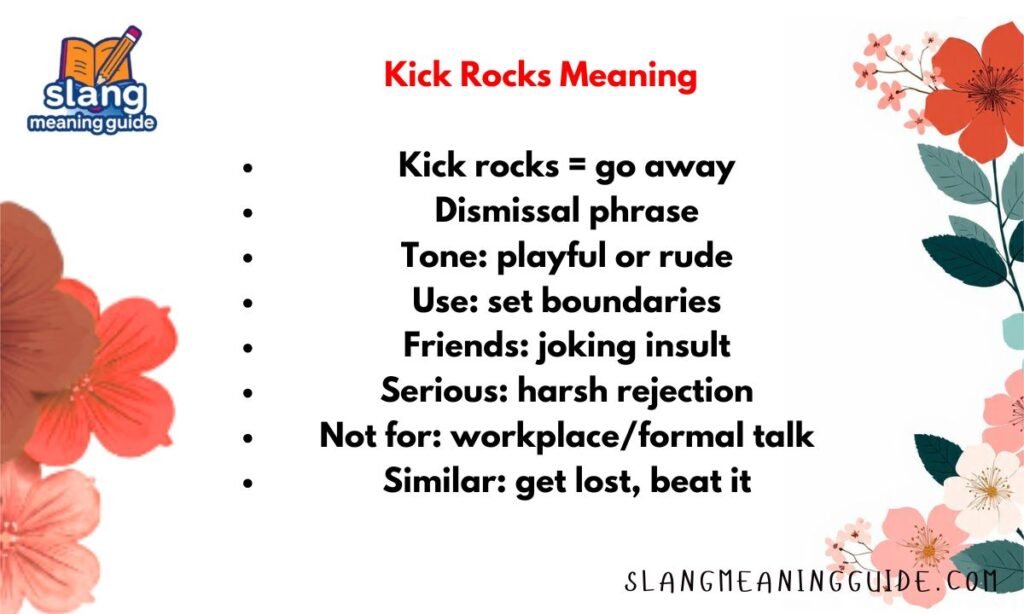
This phrase is a dismissal. When someone tells you to kick rocks, they’re telling you to leave, back off, or stop bothering them. The tone can range from playful to genuinely cold depending on who’s saying it and why.
The Core Definition
At its simplest, kick rocks means “go away.” It signals that the person is done with the conversation, the situation, or you specifically. The phrase doesn’t need extra words to land its point.
Think of it as a more colorful version of “get lost” or “beat it.” It carries the same rejection but wraps it in a vivid mental image that makes it stick.
How Tone Changes Everything
The same two words can mean completely different things based on delivery. A friend laughing while they say it is teasing. A stranger saying it with a flat expression is a hard dismissal.
This tonal flexibility is a big reason the phrase survives across generations. It bends to fit friendly banter, firm boundary-setting, and everything in between.
The Origin of “Kick Rocks”
No one has pinpointed an exact birthdate for this phrase. What we do know is that it grew out of early American street slang and has roots in multiple cultural environments.
Early American Slang Roots
During the early and mid-20th century, dismissive phrases using physical imagery were common. “Pound sand,” “take a hike,” and “hit the bricks” all share the same DNA as kick rocks.
The image of someone literally kicking rocks down a road captures sulking, aimlessness, and rejection all at once. That visual punch made it memorable and easy to repeat.
Military and Urban Influence
Military culture in the mid-1900s relied heavily on short, sharp commands. Dismissive phrases like this one fit naturally into barracks language, where directness was a virtue.
By the 1980s and 1990s, hip hop culture picked it up and gave it staying power. Street conversations and music lyrics spread the phrase across demographics and regions until it became broadly familiar.
Kick Rocks in Relationships and Social Settings
Context shapes how this phrase lands in personal situations. Using it wrong can turn a minor annoyance into a serious conflict.
What It Signals in a Relationship
If a partner tells you to kick rocks, they’re drawing a boundary hard and fast. It rarely comes from a calm place. It usually shows up when frustration has been building for a while.
In serious relationship arguments, the phrase can signal that someone feels dismissed or disrespected. It’s less of a request and more of a warning that the conversation is over.
How Friends Use It Differently
Between close friends, kick rocks often functions as a punchline. One person says something bold or ridiculous, and the other fires back with “kick rocks” as a joking rejection.
The shared history between friends removes the sting. They both know the tone, so the same phrase that would wound a stranger just gets a laugh. Context and relationship matter more than the words themselves.
When to Use It and When to Hold Back
Knowing when to deploy this phrase is just as important as knowing what it means. Getting the timing wrong can backfire quickly.
Good Situations for the Phrase
Use it when someone is being pushy and you need to draw a line without a long explanation. It also works well in casual banter when both people understand the playful frame.
If someone is repeatedly asking for favors, showing unwanted attention, or pushing past a clear boundary, kick rocks delivers the message with confidence and efficiency.
Situations Where It Will Cause Problems
Workplace settings, serious conflicts, and conversations with emotionally vulnerable people are all wrong contexts for this phrase. It reads as dismissive and uncaring in those environments.
If someone is genuinely upset or dealing with something real, a dismissal like this will make things worse. Save it for situations where the relationship can handle the edge.
20 Alternatives to “Kick Rocks” Organized by Tone
Sometimes you want the same energy but a different phrase. Here are options that match the message while adjusting the delivery.
| Phrase | Tone | Best Used When |
| Get lost | Direct | Firm rejection |
| Beat it | Sharp | Ending an interaction fast |
| Take a hike | Playful | Friendly teasing |
| Hit the road | Neutral | Asking someone to leave calmly |
| Scram | Old-school | Humorous situations |
| Vamoose | Lighthearted | Low-stakes banter |
| Bounce | Casual | Social settings with friends |
| Go fly a kite | Gentle | Softening the dismissal |
| Not right now | Polite | Professional or sensitive settings |
| I need space | Calm | Relationship conversations |
Choosing the Right Alternative
Match the phrase to the relationship and the moment. A soft phrase in a high-tension moment can feel passive-aggressive. A sharp phrase in a lighthearted moment can accidentally land wrong.
The goal is always clarity. Whether you say kick rocks or choose a softer version, the other person should understand exactly what you mean without confusion or misreading.
Modern Online Versions
Digital communication has spawned its own versions of the same dismissal. Phrases like “touch grass,” “log off,” and “be for real” carry the same kick rocks energy in online conversations.
These evolved naturally because the internet needed ways to dismiss trolls, bad arguments, and unwanted attention. The spirit of the original phrase lives on in new language shaped by new contexts.
Why This Phrase Has Lasted So Long
Most slang fades within a decade. Kick rocks has been around since at least the mid-20th century and shows no signs of disappearing. There’s a reason for that.
It Fills a Real Need
People constantly need a way to draw boundaries without launching into a full explanation. Kick rocks delivers a complete message in two words. That efficiency is rare and valuable in everyday language.
It also avoids profanity while still carrying weight. That makes it usable in more settings than harsher dismissals, which expands its reach across age groups and contexts.
The Mental Image Does the Heavy Lifting
Language that creates pictures sticks. When you hear “kick rocks,” your brain immediately conjures someone sulking away and literally kicking at pebbles. That image is funny, vivid, and a little pathetic all at once.
That combination of humor and sting is hard to replicate. It’s why the phrase outlasts blunter alternatives that lack the same visual energy.
Kick Rocks in Pop Culture
The phrase has shown up in music, TV shows, movies, and social media across several decades. Its appearances in popular media have kept it fresh for new audiences.
Music and Television
Hip hop lyrics in the 1990s and 2000s used the phrase regularly to signal confidence and rejection. Characters in sitcoms and dramas dropped it to signal attitude without crossing into explicit language.
Each appearance reinforced the phrase for a new generation. Young viewers and listeners absorbed it naturally, and it moved from screen to street conversation without much effort.
Social Media and Memes
Platforms like Twitter, TikTok, and Instagram gave the phrase a new life. Short, punchy dismissals perform well online, and kick rocks fits the format perfectly.
Memes built around the phrase spread it to people who might never have encountered it in older media. The internet compressed its cultural transmission from decades to days.
Frequently Asked Questions
What does kick rocks mean in slang?
It means go away, leave me alone, or stop bothering me.
Is kick rocks rude?
It depends on tone. Between friends it’s often playful, but it can be genuinely rude in serious contexts.
Where did kick rocks come from?
It evolved from early American slang, likely mid-20th century, and was popularized through urban and hip hop culture.
Can you use kick rocks at work?
No. It’s too casual and dismissive for professional environments.
What does it mean when someone tells you to kick rocks in a relationship?
It usually signals strong frustration and a desire for distance or space.
Is there a polite version of kick rocks?
Yes. “I need space” or “not right now” delivers a similar boundary without the edge.
Does kick rocks always mean someone is angry?
No. Among close friends it’s often used as a joke or light teasing.
What’s a modern online equivalent of kick rocks?
“Touch grass” and “log off” carry the same dismissive energy in digital conversations.
Conclusion
Kick rocks is two words doing the work of ten, delivering a clear boundary with personality and zero apology. Its staying power comes from the perfect balance of humor and sting, soft enough to use with friends and sharp enough to mean business when necessary. Use it wisely, read the room first, and you’ll always land it right.