
From 1950s teen slang to pop culture staple to 2026 Instagram caption — here’s everything behind this playful American exit line.
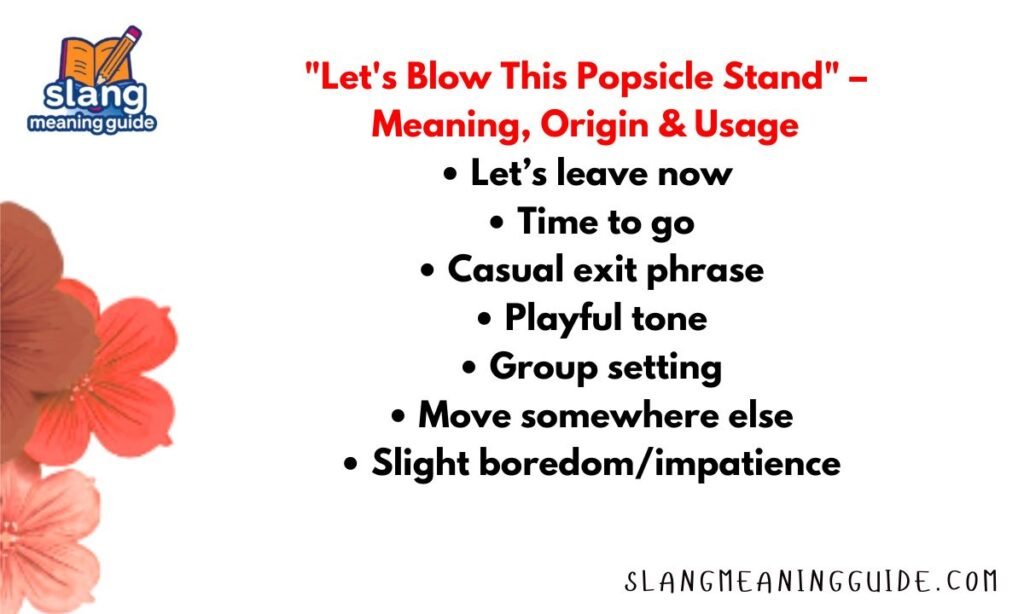
Quick Answer: “Let’s blow this popsicle stand” is a humorous American idiom meaning “let’s leave this place” or “let’s get out of here.” It is used in casual group settings when you are ready to move on — often implying the current spot is dull or it is simply time for the next adventure. No actual popsicle stands are involved.
What Does “Let’s Blow This Popsicle Stand” Mean?
At its simplest, this idiom is just a fun, quirky way to say “let’s go.” The word blow here comes from old American slang meaning to leave or exit a place quickly. A popsicle stand is the metaphorical setting — anywhere you happen to be at the time. Together, the phrase means: time to leave this spot and head somewhere better.
Wiktionary defines the verb form as simply meaning “to leave an establishment speedily” — and that captures the energy perfectly. It is not angry or aggressive. It is light, often funny, and always casual.
What “Blow” Actually Means Here
In older American slang, “blow” frequently meant to depart or exit fast. You hear echoes of it in phrases like “let’s blow this joint” or “blow town.” The word carries speed and a slight irreverence — you are not politely excusing yourself, you are making a move. That energy is exactly what gives this idiom its charm.
The “popsicle stand” piece adds the comic layer. A popsicle stand is the most modest, unhurried, low-stakes place imaginable. Saying you are going to blow one creates a funny contrast — dramatic action, trivial setting. That gap between the two is where the humor lives.
Is It Negative or Positive?
Neither, really. Unlike “get a load of this guy,” which carries sarcasm or mockery, “let’s blow this popsicle stand” is almost always warm and playful. You might use it when bored, yes — but it is not a put-down to the place or the people in it. It simply signals readiness to move.
Occasionally it implies mild impatience or boredom. But it never sounds harsh. In fact, it often makes departing feel a little more fun, adding a touch of personality to what could otherwise be an awkward “okay, we should probably go” moment.
The Real Origin of “Blow This Popsicle Stand”
The phrase’s history is genuinely interesting — and cleaner than many origin myths suggest. Here is what the documented record actually shows.
- 1924 — Frank W. Epperson receives the first patent for the popsicle in San Francisco, making the phrase possible
- Early 1950s — Predecessor phrases like “blow this joint,” “blow this burg,” and “blow this scene” are common in American slang
- 1955 — The earliest documented use of “blow this popsicle stand” appears in the Minneapolis Morning Tribune: a student says “I think I’ll blow this popcorn stand”
- 1955 film — Kiss Me Deadly (film noir) is frequently cited as an early popular-culture appearance of the phrase
- Late 1970s–80s — The expression appears in Mork and Mindy, The Blues Brothers (1980), and A Nightmare on Elm Street: The Dream Child (1989)
- 1997 — Good Will Hunting features a variation of the phrase, cementing it across generations
- 2025–2026 — Instagram lifestyle bloggers and travel creators revive it as a caption staple for spontaneous departure content
The “pop stand” reference likely connects to 1950s American teen culture. Local drug stores had soda fountains — called pop stands — where teenagers would hang out. “Blowing” the pop stand meant leaving the hangout. Over time, “pop stand” evolved into “popsicle stand” for extra comic flair.
The Bogart Connection — Fact or Fiction?
A popular theory traces the phrase to Humphrey Bogart in a 1930s or 1940s gangster film — the story goes that he was thrown out of a speakeasy and contemptuously called it a “pop stand.” It’s a great story, but no documented film scene has ever been confirmed to match it exactly. Multiple researchers have watched the candidate films and come up empty.
What is true is that Bogart’s era popularized “blow this joint” as a cool, contemptuous exit line. The popsicle variant almost certainly evolved from that — swapping the edgy “joint” for the deliberately silly “popsicle stand” to create a phrase that sounds funny precisely because it is not tough at all.
How to Use “Let’s Blow This Popsicle Stand” Today
The phrase works best in group settings — at least two people, ready to leave, with a light mood. It signals departure without drama. Below are real-world contexts where it lands naturally.
At a Party
“This music stopped ages ago — let’s blow this popsicle stand and find somewhere with a DJ.”
End of Workday
“TGIF, team. Let’s blow this popsicle stand and grab some food.”
Travel / Sightseeing
“We’ve seen the whole museum. Let’s blow this popsicle stand and head to the beach.”
Social Media Caption
“Last day of the conference. LET’S BLOW THIS POPSICLE STAND ✌️ #HomewardBound”
Pop Culture Appearances Over the Decades
The phrase has shown up consistently across American film and TV, which explains why it feels so culturally familiar even to people who have never used it themselves.
| Year | Title | How It Was Used |
|---|---|---|
| 1955 | Kiss Me Deadly | Early documented film use; private investigator signals departure |
| 1980 | The Blues Brothers | Used as a casual group exit line |
| Late 1970s | Mork and Mindy (TV) | Key appearance credited with boosting mainstream awareness |
| 1989 | A Nightmare on Elm Street: The Dream Child | Variation used by a main character before an exit scene |
| 1997 | Good Will Hunting | Phrase appears in one of the film’s memorable informal exchanges |
Alternative Phrases That Mean the Same Thing
If the idiom feels too old-school for your audience, these alternatives cover the same ground with varying tones.
- Let’s blow this joint — older, slightly edgier version of the same idea
- Let’s bounce — modern, casual, popular with younger speakers
- Let’s make a move — neutral and works in almost any setting
- Let’s book it — implies more urgency, faster departure
- Time to roll — relaxed, friendly, versatile
- Let’s get out of here — direct, no frills, universally understood
- Let’s hit the road — best for travel or driving contexts
The 2026 Slang Revival — Why People Are Using It Again
Vintage American slang is having a genuine moment on Instagram, TikTok, and lifestyle blogs. Phrases that feel deliberately retro now read as charming and self-aware rather than dated. “Let’s blow this popsicle stand” fits that energy perfectly.
Travel creators drop it as a caption when leaving one destination for another. Office culture memes use it for Friday afternoon escape vibes. The phrase works because it is specific enough to feel personal but broad enough to fit almost any exit scenario. It carries nostalgia without requiring the audience to know where it came from.
Frequently Asked Questions
What does “let’s blow this popsicle stand” mean?
It means “let’s leave this place” — a playful, humorous American idiom for signaling that it’s time to go somewhere else.
Where did “blow this popsicle stand” originate?
The earliest documented printed use appeared in a 1955 Minneapolis newspaper; the phrase likely evolved from the older “let’s blow this joint” used in 1940s American slang.
Is the phrase negative or insulting?
No — it’s almost always warm and playful, implying readiness to move on rather than contempt for the place or people being left.
What are some alternatives to “let’s blow this popsicle stand”?
Common alternatives include “let’s bounce,” “let’s make a move,” “let’s book it,” and the closely related “let’s blow this joint.”
Is it still used in 2026?
Yes — it has seen a revival on Instagram and TikTok, used as a nostalgic, self-aware caption for departure moments and travel content.
Conclusion
“Let’s blow this popsicle stand” has survived for over seventy years because it does something no plain phrase can — it turns a simple exit into a small moment of personality. Born from 1950s soda-fountain slang, embedded in decades of American film and TV, and now revived by a generation that appreciates deliberate retro charm, this idiom earns its place in everyday speech. Use it when the energy is right, the group is ready, and you want to make leaving feel just a little more like an adventure.