

You hear someone talk and something feels off. The words are there, but they come out muddy and garbled. People lean in, strain their ears, and still miss half of what was said. That is exactly the moment someone earns the label “marble mouth.”
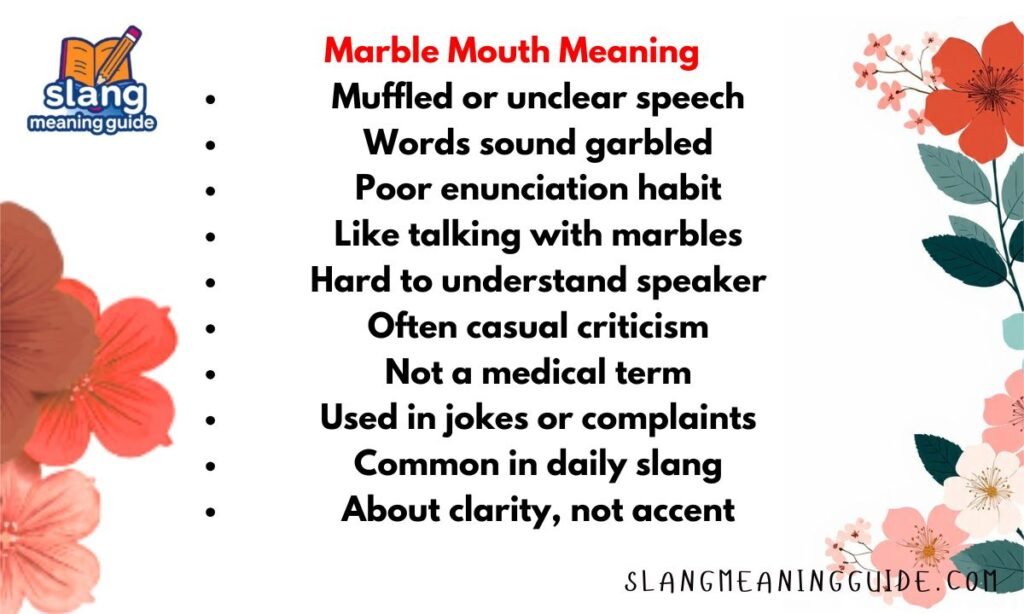
Marble mouth describes a person whose speech is so muffled, mumbled, or poorly enunciated that listening to them feels like decoding a puzzle. The words are physically in their mouth — they just never quite make it out clearly. It is both a literal description and a sharp piece of everyday slang.
What “Marble Mouth” Means
The term marble mouth is an idiomatic expression used to describe unclear, garbled speech. It paints a vivid picture: imagine trying to talk with a mouthful of round, rolling marbles. The sounds come out distorted, soft, and hard to follow. That is what it feels like to listen to someone described this way.
In everyday use, the phrase is almost always a criticism. It targets people who mumble, swallow their words, rush through sentences without pausing, or simply fail to open their mouth enough when they speak. It is not about accents or speech disorders specifically — it is about the end result: words that cannot be understood.
Core Meanings Explained
The Classic Mumbler
Definition: A person who speaks too quietly or without clear enunciation, making their speech hard to follow.
Key usage: Used when someone speaks but the listener has to constantly ask them to repeat themselves. The problem is not volume alone — it is a lack of mouth movement and clarity.
Examples:
- “Stop being a marble mouth and say it properly.”
- “I sat through his whole presentation and understood maybe half of it — total marble mouth.”
Speech Impediment Context
Definition: A mild, informal descriptor for someone who seems to physically struggle with forming words cleanly.
Key usage: Applied when a person’s speech sounds physically obstructed or labored, even if there is no diagnosed condition behind it. It is slang, not a medical term, and should be used carefully in sensitive contexts.
Examples:
- “Eli Manning was famously called a marble mouth because of how he stumbled through post-game interviews.”
- “He is brilliant in writing but a total marble mouth on stage.”
Musical and Performance Criticism
Definition: A singer or performer who fails to enunciate lyrics clearly enough for audiences to understand.
Key usage: Common in music criticism and vocal coaching. Enunciation is a core skill for performers, and marble mouth describes the failure to deliver it.
Examples:
- “Get the marbles out of your mouth — I couldn’t catch a single lyric.”
- “The coach told her she was singing like a marble mouth and needed to open up more.”
Origin and Evolution
The phrase traces directly back to the ancient Greek orator Demosthenes, one of history’s most celebrated public speakers. According to historical accounts, Demosthenes had a natural speech impediment early in life.
To overcome it, he practiced delivering speeches with small pebbles placed in his mouth, shouting over the crashing waves of the ocean to build projection and clarity.
The logic was simple: if you can speak clearly with objects in your mouth, speaking without them becomes far easier. That training legend gave birth to the idioms “marble mouth” and “get the marbles out of your mouth,” both of which carry the same core message — speak clearly or do not speak at all.
| Term | Estimated Origin | Platform Where It Became Popular | Current Status |
| Marble mouth | Ancient Greece (via Demosthenes legend) | Everyday spoken English | Widely used slang |
| Get the marbles out of your mouth | 17th–18th century elocution culture | Speech training, theatre | Still common in vocal coaching |
| Mumble mouth | Modern informal English | Social media, casual conversation | Regional variation in use |
How People Use Marble Mouth in Conversations
People drop this phrase casually when complaining about someone who is hard to understand. It shows up in text messages, social media comments, sports commentary, and music criticism. It is punchy, visual, and lands faster than a full explanation.
Someone joking around with a friend who rushes their words might say it without any real criticism behind it. It also works as a light-hearted nudge between friends. Context determines whether it stings or gets a laugh.
Real usage examples:
- “Bro what did you just say? Stop being a marble mouth 😭”
- “Half the cast on that show are marble mouths, I need subtitles”
- “My professor speaks like he has marbles in his mouth every single lecture”
- “Loved the album but the vocals? Total marble mouth — couldn’t understand a word”
- “Tell him to stop mumbling in meetings. Classic marble mouth energy.”
Common Misunderstandings
Some people assume marble mouth is a clinical or medical term. It is pure slang, and using it in a medical or professional setting would be inappropriate and inaccurate. It also gets confused with other “marble” idioms that carry completely different meanings.
Incorrect interpretations:
- Thinking it refers to a specific diagnosed speech disorder
- Confusing it with “lose your marbles,” which means to go crazy — completely unrelated
- Assuming it only applies to singing or performance contexts
- Believing it is tied to a specific accent or cultural background
- Using it as a clinical description in any healthcare or academic setting
Formal vs Informal Use
In formal settings, marble mouth has no place. Medical professionals, educators, and speech therapists use precise clinical language to describe speech difficulties. Marble mouth belongs to casual conversation, not professional diagnosis or formal writing.
Formal alternatives:
- “He demonstrates reduced oral articulation in conversational speech.”
- “The patient presents with dysarthric speech patterns.”
- “Her enunciation requires significant development before public performance.”
Informal uses:
- “He is such a marble mouth in interviews.”
- “Get the marbles out of your mouth, I can’t hear you.”
- “Why does every character in this show talk like a marble mouth?”
Comparison With Similar Words or Slang
| Word | Meaning | Where It’s Used | Difference From Marble Mouth |
| Mumbler | Someone who speaks too quietly or indistinctly | Everyday conversation | Less vivid, no historical origin |
| Incoherent | Unable to express ideas clearly | Formal and informal | Broader; applies to ideas, not just speech sounds |
| Tongue-tied | Too nervous or confused to speak properly | Casual conversation | Implies nervousness, not a general habit |
| Lose your marbles | To go crazy or lose your mind | Casual slang | Completely different meaning — mental state, not speech |
| Slurring | Blending words together unclearly, often from fatigue or alcohol | Medical and casual | Implies a physical or substance-related cause |
Examples in Social Media and Text Messages
Text conversation:
“Did you watch his press conference?” “Yeah lol what was he even saying” “Right? Marble mouth energy the whole time 💀”
Twitter/X style:
“Watched the interview three times and still couldn’t understand him. Marble mouth hall of fame.”
Group chat:
“Someone tell the new guy to stop mumbling in stand-ups” “LMAO he is genuinely the biggest marble mouth I’ve ever worked with”
Frequently Asked Questions
What does marble mouth mean in simple terms?
It means someone who speaks so unclearly or mumbles so much that they are very hard to understand.
Is marble mouth a medical term?
No, it is an informal slang expression and has no clinical or medical definition.
Where does the phrase marble mouth come from?
It comes from the story of Demosthenes, the Greek orator who trained to speak clearly by holding pebbles in his mouth.
Is saying someone is a marble mouth offensive?
It can be, depending on context — it is a criticism of how someone speaks and should be used carefully.
What is the difference between marble mouth and losing your marbles?
Marble mouth describes unclear speech; losing your marbles means going crazy — they share a word but nothing else.