
A single finger can tell a story that takes a novelist three chapters to write. Gesture dance turns the human hand into the most powerful storytelling tool on earth. Here is everything you need to know about what gesture dance means — and why it matters more in 2026 than ever before.
What Is Gesture Dance?
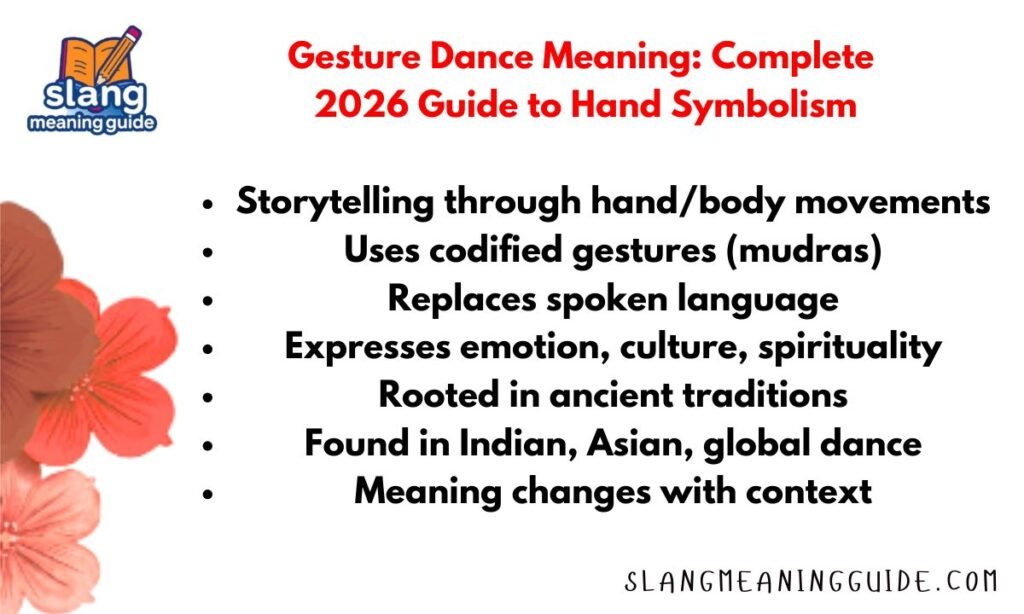
Gesture dance is any dance form that uses deliberate, codified hand and body movements to communicate meaning, emotion, or narrative. It replaces spoken language with physical symbols — each position of the fingers, wrist, and arm carries a precise message.
Cultures across every continent have developed their own gesture vocabularies across thousands of years. From Indian mudras to Cambodian apsara hand forms to China’s ancient Qiuci flows, gesture dance is both deeply local and universally human. The body becomes the text. The hands become the words.
Core Definition of Gesture Dance
The word mudra comes from Sanskrit. It derives from the root verb “mud,” meaning pleasure. The suffix added to it means “to give” — so a mudra literally means “that which gives pleasure.” In dance, this translates into hand shapes that please both the gods and the viewer.
In the Indian classical tradition, the ancient Natyashastra — a 2,000-year-old treatise on performing arts — first codified this idea.
It gave dancers a complete language of hands: specific finger positions, wrist angles, and combinations that each carry defined meanings. That system still forms the foundation of gesture dance training today.
Why Gesture Replaces Words
The ancient principle is this: where the hand goes, the eyes follow. Where the eyes go, the mind follows. Where the mind goes, emotion follows. This chain — hand to eyes to mind to feeling — is the entire engine of gesture dance. A dancer does not need to speak. The hands speak for them.
This is why gesture dance works across language barriers. A viewer who does not speak Hindi can still feel the story of a Bharatanatyam performance.
A viewer who does not understand Mandarin can still follow the arc of a Qiuci narrative. Gesture dance communicates in a frequency that bypasses language entirely.
Historical Gesture Dance Origins
Gesture dance did not begin as art. It began as ritual. Ancient priests, temple performers, and spiritual leaders used precise hand positions to invoke deities, mark sacred transitions, and enact cosmic narratives in physical form. The art came after — once the gestures were standardized and taught.
Every major ancient civilization developed its own gesture vocabulary. The oldest surviving written record of gesture systems in dance comes from the Indian Natyashastra, but visual evidence — cave paintings, temple sculptures, and friezes — shows gesture dance across Egypt, Greece, Mesopotamia, and East Asia just as early.
Ancient Silk Road Influences
The Silk Road was not just a trade route. It was a corridor for cultural exchange — and gesture dance traveled along it just as actively as silk and spice did. The Qiuci region, known today as Kuqa in Xinjiang, China, sat at a critical junction of the Silk Road.
It absorbed dance traditions from India, Persia, and Central Asia, blending them into a unique gesture vocabulary tied to Buddhist iconography. The Kizil Caves near Kuqa contain some of the oldest surviving murals of dancing figures in Asia.
These paintings show celestial musicians and apsaras — heavenly beings — depicted with specific hand positions that match descriptions in Sanskrit texts. Scholars who have studied these murals recognize gestures that appear almost identically in Indian Bharatanatyam, centuries later. The Silk Road moved the hands, not just the goods.
Vedic Roots of Dance Hastas
India formalized gesture dance earlier than any other recorded civilization. The Natyashastra, attributed to the sage Bharatamuni, describes hasta mudras — hand gestures — in precise anatomical detail.
It classifies them into Asamyukta hastas (single-hand gestures, 28 in total) and Samyukta hastas (double-hand gestures, 23 primary forms). Each gesture carries multiple possible meanings depending on the context of the performance.
The text states clearly: “Sing the song by the throat. Express the meaning through hand gestures. Show the state of feelings through the eyes. Express the rhythm with the feet.”
This four-part principle remains the foundation of Indian classical dance training more than 2,000 years later. The hands are not decoration. They carry the semantic weight of the entire performance.
Mudras in Indian Classical Dance
Indian classical gesture dance is the most codified gesture system in the world. Bharatanatyam alone uses over 50 primary mudras — each with a defined shape, a defined meaning, and defined contexts for use.
Kathak, Kuchipudi, Odissi, and Manipuri each carry their own mudra vocabularies, though they share a common Natyashastra foundation.
Facial expressions pair with every mudra. The combination of hand gesture and facial emotion — called abhinaya — is what separates a technically correct mudra from a communicative one.
A dancer who forms the gesture perfectly but shows no corresponding facial expression delivers information without meaning. The two must work together.
Key Mudras and Their Meanings
The Pataka mudra — meaning “flag” — is the most fundamental. All fingers straight, close together, thumb slightly bent. This single gesture can represent a blessing, the sky, water, wind, a command to stop, the beginning of a story, or the act of taking a pledge.
The dancer’s context, the accompanying music, and the surrounding choreography determine which meaning is active at any given moment. The Mayura mudra — meaning “peacock” — brings the ring finger to touch the thumb while the other three fingers extend. It depicts peacocks, birds’ necks, Krishna’s feathers, and creeping vines.
The Ardha Chandra — “half moon” — holds the thumb straight in line with the fingers at a horizontal angle. It depicts the moon, a spear, and the throat. Each of these gestures, performed in sequence with music and expression, allows a dancer to narrate an entire story without speaking a single word.
Qiuci Hand Gestures 2026 Revival
Qiuci dance is one of the most significant cultural revivals of 2026. This ancient form from the Qiuci region of Xinjiang draws directly from the Kizil Cave murals, which depict celestial musicians holding instruments and making specific hand gestures in frozen performance.
The revival brings those painted gestures back into motion. In February and March 2026, the stage production Apricot Flower About Silk Road Qiuci debuted in Beijing, blending storytelling, music, and dance to bring the world of ancient Kuqa to contemporary audiences.
The production sparked a wave of classroom interest across Xinjiang, with teachers introducing children to the thumb-index pinch gesture — the signature move of the Kizil Cave celestial musicians — as a starting point for understanding their own cultural heritage.
The Qiuci gesture vocabulary shares roots with Indian mudras, reflecting the Buddhist exchange that traveled the Silk Road more than 1,000 years ago.
The fluid, flowing quality of Qiuci hand movements — often described as resembling water more than angles — distinguishes it visually from the more precise, architectural quality of Bharatanatyam hastas. Both are precise. Both are meaningful. But they express that precision through different physical aesthetics.
Symbolism of Key Hand Forms
Gesture dance compresses enormous meaning into small physical movements. A shift of one finger changes the entire meaning of a mudra. Understanding the symbolism behind common gestures reveals how much information a trained dancer transmits in a single second of performance.
The table below captures the most widely recognized gesture forms across traditions:
| Gesture Form | Common Meaning | Dance Tradition |
| Open palms, fingers up | Welcome, blessing, peace | Bharatanatyam, Qiuci |
| Thumb-index pinch | Celestial flow, harmony | Qiuci, Kizil Cave murals |
| Raised arms, palms out | Praise, hope, invocation | Contemporary, Indian |
| Clenched fist | Struggle, power, resistance | Modern / Graham technique |
| Anjali (palms joined) | Greeting, respect, prayer | Bharatanatyam, Southeast Asia |
| Lotus (curved spread fingers) | Beauty, divine blooming | Bharatanatyam, Cambodian |
| Sword gesture (extended index) | Direction, battle, focus | Multiple classical forms |
Flower Mudra Interpretations
The Alpadma mudra — all fingers spread and curved slightly outward — depicts a fully bloomed flower. It carries meanings of beauty, growth, abundance, and divine offering. Dancers use it to represent nature coming alive, the arrival of spring, or the blossoming of devotion toward a deity.
This gesture appears across multiple Asian dance traditions. Cambodian apsara dance uses a nearly identical form. Qiuci mural paintings show celestial musicians making comparable hand shapes.
The flower gesture may be the single most cross-cultural gesture in dance history — every tradition that developed independently arrived at roughly the same form to represent the same idea.
Sword Gesture in Performance
The sword gesture — a flat extended hand cutting downward or forward — appears across Indian, Southeast Asian, and Central Asian dance traditions. In Bharatanatyam, it relates to the Pataka mudra in combat contexts, depicting the act of grasping or swinging a blade.
In Cambodian dance, a similar form marks decisive moments in warrior narratives. What makes the sword gesture significant is not just its battlefield meaning. In many traditions, the same gesture also denotes clarity, decision, and the act of cutting through confusion toward truth.
The symbolism layers: a physical weapon becomes a metaphor for mental sharpness. This dual-level meaning — literal and metaphorical — is present in many gesture forms and is what makes gesture dance philosophically rich as well as visually compelling.
Modern Gesture Dance Trends
Contemporary choreographers do not treat classical gesture vocabularies as museum pieces. They borrow, remix, and recontextualize them. A raised fist in a Martha Graham-influenced work draws on the same symbolic territory as a classical mudra but strips the religious context and replaces it with a political one.
The gesture persists. The meaning shifts to match the era. Social media has added an entirely new dimension to gesture dance in 2026. Short-form video platforms reward gesture-based movements because they read clearly on a small screen.
A mudra translates beautifully to a smartphone camera — it is detailed, precise, and visually distinctive. This made gesture challenges one of the most natural viral formats of the current moment.
TikTok Gesture Dance Meanings
On TikTok, simplified mudra-inspired hand movements appear in dance challenges and tutorial content. Creators adapt classical forms into accessible sequences that viewers can replicate without formal training.
These adaptations are not historically accurate — and most creators make no claim that they are — but they introduce millions of younger viewers to the basic visual logic of gesture dance.
The critical distinction is between entertainment and education. TikTok gesture trends raise awareness of classical forms and often drive curious viewers to search for the original traditions behind the movements they saw.
This awareness pipeline — social media to curiosity to formal study — is one of the unexpected benefits of gesture dance going viral in 2026.
Classroom Qiuci Lessons 2026
In early 2026, Xinjiang classrooms began incorporating Qiuci gesture basics as part of cultural heritage education. Children learn the thumb-index pinch — the core Kizil Cave gesture — as a connection to murals painted more than 1,000 years ago in caves near their homes.
The gesture becomes a physical link to history that a photograph or textbook cannot replicate. This classroom integration is significant beyond cultural preservation.
Research consistently shows that learning gesture-based movement sequences sharpens fine motor skills, improves memory through embodied learning, and increases the retention of historical content when physical movement is paired with visual information. Teaching children to move like the figures in ancient paintings does not just preserve culture. It builds cognitive capacity at the same time.
Learning Gesture Dance Basics
Starting gesture dance does not require years of prior dance training. It requires patience, careful observation, and a willingness to repeat small movements until they become precise and natural. Most classical forms begin with a single-hand gesture — held correctly, held cleanly — before anything else.
The most effective approach is to start with the hands, build body awareness, and only add footwork and facial expression once the hands feel secure. This mirrors how classical teachers have taught gesture dance for centuries. Foundation before complexity. Precision before fluidity.
Practical starting points include free video tutorials covering basic Bharatanatyam mudras, guided Qiuci gesture introductions tied to the 2026 classroom revival, and local or online classical dance schools.
Most professional teachers emphasize that learning even five or six gestures deeply — understanding their shapes, meanings, and contexts — provides more value than superficially learning fifty.
Frequently Asked Questions
What does gesture dance mean?
Gesture dance is movement that uses precise hand and body positions to tell stories and convey meaning without spoken words.
Where did gesture dance originate?
The oldest codified systems come from ancient India, via the Natyashastra, and from the Silk Road’s Qiuci region, informed by Buddhist exchange.
Is Qiuci gesture dance popular in 2026?
Yes — the Silk Road Qiuci revival sparked major stage productions in Beijing and classroom programs across Xinjiang in early 2026.
How do mudras differ from ordinary hand gestures?
Mudras are codified, trained positions with specific defined meanings; ordinary gestures are informal and culturally variable with no standardized vocabulary.
Can beginners learn gesture dance without classical training?
Yes — starting with three to five core mudras and building precision slowly is accessible to anyone, with or without prior dance experience.
Conclusion
Gesture dance meaning reaches far beyond entertainment — it is one of humanity’s oldest technologies for encoding culture, spirituality, and story into physical form.
From the 2,000-year-old mudras of Bharatanatyam to the Qiuci hand flows revived in 2026 Beijing stages and Xinjiang classrooms, every gesture carries layers of meaning that words alone cannot hold.
Learning to read these hand forms is not just learning about dance — it is learning to read one of the oldest languages on earth.