
You got a message ending in “XD” and now you’re second-guessing everything. Is it a joke? An insult? Some kind of typo? It looks like two random letters, but it carries a very specific energy that changes how a whole conversation reads. Here’s exactly what XD means, where it came from, and how to use it without looking out of place.
What Does XD Mean?
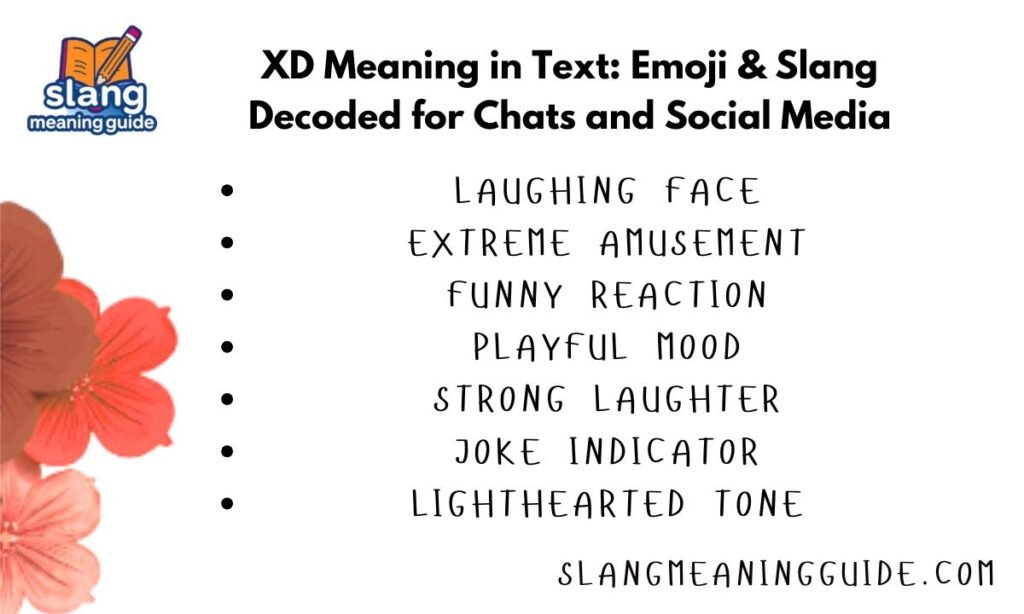
XD is a text-based emoticon that means laughter or extreme amusement. It is not an acronym — it is a visual symbol made from two keyboard characters.
- X = tightly shut or squinted eyes, the way your face looks when you’re laughing hard
- D = a wide open mouth, mid-laugh
Tilt your head sideways and you’ll see a laughing face. That’s the whole idea. It’s ASCII art that predates emojis by decades and still shows up in chats, captions, and comment sections today.
Quick meaning summary:
- Primary meaning: Laughter, amusement, strong humor reaction
- Tone: Playful, light, positive
- Who uses it most: Millennials, Gen Z, gamers, meme communities
- Where you’ll see it: Discord, gaming chats, TikTok comments, DMs, Roblox
Origin and Background of XD
XD was born in the late 1990s and early 2000s when chat rooms and online forums were the main spaces for digital conversation. Before emojis existed, people built faces out of keyboard symbols to show emotion. These were called emoticons, and XD was one of the most expressive ones in the lineup.
1990s–2000s: XD appeared in IRC chat rooms, early AOL Instant Messenger, and gaming forums
2000s–2010s: Spread into mainstream platforms like MSN Messenger, early YouTube comments, and Myspace
2010s: Went mainstream in gaming communities, anime fandom spaces, and meme culture
2019–present: Survived the emoji takeover, now used with nostalgic and ironic undertones alongside emojis like 😂
The fact that XD outlasted dozens of other old-school emoticons says something. It filled a specific emotional slot that “lol” couldn’t quite match.
How XD Is Used in Daily Life
XD shows up constantly in casual digital conversations, usually at the end of a sentence to signal that something is funny or that the person is in a lighthearted mood.
Common patterns:
- Placed at the end of a funny comment: “I tripped over nothing XD”
- Used as a standalone reaction: Someone sends a meme, you reply “XD”
- Paired with emojis for extra emphasis: “XD 😂” or “lmao XD”
- Typed in lowercase for a more casual feel: “xd” vs “XD”
- Doubled for stronger effect: “XDD” or “XDDD”
Platform-specific use:
Gaming chats (Discord, Roblox): High frequency, often typed in lowercase mid-game
TikTok comments: Used to react to funny videos or relatable content
Instagram DMs and captions: Less common but still appears in casual conversations
Text messages: Used between friends who’ve been texting that way for years
Anime and fandom communities: Particularly heavy use, often paired with “omg” or “lmao”
Emotional and Practical Meaning of XD
XD does something that “lol” often doesn’t — it feels visually expressive. When someone types XD, it signals more than a mild chuckle. It tells the reader the sender is genuinely amused or at least wants the message to land as warm and playful.
Emotional signals XD sends:
- “I’m laughing, not being sarcastic”
- “This is a lighthearted moment, don’t take it seriously”
- “I find this genuinely funny, not just politely amusing”
- “I’m comfortable enough with you to be silly”
Practical uses:
- Softens a message that could otherwise read as blunt or harsh
- Signals that a joke is a joke, not a real complaint
- Keeps the energy light after a tense or awkward exchange
- Acts as a social cue to stay relaxed in the conversation
XD vs Similar Slang and Laughter Expressions
XD lives alongside a whole ecosystem of laughter slang, and each one has a slightly different weight.
| Expression | Meaning | Intensity |
| XD | Visual laughing emoticon | Medium-high |
| LOL | Laugh out loud | Low-medium |
| LMAO | Laughing my ass off | High |
| ROFL | Rolling on floor laughing | Very high |
| 😂 | Crying laughing emoji | High |
| Haha / hehe | Typed laughter | Low |
| KEK | Gamer slang for laughter | Medium (niche) |
| LMFAO | Stronger version of LMAO | Very high |
Key differences:
- XD vs LOL: XD feels more expressive and visual, LOL can feel automatic or sarcastic
- XD vs LMAO: LMAO is stronger and more emphatic, XD is softer and more playful
- XD vs 😂: XD is text-based and nostalgic, 😂 is visual and modern
- XD vs haha: XD feels more enthusiastic, haha can land as flat or dismissive
Common Misunderstandings About XD
A few things trip people up when they first encounter XD.
- It is not an acronym. XD doesn’t stand for “extra dope,” “extremely disappointed,” or any letter-based phrase. It’s a face.
- Lowercase xd doesn’t change the meaning. “xd” and “XD” mean the same thing. Lowercase just feels more casual or ironic in certain communities.
- It’s not outdated. Some people assume XD is a relic of 2007. It’s less universal than it used to be, but it’s still active, especially in gaming and meme spaces.
- It’s almost never rude. In rare cases, using XD after someone shares bad news could come across as dismissive, but in normal conversation it’s harmless and positive.
- XD in Roblox is not different. Roblox players use XD the same way everyone else does — as a laughter reaction.
XD in Different Contexts
The same two characters read differently depending on where and how they’re used.
Casual One-on-One Chats
- “I just burned my toast again XD”
- “You really said that out loud?? XD”
- “Okay that got me XD”
Social Media and Comments
- “This video is too relatable XD 😭”
- “Me every Monday morning XD”
- “Why is this so accurate XD”
Gaming and Discord
- “Got killed by a bot XD”
- “XD bro you actually missed that”
- “My team just ran off a cliff xd”
Dating App Conversations
- XD is generally a positive sign — it means the person is comfortable enough to be playful
- “You’re actually funny XD” reads as a genuine compliment
- Be careful using it too early if you want to come across as mature or serious
Group Chats
- XD is common in fast-moving group threads where people react quickly
- Often paired with memes or reactions
- Sets a relaxed, joking tone for the whole conversation
Meaning Across Social Media Platforms
TikTok
XD appears in comments reacting to funny or chaotic videos. Often used alongside 💀 or 😭 for layered humor.
Used in DMs and casual captions. Less common than on TikTok but still active among younger users and in niche interest communities.
Discord
One of the highest-frequency platforms for XD. Gaming servers and general hangout servers use it constantly, often in lowercase.
Snapchat
Appears in streaks and casual snaps between friends. Usually signals a lighthearted or goofy vibe.
Twitter / X
Used in replies to viral jokes or memes. Can also appear ironically, where someone types XD to emphasize they find something predictable or dry.
How to Respond When Someone Sends XD
The easiest rule: match the energy. If someone sends XD, they’re in a playful mood. Here are some natural responses.
Casual replies:
- “XD right??”
- “lmaooo same”
- “I can’t 😂”
Friendly replies:
- “Okay that actually got me 😭”
- “XD XD I’m crying”
- “Stop I’m in public trying not to laugh”
Neutral replies:
- “Haha yeah”
- “Honestly fair XD”
- “Right 😅”
If XD feels out of place or unexpected:
- Just continue the conversation normally — it’s not a question that needs answering
- You can mirror it back: “XD what even was that”
When Not to Use XD
XD is a casual tool and context matters a lot.
Avoid XD in these situations:
- Work emails or professional Slack channels
- Condolence messages or serious emotional conversations
- First contact with someone you don’t know well (can read as immature)
- Customer service or formal complaints
- Any situation where you want to be taken seriously
Safe alternatives by situation:
- Professional setting: “That’s funny!” or “Ha, that made me laugh”
- Formal message: Skip the laughter reaction entirely
- Sensitive conversation: Respond with words, not emoticons
Why XD Still Matters in 2026
XD has survived longer than most people expected. The reason is a combination of nostalgia, efficiency, and subculture identity.
Nostalgia: People who grew up with XD keep using it because it feels natural
Gaming culture: Gaming communities adopted XD early and it became embedded in their communication style
Ironic use: Younger users sometimes use XD to signal they’re aware of its old-school vibe, which itself becomes a joke
Speed: Two characters, clear meaning, no need to open the emoji keyboard
Anime and fandom communities: Heavily overlap with early internet culture where XD was standard
It’s less dominant than it was in 2010, but it hasn’t disappeared. It just shifted from mainstream to subcultural.
Examples of XD in Sentences
- “I just tried to pay with an expired card XD”
- “She actually said that to his face XD I’m dead”
- “XD okay that was actually a good joke”
- “My dog just ran into the glass door again XD”
- “I’ve watched this clip 12 times XD it doesn’t get old”
- “XD bro you’re cooked” (gaming context — lighthearted teasing)
- “That plot twist?? XD I didn’t see that coming”
Frequently Asked Questions
What does XD mean in simple words?
XD is a text emoticon that represents a laughing face, used to show amusement or strong humor in digital conversations.
Is XD positive or negative?
XD is almost always positive — it signals laughter, playfulness, and a lighthearted mood.
Where is XD commonly used?
XD is most common on Discord, in gaming chats, TikTok comments, group texts, and among anime and meme communities.
Is XD formal or informal?
XD is informal and should only be used in casual conversations with friends or people you’re comfortable with.
Is XD outdated in 2026?
Not entirely — XD is less universal than before but still widely used in gaming, meme culture, and by millennials who grew up with it.
Conclusion
XD is two characters that do a lot of work. It’s a laughing face built from a keyboard, born in chat rooms before smartphones existed, and still going strong in gaming servers and comment sections today.
It’s not rude, not an acronym, and not dead — it’s just a very specific kind of playful energy that fits casual digital conversation better than almost anything else. Read the room, match the tone, and XD works exactly the way it’s supposed to.