
You get a link in a group chat. Before you tap, you see four letters above it. You pause. Those four letters just stopped you from opening something you might regret. That is NSFW doing its job — and most people who use it daily still do not know the full story behind it.
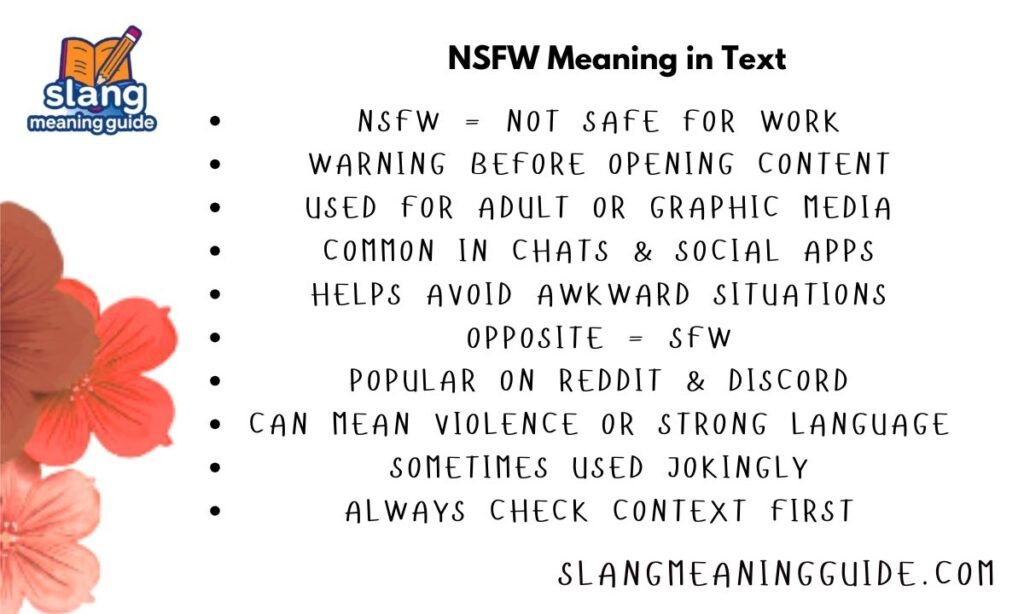
Quick answer: NSFW stands for “Not Safe For Work.” It is a content warning placed before links, images, videos, or messages that contain material inappropriate to open in professional, public, or family settings. It tells you to wait, not click yet.
What Does NSFW Mean in Text and Chat?
NSFW is a four-letter acronym used as a warning before content that could embarrass you if opened at the wrong time or place. The full form is “Not Safe For Work,” though the warning applies far beyond office desks.
People use it in texts, group chats, emails, social media captions, and Reddit posts. It is not a judgment about the content itself — it is a heads-up about context. The content might be perfectly legal and relatively normal, just not something you want your boss or your grandmother seeing over your shoulder.
Quick example in chat
Friend: “Sending you something, it’s NSFW 😅”
You: “Got it, checking it later at home.”
Full Form, Stands For, and Short Meaning
- Full form: Not Safe For Work
- Short meaning: A content warning for material inappropriate in public or professional settings
- Common use: Before links, videos, images, or messages with adult content, graphic violence, or strong language
- Opposite term: SFW — Safe For Work, meaning the content is fine to open anywhere
- Related warning: NSFL — Not Safe For Life, used for content more disturbing than explicit
Origin and History of NSFW
The term traces back to early internet forums and email chains in the late 1990s and early 2000s. People sharing links at work needed a shorthand to warn coworkers before they clicked something that would land them in HR.
- Around 2000–2002: First documented use on message boards and early online communities
- 2003: Defined on Urban Dictionary, the unofficial record of internet slang
- Mid-2000s: Reddit formally adopted it as an official post tag, giving it institutional weight
- 2011: Added to Oxford Dictionaries Online
- 2015: Merriam-Webster added it to their dictionary
- 2016: Oxford English Dictionary included it, citing earliest evidence from 2002
It moved from email courtesy to platform policy to standard dictionary entry in about fifteen years. Not bad for an office acronym.
How People Use NSFW in Daily Conversations
NSFW appears in personal messaging, group chats, and social media far more than in formal communication. Here is how it shows up across different everyday situations:
- Before a link: “This article is wild, NSFW though” — gives the receiver a choice before clicking
- Before a video: “NSFW but this clip is genuinely shocking” — prepares them for intensity
- Before an image: “NSFW incoming, don’t open this at the office” — lets them decide when to look
- Ironically: “NSFW but I just discovered the best pasta of my life” — uses the format for comedic effect on harmless content
- In group chats: Protects people who are in different environments when the message arrives
Note: Ironic NSFW only works when both people know the joke. Using it on genuinely adult content as if it were a joke trains people to ignore the warning. That is when real situations become awkward.
NSFW Meaning Across WhatsApp, Instagram, TikTok, and Snapchat
The core meaning is the same everywhere, but how each platform handles it differs:
| Platform | How NSFW is used |
|---|---|
| Typed before links or media in personal and group chats — no built-in filter | |
| Used in DMs or captions; the platform has its own content filters for public posts | |
| TikTok | In video captions to alert viewers before they hit play; not a platform tag |
| Snapchat | Added before sending snaps, especially in private groups, as a personal heads-up |
| An official post tag that hides content behind a confirmation screen | |
| Discord | Used to designate channels as adult-only, restricting access by settings |
| Twitter / X | Content tag on posts and media, which can be filtered by user preferences |
Other Meanings of NSFW You Should Know
The standard meaning covers almost all real-world use, but a few variations exist in specific communities:
- Not Safe For Wife — A joke variation used in meme communities for content someone would not want their partner to see them viewing. Clearly ironic.
- Not Suitable For Watching — Occasionally used to stress that the content is genuinely difficult to sit through, separate from workplace context.
- Not Safe For Wimps — Used in extreme sports and horror communities to signal content that requires a strong stomach rather than warning about explicitness.
None of these create real confusion in practice. Context makes the reading obvious every time.
NSFW in Different Contexts
In texting and messaging
- Functions as a courtesy — gives the person a moment to choose when to engage with the content
- Keeps trust intact in close relationships by avoiding unwanted surprises
- Prevents awkward situations when someone is in a mixed or public setting
In love and relationships
- Often signals intimate or suggestive content between partners
- Using it shows awareness of consent — you are not assuming the other person is ready to receive that kind of content without warning
- Absence of the warning before explicit content is increasingly considered inconsiderate
In casual slang
- Gen Z uses it as both a genuine warning and a comedic device
- Attaching it to completely harmless content (“NSFW: my dog learned a new trick”) signals that what follows is personally significant or dramatic
- The irony only works because everyone already knows what NSFW actually warns about
In gaming and creative communities
- Flags graphic violence, dark themes, or mature content in gaming clips and fan art
- Used in fan fiction and art communities to separate content made for adult audiences from general-audience work
Who Uses NSFW Most
| Group | How they use it | Why it works |
|---|---|---|
| Reddit users | Official post tagging before explicit or graphic content | Platform expectation; part of community norms |
| Content creators | Caption or description warning before mature material | Protects audience trust and platform standing |
| Gen Z | Group chats, DMs, social captions — serious and ironic | Fast, universally understood, no explanation needed |
| Gaming communities | Flagging graphic violence or mature game clips | Gaming content ranges widely in intensity |
Common Confusions and Wrong Interpretations
A few persistent myths around NSFW are worth clearing up:
- NSFW does not mean illegal content. It flags content inappropriate for certain contexts — not content that breaks any law. Legal adult material, graphic journalism, strong language, and dark humor all qualify as NSFW. Actual illegal content gets removed, not tagged.
- NSFW does not always mean sexual. Graphic violence, disturbing news footage, and offensive language all warrant the label. Not every NSFW warning leads somewhere explicit.
- NSFW and SFW are opposites. Mixing them up sends someone toward something they were not prepared for, or steers them away from something completely fine. The distinction matters more than it seems.
- Using NSFW ironically on safe content too often backfires. It trains the recipient to tune out the warning, which creates real problems when a genuine one arrives.
Similar Terms, Alternatives, and Related Slang
- SFW Safe For Work — the opposite; content is fine to open anywhere
- NSFL Not Safe For Life — more extreme than NSFW; used for genuinely disturbing content like gore
- TW Trigger Warning — flags content that may be emotionally distressing to specific audiences
- CW Content Warning — broader label used on social media for sensitive topics
- 18+ Age-restricted content; similar function, more formal framing
- Spoiler Warning label for plot-related information that ruins surprise
Real Conversation Examples of NSFW in Action
Example 1 — graphic video link
A: “NSFW but this documentary clip is genuinely hard to watch.”
B: “Thanks, opening it at home tonight.”
Example 2 — meme in group chat
A: “This meme is hilarious but totally NSFW 😂”
B: “Bookmarking it for after work.”
Example 3 — ironic use
A: “NSFW but I just ate the most incredible sandwich of my entire life.”
B: “The drama. What was in it.”
Example 4 — Reddit context
A: “Had to mark the post NSFW because of the language.”
B: “Makes sense, platform flagging is real.”
Example 5 — gaming clip
A: “NSFW clip from last night’s session — some brutal moments.”
B: “Sending it to the squad.”
How to Reply When Someone Says NSFW
There are really only two situations: you are ready to engage with it, or you are not in the right place yet.
- If you are somewhere public or at work: “Noted, checking this later at home.” Short, no pressure on either side.
- If you are fine to open it: React to the actual content — not just the warning. Acknowledge what you saw.
- If it was more intense than expected: “That was more than I anticipated, appreciate the heads-up though.” Honest feedback without drama.
- If it was clearly ironic NSFW: Play along. “The audacity to mark a sandwich NSFW.”
The person who added NSFW put it there as a courtesy. A quick acknowledgment that the warning registered is all they need.
Is NSFW Still Relevant in 2026?
Yes. Remote work and mobile privacy changed where people open content, but the core problem NSFW solves has not gone away. People still move between public and private spaces throughout the day, and mixed-audience group chats have not gotten smaller.
- Reddit, Discord, Twitter/X, and Patreon all still use NSFW as an official content tag
- Merriam-Webster and the Oxford English Dictionary both carry it — it is no longer just slang
- Gen Z uses it daily in casual text alongside ironic variations
- Platforms have built filter systems around it, which means the abbreviation is now part of actual content policy — not just social courtesy
New slang emerges constantly, but NSFW survives because it solves a real problem with four letters. That kind of utility does not expire.
Frequently Asked Questions
What does NSFW stand for in a text message?
NSFW stands for “Not Safe For Work” — a warning that the content being shared is inappropriate to open in public, professional, or family settings.
Does NSFW always mean sexual content?
No — NSFW also covers graphic violence, strong language, disturbing subject matter, and anything else inappropriate for certain audiences or settings.
Is it OK to send NSFW content to someone?
Only if they have clearly consented to receiving it — always warn first, never assume, and respect it if they say they would rather not.
What is the difference between NSFW and NSFL?
NSFL (Not Safe For Life) is used for content more extreme and disturbing than NSFW — typically gore or deeply upsetting material that goes beyond typical adult content warnings.
Is NSFW outdated in 2026?
No — it is still widely used across major platforms, included in mainstream dictionaries, and built into official content moderation systems on Reddit, Discord, Twitter/X, and others.
Conclusion
NSFW is four letters that do one thing well: they give the recipient a choice before they encounter something they might not be ready for. It started as an email courtesy in early internet forums, became a platform tag, entered the dictionary, and is now part of how people communicate online every day. Simple, practical, and still relevant. Always better sent than left out.