
Someone just said “clock it” with a little finger snap, and now everyone’s laughing except you. Is it shade? A compliment? A dare? The phrase sounds casual, but it carries cultural weight, generational layers, and a very specific meaning that changes depending on who’s using it. Here’s everything you need to know.
Quick Definition: What Does “Clock It” Mean?
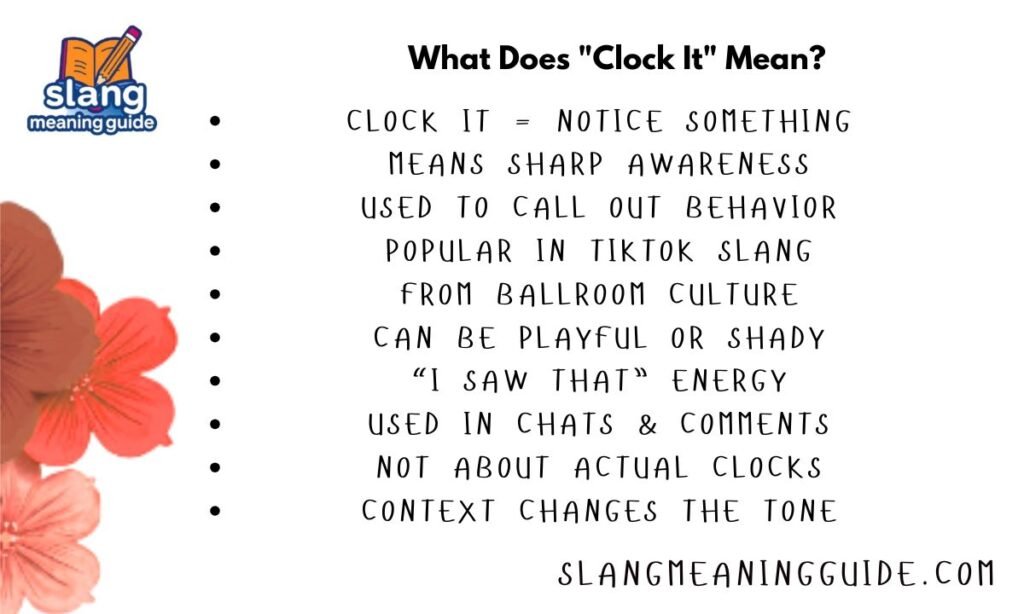
“Clock it” means to notice, recognize, or call out something — often something subtle, unspoken, or that someone was trying to hide.
At its core, it signals sharp awareness. Common interpretations include:
- “I see exactly what’s going on here.”
- “I caught what you just did.”
- “That truth just got exposed.”
- “I noticed what others missed.”
Simple examples:
- “The way she changed her tone when he walked in — I clocked it.”
- “Don’t act normal. We all clocked the attitude.”
- “He clocked the mistake before anyone else noticed.”
It sits somewhere between “I noticed” and “I’m calling that out” — sharper than a quiet observation, softer than a full confrontation.
Where Did “Clock It” Originate?
“Clock it” did not start on TikTok. It did not come from Gen Z. And it is not new.
The phrase has deep roots in Black and Latinx ballroom culture, born in 1960s New York City:
- In ballroom spaces, “to clock someone” meant to notice something about them they were trying to conceal — particularly around gender identity or sexuality.
- A trans woman being “clocked” meant someone had identified her as trans, often against her wishes. This gave the word serious weight in those communities.
- The phrase spread through drag and ballroom scenes for decades before reaching mainstream audiences.
How it reached the mainstream:
- RuPaul’s Drag Race introduced ballroom language to a wider TV audience from the 2000s onward.
- TikTok influencer Queen Opp went viral in 2022 repeatedly saying “clock that tea,” helping push the phrase into everyday use.
- Love Island USA star Ace Greene’s viral 2025 diss track included “clock it” and the finger gesture in the chorus — that was the final push into Gen Z and Gen Alpha vocabulary.
Ballroom icon Leiomy Maldonado, who helped popularize the finger clap gesture on HBO Max’s Legendary, has noted that the phrase has been in ballroom culture far longer than most people credit.
Real-Life Conversations: Clock It in Action
Here’s how it actually sounds across different platforms.
WhatsApp:
- Person A: “Why is he being so helpful all of a sudden?”
- Person B: “I clocked that energy the second he walked in.”
Instagram DMs:
- Person A: “Did you see her delete those comments?”
- Person B: “Oh, I clocked it immediately 😂”
TikTok comment section:
- Creator video: “POV: He says he’s not jealous.”
- Comment: “The way he looked at your phone… clock it 👀”
Text message:
- Person A: “You were so quiet in that meeting.”
- Person B: “Quiet doesn’t mean I wasn’t clocking everything.”
The pattern across all of these: it’s less about literal observation and more about emotional and social awareness.
Emotional and Psychological Meaning
When someone says “I clocked it,” they’re doing more than describing what they saw. They’re signaling something about themselves.
What “clock it” communicates psychologically:
- “I’m perceptive. I see what others miss.”
- “I’m aware of what’s happening socially.”
- “I won’t be fooled or played.”
- “I see the truth, even if I’m not confronting it directly.”
There’s also a protective quality to it. Saying “I clocked it” lets you signal awareness without escalating conflict. You’re not starting a fight — you’re just making it clear you’re not oblivious. That middle ground is exactly why the phrase caught on so fast.
What the Finger Clap Gesture Means
The gesture — tapping the middle finger against the thumb — is everywhere right now. But it does not technically mean “clock it.”
What the finger clap actually is:
- It comes from ballroom culture, where it was used as a silent signal of approval — miniature applause.
- Leiomy Maldonado used it on Legendary as a nod of recognition, not a callout.
- The gesture became fused with “clock it” through viral TikTok content, where the two started appearing together.
- The correct version uses the middle finger and thumb — not the index finger and thumb. Most people doing it online are using the wrong fingers.
The two got combined through internet virality, not because they originally meant the same thing. Ballroom culture created both separately; internet culture merged them.
Usage in Different Contexts
The phrase flexes depending on setting and tone.
Social media (TikTok, Instagram, Twitter/X):
- Used in reaction comments and call-outs
- Adds drama without full confrontation
- “That smirk right after she ‘apologized’… clock it.”
Between friends:
- Playful, conspiratorial, affectionate
- “I clocked that crush energy the second you mentioned his name.”
- “Your mood changed the moment she walked in. Clocked.”
Romantic situations:
- Used to point out mixed signals or unspoken feelings
- “You keep bringing him up casually. We’ve all clocked it.”
Professional settings:
- Avoid it in formal environments — it reads as confrontational
- In casual workplaces, it can work among colleagues who know each other well
- “I noticed the pattern early” is the professional equivalent
When NOT to Use “Clock It”
Not every situation calls for it. Here’s when to hold back:
Formal settings — meetings, presentations, job interviews
With people unfamiliar with slang — it will confuse or alienate them
Sensitive emotional conversations — it can come off as dismissive or mocking
Around someone questioning their gender or identity — in ballroom culture, being “clocked” as trans was often unwanted and painful; using it carelessly in those contexts is disrespectful
Cross-cultural communication — it doesn’t translate well outside English-speaking, internet-native spaces
Context is the difference between sounding sharp and sounding unkind.
Common Misunderstandings About “Clock It”
A few things people consistently get wrong:
- It’s not about time. Nothing to do with clocks, schedules, or watching the hours.
- It’s not always confrontational. You can clock something quietly, without making it a big deal.
- It’s not always negative. “I clocked your growth this year — genuinely proud of you” is warm and positive.
- It’s not a Gen Z invention. It comes from Black and Latinx queer ballroom culture, decades before TikTok existed.
- The finger snap doesn’t mean “clock it.” The gesture is a separate signal from ballroom that got incorrectly merged through viral content.
Variations and Related Terms
The phrase shows up in several forms, each with a slightly different flavor:
“Clocked it” — past tense; I already noticed it
“Clocking that” — present tense; I’m currently noticing it
“Clock that tea” — notice this piece of truth or gossip
“You got clocked” — someone called you out
“Don’t clock me” — don’t expose what I’m doing
“Clock the vibe” — read the atmosphere of a room
“Clocked and filed” — noticed it, stored it mentally, moving on
“Clock the details” — pay close attention to something specific
Each variation keeps the core meaning intact — awareness, recognition, exposure — while shifting the tone.
How to Respond When Someone Says “Clock It”
Match your reply to the energy they brought.
Casual/playful replies:
- “Nothing gets past you.”
- “You’re too sharp for this group chat.”
- “Okay, detective.”
Funny replies:
- “FBI energy activated.”
- “You clock everything. It’s actually terrifying.”
- “Should I be scared right now?”
Mature replies:
- “Fair. I knew you’d notice.”
- “Yeah, I’ve been sitting with that too.”
Respectful replies:
- “You’re right. That’s worth addressing.”
- “Thanks for paying attention.”
The goal is to match their tone. A playful “clock it” deserves a playful response. A serious one deserves a measured one.
Cultural Roots: Why Credit Matters
Clock it came from ballroom — a culture created by Black and Latinx queer and trans people who built their own world when mainstream society excluded them. This context matters for two reasons.
Why understanding the origin is important:
- Phrases from marginalized communities get borrowed, stripped of meaning, and the source communities rarely get credit
- In ballroom, being “clocked” could have real consequences for trans people — it meant being exposed, which was sometimes dangerous
- Using the phrase carelessly, especially toward trans or queer people, can carry unintended weight
- Honoring the origin doesn’t mean you can’t use the phrase — it means using it with awareness
This is a pattern that has happened with voguing, “tea,” “it’s giving,” and countless other expressions. Knowing the history doesn’t make you less cool for using the slang. It makes you more informed.
Is “Clock It” Safe for Kids?
Generally yes — with a caveat.
- The phrase is not vulgar or explicit
- Most kids use it to show social awareness or get a laugh
- It reflects developing emotional intelligence and reading of social cues
Where parents should pay attention:
- If used to mock or repeatedly call out another kid, it can edge into bullying
- The gesture (finger clap) is often done incorrectly and kids usually don’t know its origin
- Opening a conversation about where slang comes from is a good opportunity, not a red flag
Most of the time, a tween saying “clock it” just means they’re paying attention to the room — which is actually a healthy sign.
FAQ About “Clock It”
What does “clock it” mean in slang?
It means to notice, recognize, or call out something — often something subtle or unspoken.
Is “clock it” rude or disrespectful?
Not inherently — tone and context determine whether it feels playful, sharp, or confrontational.
Where does “clock it” actually come from?
It originated in Black and Latinx ballroom culture in New York City, where “clocking” someone meant recognizing something about them they were hiding.
Does the finger gesture mean the same thing as “clock it”?
No — the finger clap is a separate signal from ballroom culture meaning approval; the two were merged incorrectly through viral TikTok content.
Can you use “clock it” in professional settings?
Only in casual, informal workplaces — avoid it in formal environments where it reads as confrontational or out of place.
Conclusion
“Clock it” is two words doing a lot of work. It signals awareness, calls out truth, and communicates social sharpness without needing a full confrontation.
It comes from ballroom culture — a community built by Black and Latinx queer and trans people — and has traveled through drag, reality TV, and TikTok to land in everyday group chats and school hallways. Use it when you want to signal that you see what’s happening.
Use it knowing where it came from. And if someone clocks you? The honest response is usually to just accept it — because they’re probably right.