
You typed it fast and now you’re staring at the screen wondering if it looks right. English has enough irregular spellings to make anyone second-guess themselves. Here’s the short answer — and everything else worth knowing about this word.
Is It Beaf or Beef?
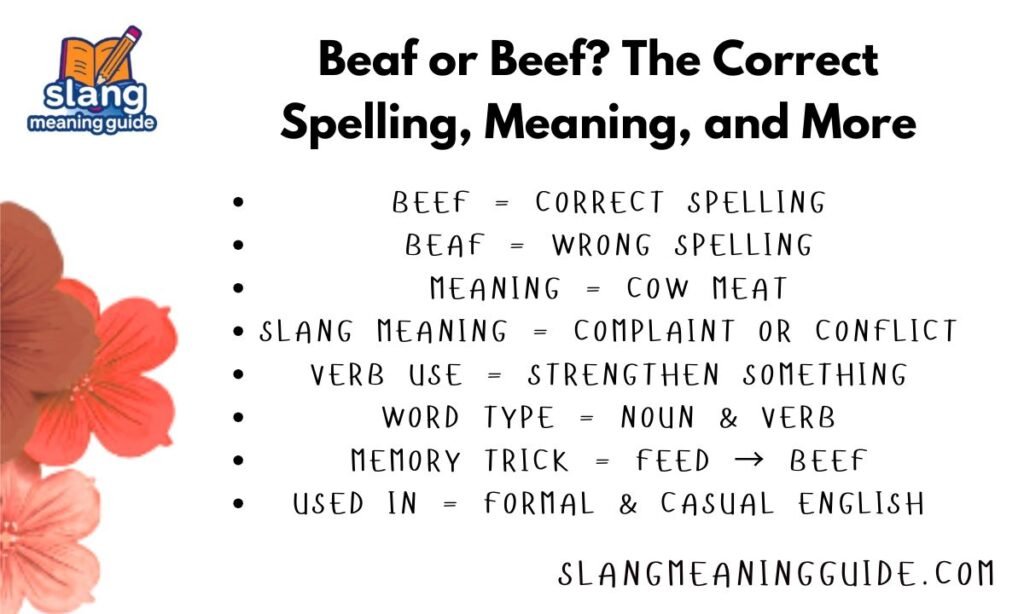
Beef is the correct spelling. Always.
Beaf is not a real word. It has no dictionary entry, no definition, and no legitimate use in written English. Spell-check flags it every single time.
The confusion happens because English is inconsistent. Words like leaf, deaf, and sheaf all use the “ea” vowel pattern. So the brain assumes beef might follow the same rule. It doesn’t.
Beef uses a double “ee” — and that’s the only version that exists.
Quick Answer: Beaf vs Beef
| Beef | Beaf | |
| Correct? | ✅ Yes | ❌ No |
| Real word? | Yes | No |
| Meaning | Cow meat / a complaint | None |
| Part of speech | Noun and verb | Not valid |
| Spelling pattern | -ee- (double e) | Incorrect |
| Used in formal writing? | Yes | Never |
Read Must: Absense or Absence? Here’s the Only Correct Spelling
Core Meanings of “Beef” Explained
Beef does more than describe dinner. It carries three distinct meanings depending on context.
Beef as Food
This is the most common use. Beef refers to the meat that comes from cattle — cows, bulls, oxen, or steers.
examples:
- She slow-cooked the beef for three hours until it fell apart.
- Ground beef is the base of a good burger.
- The menu offered a choice between salmon and roast beef.
- He bought grass-fed beef from the local butcher.
Beef as a Complaint or Dispute
This is the slang use — and it’s everywhere. When someone says they “have beef” with another person, they mean a grievance, a conflict, or unresolved tension.
examples:
- He had beef with his landlord over the broken heating.
- What’s your beef with the new policy?
- The two artists had public beef for years before settling it.
- She made it clear she had no beef with the decision.
Beef as Muscle or Strength
This use is less common but real. Beef can describe physical bulk or power, or the act of reinforcing something.
examples:
- He put on serious beef after six months of training.
- They beefed up security ahead of the concert.
- The coach beefed up the defensive lineup before playoffs.
- The report needed more beef — more data, more substance.
Living Without Worry — When “Beef” Becomes a Mindset
There’s a certain kind of person who carries no beef with anyone.
No grudges. No unresolved tension. And No lingering complaints.
That’s the mindset — living without worry, without drama, without the weight of things left unsaid. In slang culture, “no beef” signals peace. It means clean slate, no hard feelings, move forward.
When you stop carrying beef with people who wronged you, you stop carrying the weight too. That’s not weakness. That’s choice.
The word itself has evolved from describing what’s on your plate to describing what’s in your head. And the people who carry the least of it tend to live the most freely.
Origin + Evolution Timeline
Where Did “Beef” Come From?
| Period | What Happened |
| Prehistoric times | Humans began eating cattle meat with no standardized name |
| 13th century | Old French boef (meaning ox or cow) entered English after the Norman Conquest |
| 1300s | English adopted the word as beef, referring to the meat from cattle |
| 1860s | “Beef” began being used as a verb meaning to complain |
| 20th century | “Beef” entered American slang as a word for conflict or grudge |
| Hip-hop era (1980s–2000s) | “Beef” exploded in rap culture to describe feuds between artists |
| Social media age | The word became universal shorthand for any public dispute or rivalry |
| Today | Both meanings — food and conflict — are widely recognized globally |
Key milestones at a glance:
- Rooted in Old French boef, which itself traces to Latin bov- (meaning head of cattle)
- The “ee” spelling was standardized in English centuries ago — never “ea”
- “Beaf” never appeared in any recognized dictionary at any point in history
- The slang use of “beef” as conflict predates hip-hop by over a century
- Today, the global beef industry is worth hundreds of billions of dollars annually
- “Beaf” shows up in search engines purely because people type it wrong
Common Misunderstandings About “Beef”
Misunderstanding 1: “Beaf” is an alternate or regional spelling
It is not. There is no British version, no American variant, no informal spelling. Beef is spelled the same everywhere in the English-speaking world.
Misunderstanding 2: The “ea” pattern should apply here
Words like leaf, sheaf, and deaf use “ea.” But beef comes from a completely different linguistic root — Old French, not Old English. Different origin, different spelling rule.
Misunderstanding 3: “Beef” only means meat
Not even close. Beef is a noun for food, a noun for a complaint, a noun for a feud, and a verb meaning to strengthen or to complain. It’s one of the most versatile words in everyday English.
Misunderstanding 4: The plural of beef is always “beefs”
Only when referring to complaints or grievances. When talking about types of cattle or the meat itself, beef functions as an uncountable noun — no plural needed.
Formal vs. Informal Uses of “Beef”
The word moves comfortably between professional and casual contexts.
Formal Uses
In culinary, agricultural, and business writing, beef is standard:
- Food industry: “The restaurant sources its beef from certified organic farms.”
- Agriculture: “Beef cattle production accounts for a significant share of U.S. farm revenue.”
- Nutrition: “Lean cuts of beef are a strong source of protein and iron.”
- Legal/workplace: “She filed a formal beef — a written complaint — with HR about the incident.”
Informal Uses
In daily speech and online conversation, beef gets used more loosely:
- “I’ve got no beef with you — we’re good.”
- “They’ve had beef since that game last year.”
- “The gym really beefed him up.”
- “What’s the beef? Just tell me what’s wrong.”
Both registers are correct. The word adapts naturally to the situation.
In Context
These related terms strengthen vocabulary around the topic and help search engines understand the content:
- Bovine meat — technical term used in nutrition and agriculture
- Ground beef — common retail form, used in burgers and tacos
- Beef up — phrasal verb meaning to strengthen or reinforce
- Corned beef — cured beef product, popular in sandwiches and stews
- Lean beef — lower-fat cuts like sirloin or round
- Wagyu beef — premium Japanese cattle breed, prized for marbling
- Grievance / complaint — formal synonyms for the slang meaning of beef
- Feud / dispute / rivalry — words that overlap with the conflict meaning
- Cattle / livestock — broader agricultural terms connected to beef production
- Protein source — nutritional context in which beef frequently appears
How to Never Misspell “Beef” Again
Three memory tricks that stick:
Trick 1: The cow eats feed Cows eat feed. Feed has a double “ee.” So does beef. Same animal, same vowel.
Trick 2: The mnemonic B-E-E-F: “Best Ever Eaten Food.” Four letters, double “e” locked in.
Trick 3: Rhyme it Beef rhymes with reef, brief, and chief — all spelled with “ee,” never “ea.” Group them together in your head and the pattern holds.
Frequently Asked Questions
Is “beaf” ever an acceptable spelling?
No — beaf is always a spelling mistake, with no recognized use in any form of English.
What does “having beef with someone” mean?
It means having a complaint, grudge, or ongoing conflict with that person.
How do you pronounce “beef”?
It’s pronounced BEEF — one syllable, rhymes with leaf, brief, and relief.
Can “beef” be used as a verb?
Yes — “to beef” means to complain, and “to beef up” means to strengthen or reinforce something.
What are common cuts of beef?
The most popular cuts include sirloin, ribeye, brisket, chuck, flank, and ground beef.
Conclusion
Beaf is not a word. Beef is.
The spelling is simple once you lock in the double “ee” — and the memory tricks above make sure it sticks. From the dinner table to rap feuds to legal complaints, beef is one of the most flexible words in English.
It feeds people, drives conversation, and describes everything from what’s on your plate to what’s on your mind. Get it right, write with confidence, and carry no unnecessary beef with anyone.