
Some words stop you cold. You read them once and need answers fast. Eproctophilia is one of those words — odd, clinical, and oddly specific. Keep reading. The full picture is more layered than you expect.
What Is Eproctophilia
This is a psychological term. It belongs to the world of sexology and behavioral science.
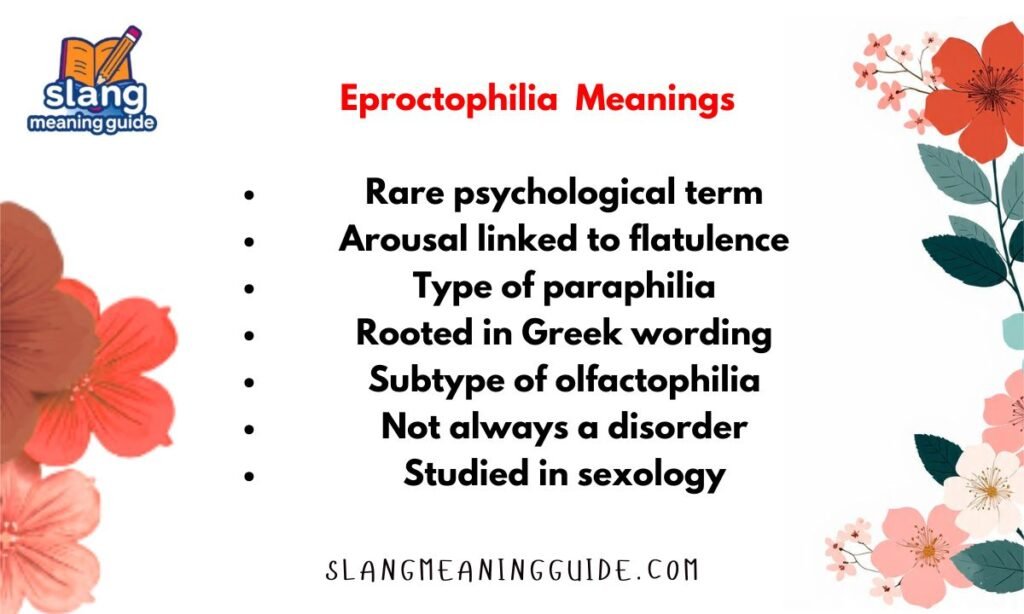
Eproctophilia refers to sexual arousal linked to flatulence. It is classified as a paraphilia — an atypical pattern of sexual interest.
Breaking Down the Word
The term has Greek roots. “Procto” relates to the rectum or anus. “-Philia” means love or deep attraction.
Put them together and the meaning becomes clear. The word literally describes an attraction tied to the act of farting. It appears in forensic psychology texts and academic dictionaries, not just online slang.
How Experts Define It
Researchers define eproctophilia as a fixation on flatulence. The arousal can come from the sound, the smell, or the act itself.
A published case study in the Archives of Sexual Behavior documented a real individual with this attraction. That study marked one of the first formal academic examinations of the condition. It confirmed eproctophilia as a genuine area of psychological study.
Is Eproctophilia a Mental Disorder
Many people confuse rare with disordered. These are not the same thing. A paraphilia describes an unusual sexual interest. A paraphilic disorder involves distress, harm, or non-consenting others.
The Clinical Distinction
Eproctophilia on its own is not automatically a diagnosis. If the interest causes no distress and involves consenting adults, it stays in the paraphilia category.
Psychologists use the DSM-5 to draw this line carefully. The presence of an unusual interest does not mean a person needs treatment. The question is always whether it causes harm or significant personal suffering.
When It Becomes a Concern
A concern arises when the interest takes over daily functioning. It also becomes problematic when it involves non-consensual situations.
Outside those conditions, mental health professionals generally treat it as a variant of human sexuality. Judgment-free awareness is key to understanding this topic properly.
How Common Is Eproctophilia
Hard numbers are difficult to find. Most people never disclose unusual sexual interests to researchers. Self-reporting is low because stigma is high. This makes prevalence data scarce across all paraphilias, including eproctophilia.
What Research Suggests
The published case study described eproctophilia as rare. The subject in that study was a 22-year-old male who reported the attraction developing in middle school.
His experience suggests early-onset interest, possibly linked to curiosity and conditioning. Researchers noted his attraction was stable and not associated with other disorders.
Who Experiences It
Most documented cases involve heterosexual males attracted to female flatulence. However, eproctophilia can appear in any gender or orientation.
Because research is limited, assumptions are risky. A wider population may exist that simply never enters academic literature due to personal privacy.
Eproctophilia vs Similar Paraphilias
Eproctophilia does not stand alone. It shares space with related categories. Understanding the differences helps avoid confusion between overlapping terms.
Connection to Olfactophilia
Olfactophilia is the broader category. It describes sexual arousal from body odors in general.
Eproctophilia is a subtype of olfactophilia. The key difference is specificity — eproctophilia focuses solely on flatulence, not all body scents.
Comparison Table
| Term | Focus |
| Olfactophilia | Body odors broadly |
| Eproctophilia | Flatulence specifically |
| Coprophilia | Feces |
| Urophilia | Urine |
Each term names a distinct category. They are related but not interchangeable.
Why People Search This Term
Curiosity drives most searches. People encounter the word and want a straight answer. The internet mixes jokes with real definitions. That makes it hard to find reliable information quickly.
Educational Curiosity
Psychology students often encounter paraphilia lists in coursework. Eproctophilia appears in those lists as an example of olfactory-based attraction.
Reading the term in class or a textbook sends many people to search engines. They want clarity, not shock content.
Online Culture and Viral Content
Unusual psychology facts spread fast on social media. Short-form video platforms regularly feature niche terms as hook-style content.
Eproctophilia fits that pattern well. It is unusual enough to earn clicks but real enough to warrant a proper explanation.
Frequently Asked Questions
What does eproctophilia mean in simple terms?
It means sexual arousal connected to flatulence.
Is eproctophilia a real psychological term?
Yes. It appears in academic sexology literature and psychological references.
Is it classified as a mental disorder?
Not automatically. It becomes a disorder only when it causes distress or involves non-consent.
Is eproctophilia common?
No. It is considered rare and is not well-studied due to low self-reporting rates.
What causes eproctophilia?
Exact causes are unknown. Theories include sensory conditioning and early-life associations.
Can someone with eproctophilia have normal relationships?
Yes. Many people with paraphilias maintain healthy, consensual relationships.
Is there treatment available?
Treatment exists if the person experiences distress. Otherwise, none is typically required.
Conclusion
Eproctophilia is a real, documented psychological term describing sexual arousal from flatulence. It is rare, largely unstudied, and best understood through the lens of paraphilia science rather than internet humor. Knowing the correct meaning allows for informed, respectful conversations about human sexuality in all its complexity.