
Millions of people type “trailor” every single day and never realize it is wrong. The two spellings look nearly identical and sound exactly the same. But only one belongs in your writing, your documents, and your search results.
What Is “Trailor” and Why Do People Write It?
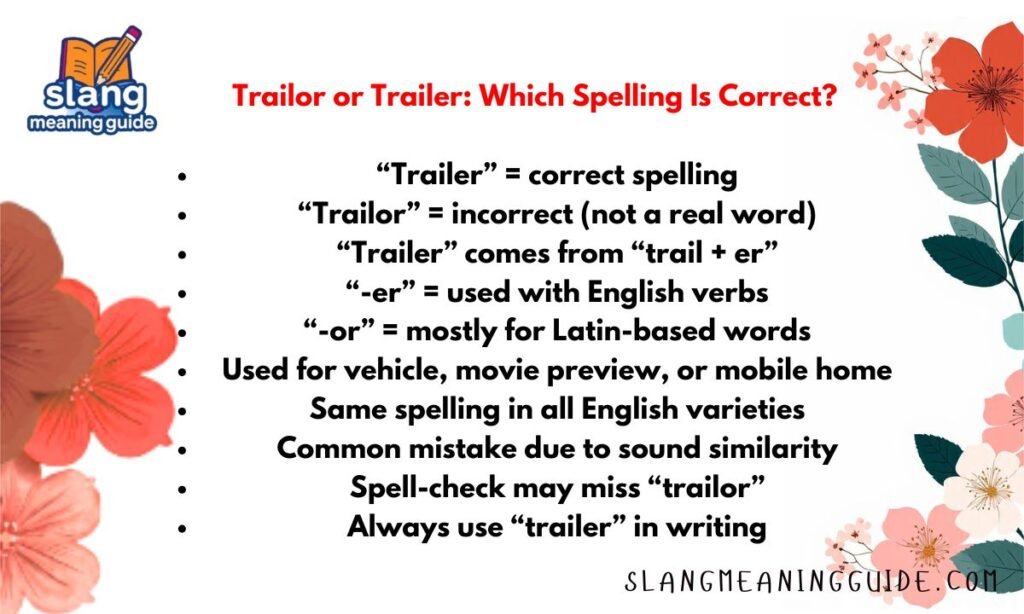
“Trailor” is not a word. It has no definition, no dictionary listing, and no accepted usage in standard English. Yet it shows up constantly in emails, online content, and even published work.
The reason is simple: it sounds right. And that is precisely what makes it such a persistent and damaging mistake.
The Root of the Confusion
English borrows suffix patterns from multiple language families. Words from Latin roots often end in “-or,” like “actor,” “doctor,” and “senator.” Words built from English verbs usually end in “-er,” like “teacher,” “runner,” and “builder.”
“Trail” is a native English verb. It means to drag or follow behind something. That verb follows the standard English pattern. Add “-er” and you get “trailer” — the person, thing, or vehicle that trails. The “-or” ending simply does not apply here, and never has in the word’s entire history.
Why Autocorrect Does Not Always Catch It
Many spell-checkers fail to flag “trailor” because it resembles real words like “tailor” and “sailor.” Those words end in “-or” because they come from different linguistic roots entirely. A spell-checker may recognize the pattern and let “trailor” pass unchallenged.
This makes the problem worse. Writers see no red underline and assume the spelling is fine. It is not. The word does not exist, regardless of what autocorrect suggests or ignores. Proofing manually remains essential for catching this specific type of error.
What “Trailer” Actually Means
“Trailer” is a real, versatile, and widely used English noun. It carries three distinct meanings depending on context. Knowing all three helps you use it correctly every time.
One word covers transportation, entertainment, and housing — and each usage follows the same correct spelling.
Trailer as a Towed Vehicle
In transportation, a trailer is any unpowered unit towed behind a motorized vehicle. Trucks pull freight trailers on highways. Families attach boat trailers to pickup trucks on weekends. Farmers use utility trailers to haul equipment across fields.
The word is a core term in logistics, construction, and agriculture. It appears in contracts, shipping documents, federal regulations, and insurance policies. Any document in these industries that uses “trailor” immediately signals a spelling error to trained professionals.
Trailer as a Film or Media Preview
In entertainment, a trailer is a short promotional video for an upcoming movie, TV show, or video game. Film studios pioneered this format in the early twentieth century. The name came from the fact that these previews originally played after, or “trailed,” the main feature.
Today, movie trailers are among the most-watched pieces of online video content. A major studio release can generate hundreds of millions of trailer views within days. Every headline, thumbnail, and metadata tag that spells it “trailor” loses credibility with both readers and search engines instantly.
Trailer as a Mobile Home
In residential contexts, a trailer refers to a movable dwelling unit. Trailer parks became part of American life from the 1930s onward. Today, millions of Americans live in or own manufactured homes that trace directly back to this tradition.
The word appears in real estate listings, zoning documents, and housing regulations. A misspelling here does not just look careless — it can create ambiguity in legal and property documents where precision matters enormously.
Trailor vs Trailer: Side-by-Side Comparison
| Feature | Trailer | Trailor |
| Dictionary listing | Yes | No |
| Correct English | Yes | No |
| Used professionally | Yes | No |
| Meaning | Vehicle, preview, mobile home | None |
| Suffix origin | English verb + “-er” | Incorrect pattern |
| Safe to publish | Yes | No |
The Etymology: Why “Trailer” Has Always Been Spelled This Way
The word “trailer” traces back to the 1580s. It originally described a hound or person following a trail. By the 1890s, it referred to small wheeled vehicles pulled behind larger ones. The entertainment meaning emerged in the 1910s, and the mobile home meaning solidified in the 1920s.
The spelling has never changed. Historical records show no “trailor” variant in any century. The incorrect spelling is a modern phenomenon driven entirely by phonetic guessing and digital typing habits.
The “-er” vs. “-or” Rule in Plain English
English uses “-er” for nouns formed from English verbs: teach becomes teacher, build becomes builder, trail becomes trailer. This rule is consistent and reliable for native-root words.
English uses “-or” for nouns often derived from Latin, typically describing a person doing a specialized action: act becomes actor, direct becomes director, instruct becomes instructor. “Trail” is not Latin. It never takes “-or.” The rule is that clean and that clear.
Where This Mistake Costs You the Most
The “trailor” error is not harmless. It appears in contexts where it actively damages results, reputations, and credibility.
Small errors carry large consequences when they appear in the wrong places at the wrong time.
In Professional and Business Writing
Resumes, cover letters, client proposals, and internal reports all reflect the writer’s attention to detail. A spelling error on the first page signals carelessness before the content even gets evaluated.
In the transportation and logistics industry specifically, “trailer” is an industry-standard term. A freight company that misspells its own core vocabulary in documentation loses professional credibility. Contracts, compliance filings, and carrier agreements all demand accurate terminology.
In SEO and Digital Content
Search engines index words exactly as written. A page optimized for “trailor” does not rank for “trailer” searches. The two are treated as different strings of characters.
Web content that uses the wrong spelling loses organic traffic, misses its target audience, and appears untrustworthy to readers who notice the error. For any website in the transportation, film, or real estate space, correct spelling is not just a grammar issue — it is a business performance issue.
Memory Tricks That Lock In the Right Spelling
Rules stick faster when you connect them to something visual or logical. These two methods eliminate the “trailor” mistake permanently.
Trick 1 — The building blocks method. Break the word apart: trail + er. You are adding “-er” to the verb “trail,” exactly the same way you add “-er” to “run” to get “runner.” The pattern is identical. No guesswork needed.
Trick 2 — The Latin test. Ask yourself: is this word from Latin? “Trail” is not. It comes from Old French and Middle English, not Latin. The “-or” ending is for Latin-derived words. Since “trail” fails the Latin test, “-or” fails too.
Frequently Asked Questions
Is “trailor” a real English word?
No — it is a misspelling with no dictionary definition and no accepted usage.
Why do so many people write “trailor”?
Because it sounds identical to “trailer” and follows a familiar but inapplicable “-or” suffix pattern.
Is “trailor” correct in British English?
No — British, American, Australian, and Canadian English all use “trailer” exclusively.
Can “trailer” be used as a verb?
Yes — “to trailer” means to tow something, as in “he trailered the boat to the lake.”
Does “trailer” always mean a vehicle?
No — it also refers to film previews and mobile homes depending on context.
Will search engines correct “trailor” automatically?
Search engines often interpret it as a misspelling, but pages using it still miss properly spelled search traffic.
Is “trailor” ever used as a surname?
Occasionally as a proper name, but this does not make it a valid common noun or standard spelling.
What other words does this “-er” vs. “-or” confusion affect?
Similar errors appear with “connector,” “instructor,” and “collector” — all correctly end in “-or” because of Latin roots.
Conclusion
“Trailor” is a spelling error with no meaning, no history, and no place in standard English writing. “Trailer” is the only correct form — whether you mean a freight vehicle, a movie preview, or a mobile home. Fix the spelling, protect your credibility, and never second-guess this word again.