
Three letters. One short message. And suddenly you’re staring at your screen wondering what the other person actually wants from you.
It shows up in Snapchat chats, Instagram DMs, and late-night text threads — sometimes casual, sometimes charged with emotion.
So what does TTM really mean, and how should you respond when someone sends it to you?
What Does TTM Mean in Text Messages?
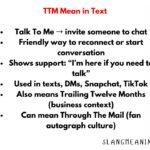
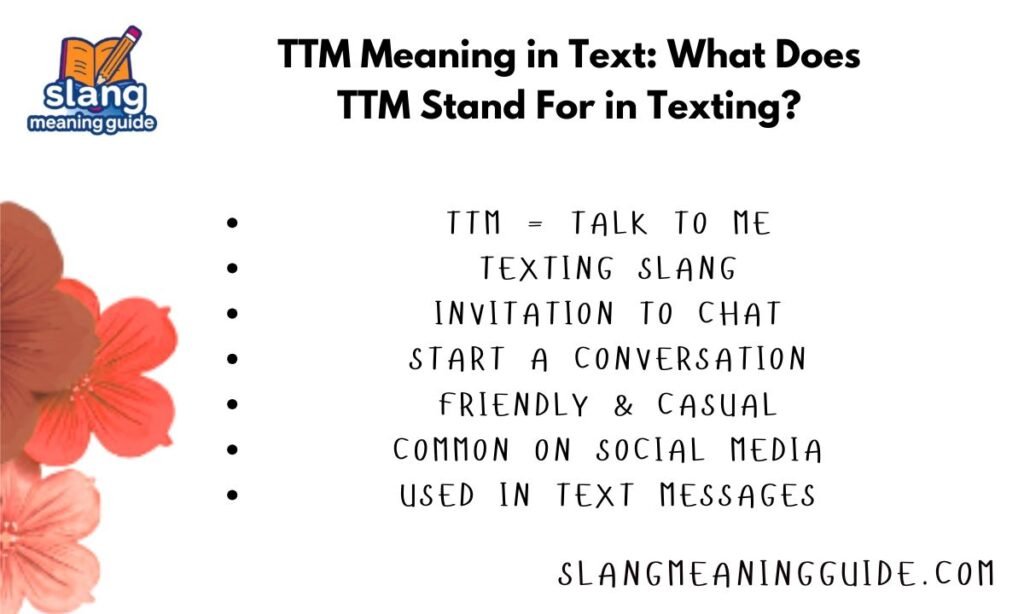
TTM stands for “Talk to Me.” It is a short, casual text abbreviation used when someone wants you to start a conversation, reply, or open up about something. The term works as both an invitation and a nudge — it tells the receiver that the sender is available and willing to listen or chat.
- “TTM, I’m bored” — a friend asking you to start a conversation
- “You good? TTM if you need anything” — showing care and availability
- “Just saw your post, TTM 👀” — curious and inviting a reply
- “TTM when you get a chance” — a relaxed, low-pressure check-in
TTM can also mean “Text to Me” in some contexts, but the intent is identical — the sender wants communication to begin or continue. Both meanings point in the same direction: reach out.
Where Did TTM Come From? (Origin of the Slang)
TTM grew out of early internet and SMS culture from the 2000s, when character limits on phones pushed users to shorten every phrase. Platforms like AIM, MSN Messenger, and early SMS made abbreviations not just trendy but practical.
- Early 2000s: Instant messaging platforms popularized short invitations to chat
- 2010s: Spread to Facebook Messenger, WhatsApp, and Kik among teens
- 2018–2022: Became common on Snapchat streaks and Instagram DMs
- 2023–2026: Still widely used across TikTok comments, iMessage, and dating apps
Unlike some slang that burns bright and fades fast, TTM has shown staying power because its meaning is clear, its tone is flexible, and it works across platforms without losing its intent.
How TTM Is Used Across Different Platforms
The same three letters carry slightly different weight depending on where you see them. Platform context shapes how TTM reads emotionally.
- Snapchat: Often used between close friends, usually means “I want to catch up” or “let’s keep our streak alive”
- Instagram DMs: Can feel flirty or curious, especially from someone who just viewed your story
- iMessage / SMS: Usually casual — a friend checking in or wanting to chat about something specific
- Twitter / X replies: Sometimes used publicly to invite someone to slide into DMs
- Dating apps: Signals openness; the person wants to move beyond swiping and actually talk
- WhatsApp groups: Less common in groups, but used in private replies to show support
The Emotional Tone Behind TTM
TTM is not a neutral message — it always carries an emotional undertone. Understanding that tone helps you respond the right way without misreading the situation.
- Friendly & casual: “Just want to catch up, no pressure” — common among close friends
- Worried or supportive: “I noticed something seemed off, I’m here for you” — emotionally aware use
- Flirty or testing: “I like you and want to talk more” — common in early-stage romantic chats
- Bored & impulsive: “I have nothing to do, entertain me” — low emotional weight, just looking for company
- Urgent or serious: “We need to talk about something” — rare but possible if paired with a serious tone
Real Example Conversations
Person A: “Haven’t heard from you in a while. TTM?”
Person B: “Hey! Sorry, been super busy. What’s up?”
Person A: “I’m free now, TTM if you wanna talk 💬”
Person B: “On my way home, calling in 10!”
How to Respond When Someone Sends You TTM
Your response to TTM should match both your mood and your relationship with the sender. There is no wrong answer — just match the energy.
- If you want to talk: “Sure! What’s going on?” or “Hey, I’m here — what’s up?”
- If you’re busy right now: “Give me an hour, then let’s chat!” or “Can’t right now but tonight works”
- If it’s from a crush: A warm reply like “Always 😊 what did you want to talk about?” works well
- If you’re not sure why they sent it: “Hey! Everything okay?” opens the door gently
- If you’re not interested in chatting: A short, polite reply — or silence — sends a clear message without drama
Other Meanings of TTM Outside of Texting
While “Talk to Me” dominates in casual digital chats, TTM carries completely different meanings in professional and specialized contexts. Knowing these avoids embarrassing mix-ups.
TTM in Other Fields
- Finance: Trailing Twelve Months — a 12-month rolling period used in earnings analysis and financial reporting
- Business / Tech: Time to Market — how quickly a product goes from concept to consumer shelves
- Collectibles / Hobby: Through the Mail — a method fans use to send items to athletes or celebrities for autographs
- Gaming (rare): To the Max — expressing intensity or peak effort in a game context
If you see TTM in a business email, a financial report, or a product launch discussion — it almost certainly means Time to Market or Trailing Twelve Months, not “Talk to Me.” Context is everything.
TTM vs. Similar Texting Slang — What’s the Difference?
TTM is part of a family of conversational abbreviations that all signal a desire to communicate. Here is how it compares to its closest cousins.
- TTM (Talk to Me): Open invitation — I’m here, reach out anytime
- HMU (Hit Me Up): More direct — contact me when you’re ready to hang or talk
- LMK (Let Me Know): Waiting for your decision or update, not necessarily a conversation starter
- WYD (What You Doing?): Checking in on your activity, often a lead-in to making plans
- IRL (In Real Life): Refers to physical world, not a conversation invitation
- Slide into my DMs: More casual/playful, used publicly — TTM is more personal
Is TTM Appropriate to Use? Age and Context Guide
TTM works in the right settings, but like all slang, it reads differently depending on who sends it and where. Here is a quick guide on when to use it — and when to skip it.
- ✅ Fine to use: With friends, family, peers, or romantic interests in casual chat
- ✅ Fine to use: On social media bios or stories to signal you’re open to conversation
- ⚠️ Use carefully: With someone you don’t know well — it can feel too forward without context
- ❌ Avoid: In professional emails, school submissions, or formal communication
- ❌ Avoid: In customer service or business contexts where the financial meaning of TTM may cause confusion
Frequently Asked Questions
What does TTM mean in a text message?
TTM most commonly means “Talk to Me” — a casual invite for someone to start or continue a conversation.
Does TTM mean the same thing on Snapchat as in regular texting?
Yes — on Snapchat it still means “Talk to Me,” though it often carries a more playful or urgent tone between friends.
Can TTM have a flirty meaning?
It can — when sent by a romantic interest, TTM signals they want closer or more personal conversation with you.
What does TTM mean in finance?
In finance, TTM stands for “Trailing Twelve Months,” a rolling period used to evaluate a company’s recent financial performance.
How should I reply when someone texts me TTM?
Match their energy — if you want to chat, reply warmly; if you’re busy, say so briefly; if you’re not interested, a short polite response works fine.
The Bottom Line on TTM
TTM is one of those text abbreviations that looks small but carries real weight. In most everyday conversations, it simply means “Talk to Me” — three words condensed into three letters to say: I’m here, I’m listening, reach out.
The next time TTM shows up in your notifications, you’ll know exactly what it means, how to read the tone, and what to say back. No guessing, no overthinking — just clear, confident communication in the language of modern texting.